
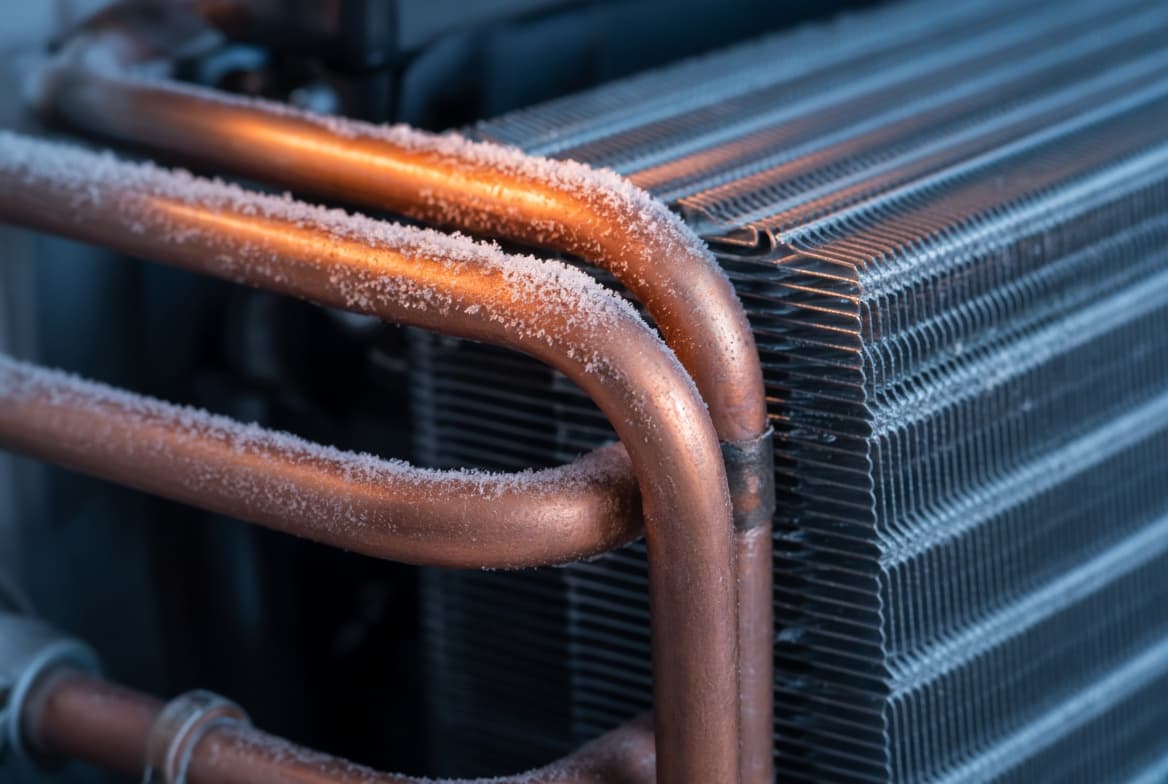
An AC condenser is the outdoor half of a central air conditioner or heat pump. It throws away the heat your system pulled out of the house: refrigerant arrives hot from the compressor, the condenser coil and fan cool it until it turns back into a liquid, and that liquid flows indoors to absorb more heat. If the condenser can't shed heat, nothing inside gets cold.
What Is an AC Condenser?
It's the metal cabinet on a pad outside your house, with a fan grille on top and thin aluminum fins around the sides. Two copper lines connect it to the indoor coil: a larger, insulated suction line bringing cool refrigerant vapor back, and a smaller, bare liquid line sending warm liquid refrigerant in.
Strictly, "condenser" means the coil. In everyday use the whole outdoor box is called the condenser or condensing unit. On a heat pump it's just "the outdoor unit," because in winter the same coil absorbs heat instead of releasing it.
What's Inside the Outdoor Unit
| Part | What it does |
|---|---|
| Compressor | The dome in the center. Pumps refrigerant and raises its pressure and temperature |
| Condenser coil | Finned tubing around the sides that transfers heat to outdoor air |
| Condenser fan and motor | Pulls air in through the coil and blows it out the top |
| Run capacitor | Gives the compressor and fan motor the boost they need to start and run |
| Contactor | Relay that switches 240-volt power to the compressor and fan when the thermostat calls |
| Pressure switches and controls | Shut the unit down on unsafe pressures; variable-speed units add an inverter control board |
How the Condenser Fits the Refrigeration Cycle
Your air conditioner moves heat; it doesn't make cold.
- At the indoor evaporator coil, cold refrigerant absorbs heat from the air your blower pushes across it and boils into vapor.
- The compressor outside squeezes that vapor into a hot, high-pressure gas.
- The condenser coil spreads the gas through many feet of finned tubing while the fan pulls outdoor air across it. Heat flows out, and the refrigerant condenses into a liquid.
- The liquid goes back inside to a metering device, its pressure drops, and the loop repeats.
The condenser rejects more heat than the evaporator absorbs, because it also dumps the heat added by the compressor. That's why a coil only partly blocked by grass clippings or cottonwood cuts cooling noticeably on a hot afternoon. For the full cycle, see how air conditioning works.
Condenser vs Evaporator vs Compressor
| Condenser coil | Evaporator coil | Compressor | |
|---|---|---|---|
| Location | Outdoor unit, around the sides | Indoors, on the furnace or in the air handler | Outdoor unit, center of the cabinet |
| Job | Releases heat outdoors | Absorbs heat and moisture from indoor air | Pumps and pressurizes refrigerant |
| Refrigerant in, out | Hot gas in, warm liquid out | Cold liquid in, cool vapor out | Cool vapor in, hot gas out |
| What fouls it | Grass, leaves, cottonwood, dirt | Dust that gets past the filter | Nothing external; heat and electrical stress |
| Common failures | Bent fins, leaks, hail, corrosion | Leaks, clogged fins, freezing | Won't start, overheating, internal failure |
If the compressor hums but won't start, or keeps tripping, the AC compressor repair guide covers that decision.
Common AC Condenser Problems
| What you notice | Likely cause | Who fixes it |
|---|---|---|
| Fan and compressor run, air only cool-ish | Dirty coil, low refrigerant, dirty indoor filter | You can clean the coil and change the filter; a leak needs a technician |
| Unit hums, fan not spinning | Weak run capacitor or seized fan motor | Technician |
| Fan spins, compressor silent, warm air | Capacitor, tripped compressor overload, failing compressor | Technician |
| Whole outdoor unit silent | Tripped breaker, pulled disconnect, burnt contactor | Reset the breaker once; technician if it trips again |
| Large areas of fins flattened | Hail, mower debris, pressure washing | Fin comb for small areas; technician for crushed coils |
| Oily residue on the coil plus weak cooling | Refrigerant leak (oil travels with the refrigerant) | EPA Section 608 certified technician |
| Grinding or screeching from the top | Worn fan motor bearings, loose blade, debris | Technician |
Dirty or bent fins are the most common problem and the one you control. When fins lie flat or matted, air goes around the coil instead of through it, operating pressures climb and the compressor works harder.
Fan motor, capacitor and contactor are the electrical wear parts. A dead fan motor is the most dangerous for the system, because the compressor keeps running against a coil with no airflow until its overload trips. See condenser fan motor symptoms and replacement, AC capacitor failure signs and the AC contactor guide.
Refrigerant leaks show up at brazed joints, U-bends and spots where tubing rubs a support. Salt air and lawn chemicals speed corrosion. Topping off without finding the leak only buys time. Our guide to AC refrigerant leak signs and repair covers how leaks are traced and what a recharge costs.
Hail flattens fins on the side facing the storm. Light damage combs out. A coil with most of its face crushed may need replacement, and hail damage is often an insurance matter, so photograph it before anyone straightens it.
How to Clean an AC Condenser Coil Safely
Clean the outdoor coil once a year, and again mid-season if you have cottonwood trees or mow close to the unit. Check your manual first: some manufacturers, especially for all-aluminum microchannel coils, specify water only.
- Kill the power. Set the thermostat to Off, then pull the disconnect in the box next to the unit. The unit runs on 240 volts. Don't open the electrical panel or touch the capacitor, which can hold a charge with the power off.
- Clear the outside. Remove leaves and cottonwood by hand or with a soft brush moving the same direction as the fins. Trim plants back.
- Open the top if you safely can. On many units the top grille and fan lift off after removing the edge screws. Support it so the motor wires aren't stretched, or leave it on if they're short.
- Rinse from the inside out with a garden hose on a gentle shower setting, top to bottom, so dirt leaves the way it came in. If you can't reach inside, rinse gently from the outside. Keep water off the electrical compartment.
- Use coil cleaner only for heavy buildup. A foaming cleaner made for outdoor condenser coils, used as labeled. Skip bleach, dish soap and acid cleaners.
- Never use a pressure washer or jet nozzle. Either folds the fins flat in seconds.
- Straighten bent fins with a fin comb sized to your coil's fins per inch.
- Let it dry, reassemble, restore power and set the thermostat back to Cool.
The AC unit maintenance checklist puts this on a seasonal schedule.
How Much Clearance Does an AC Condenser Need?
Exact numbers come from your installation manual, but manufacturer manuals commonly call for roughly 12 to 24 inches around the coil sides (sometimes less on the side facing the house) and about 4 to 5 feet of open space above the fan. In practice, keep shrubs, fences and stored items at least 2 feet from the coil, never build a deck or overhang over the top, and don't aim a dryer vent at the unit. Two units placed tight together can recirculate each other's hot exhaust. In winter, keep heavy snow off the top, but don't wrap it in plastic, which traps moisture.
Read the Data Plate Before You Get Quotes
The plate on the side of the cabinet tells you most of what a repair decision hinges on:
- Refrigerant type. R-22, R-410A, R-454B and R-32 can't be mixed.
- Capacity. On many brands, a number in the model number divisible by 12 gives thousands of BTU: 24 is 2 tons, 36 is 3 tons.
- Age. The manufacture date is encoded in the serial number. Formats vary by brand, and the manufacturer can decode it.
- Electrical ratings. Minimum circuit ampacity and maximum breaker size.
With age, tonnage and refrigerant in hand, you can judge a coil or unit quote before anyone opens the cabinet.
Condenser Coil Leak: Repair, Replace the Coil, or Replace the Unit?
| Situation | Usually makes sense |
|---|---|
| Unit under about 10 years old, one accessible leak at a joint | Repair the leak, pressure test, evacuate and recharge |
| Coil leaking and still under the parts warranty | Replace the coil under warranty; you pay labor and refrigerant |
| Out of warranty, unit 10 years or older | Price a new coil against a new outdoor unit; coil labor is heavy |
| System uses R-22 | Replace the system; R-22 production ended in 2020 and only reclaimed supply remains |
| Indoor coil also old or leaking | Replace indoor and outdoor units together |
| Leaking all-aluminum microchannel coil | Coil or unit replacement; these are hard to repair reliably in the field |
Matched systems matter. An outdoor unit's efficiency rating is certified with specific indoor coils. A mismatch can cost efficiency, cause charging problems and affect the warranty, so ask for the AHRI certificate number for the exact combination quoted.
Refrigerant rules changed recently. Under the EPA's AIM Act program, new residential split systems have moved from R-410A to lower-impact refrigerants such as R-454B and R-32, which don't mix with R-410A parts. If your system is R-410A, ask whether a matching replacement coil or outdoor unit is still available for repairing your existing system, and what a full new system would cost instead.
What Affects AC Condenser Repair and Replacement Cost
Published cost guides disagree widely on condenser coil and outdoor unit prices, so the tiers are more useful than any single number:
- Low: coil cleaning, a capacitor or a contactor. Mostly the service call.
- Middle: a fan motor, or finding and repairing one leak plus a recharge. Refrigerant type and pounds needed drive the leak cost.
- High: a new condenser coil or compressor. Labor is heavy: refrigerant recovery, brazing, a nitrogen pressure test, evacuation and a full recharge.
- Highest: a new outdoor unit, or a matched system with a new indoor coil.
Within each tier, price moves with tonnage, refrigerant, warranty status (many manufacturers cover parts for 10 years on registered units, but rarely labor), access, and season.
How Long Does an AC Condenser Last?
Most last around 10 to 15 years, some closer to 20 with care in a mild climate. Fan motors, capacitors and contactors get replaced along the way; the compressor or the coil usually ends the unit's life.
When to Call a Technician and What to Ask
Anything involving refrigerant, the electrical compartment or a unit that hums without starting is technician work. Refrigerant handling requires EPA Section 608 certification. Ask:
- What failed, and how did you confirm it (pressures, leak test, capacitor or amp readings)?
- Where is the leak, and will you pressure test with nitrogen after the repair?
- What refrigerant does my system use, and how many pounds will it need?
- Is the part under warranty, and what does labor cost on top?
- For a new outdoor unit, what's the AHRI-matched indoor coil, and does mine qualify?
- What would a full system cost, so I can compare?
Frequently Asked Questions
What does an AC condenser do?
It gets rid of the heat your air conditioner pulled out of the house. The compressor sends hot, high-pressure refrigerant into the condenser coil, and the fan pulls outdoor air across it. The refrigerant gives up its heat, turns back into a liquid and flows indoors to absorb more.
Is the AC condenser the same as the compressor?
No. The compressor is one part inside the condenser cabinet: the sealed pump, usually a dark dome in the middle, that pressurizes the refrigerant. The condenser coil is the finned grid around the sides that releases heat. People call the whole outdoor box the condenser, but the compressor, coil, fan motor and electrical parts are separate repairs.
Can I replace just the condenser unit?
Sometimes. A new outdoor unit has to be a certified match for your indoor coil and use the same refrigerant, or it won't reach its rated efficiency and may affect the warranty. If the system uses R-22, or the indoor coil is as old as the failed outdoor unit, replacing both together is usually the better use of money.
How long does an AC condenser last?
Most outdoor units last somewhere around 10 to 15 years, and well-kept units in mild climates can run closer to 20. Salt air, very long cooling seasons, a coil that's never cleaned and a wrong refrigerant charge all shorten that.
Can I hose down my AC condenser?
Yes, with the thermostat off and the power off at the outdoor disconnect. Use a garden hose on a gentle shower setting, rinse from the inside of the cabinet outward if you can safely reach in, and keep water away from the electrical box. Never use a pressure washer or jet nozzle, which folds the fins flat.
Why is my AC condenser running but not cooling?
If the fan and compressor both run but the house stays warm, the usual causes are a dirty outdoor coil, a dirty filter or indoor coil, low refrigerant from a leak, or a compressor that runs without pumping. If only the fan runs and the compressor is silent, suspect the capacitor or a tripped compressor overload.