
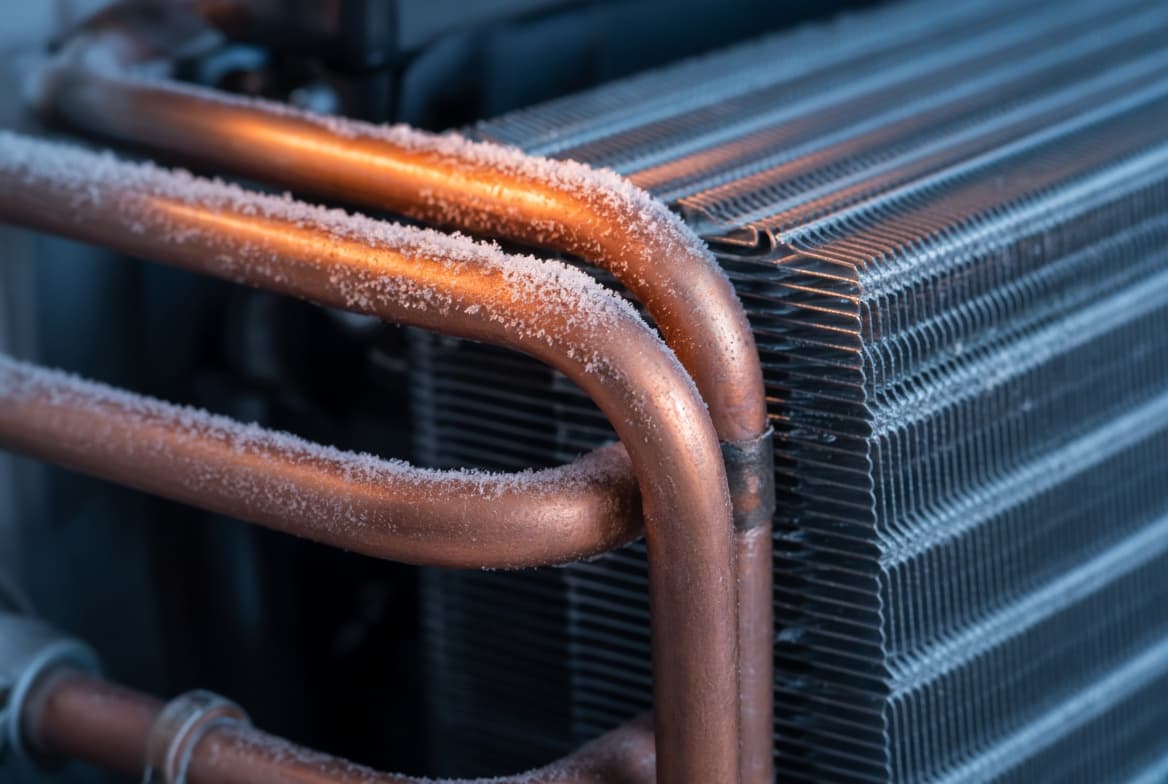
An air handler is the indoor cabinet of a central HVAC system that moves air through your ducts. It holds a blower, the indoor cooling coil, a filter, and controls, and often electric heat strips. It does not burn fuel the way a furnace does, which is why air handlers show up in homes heated by a heat pump, electric heat, or hot water instead of gas.
What Is an Air Handler?
Think of an air handler as a furnace without a burner. It pulls air from the return ducts, through a filter, across a coil that heats or cools it, and back out the supply ducts. The heating or cooling comes from somewhere else: an outdoor heat pump or air conditioner, electric heat strips, or hot water from a boiler.
"Air handler unit" (AHU) also covers big commercial units. In a house it is a furnace-sized cabinet in a closet, attic, garage, basement, or crawlspace, sometimes called a fan coil.
What Is Inside an Air Handler
| Part | What it does | What wears out |
|---|---|---|
| Blower and motor | Moves all the air in the system, in heating and cooling | Bearings, motor windings or electronics, run capacitor on older motors, dirty wheel |
| Evaporator coil | Absorbs heat and moisture in cooling; gives off heat in heat pump heating | Dirt buildup, refrigerant leaks |
| Metering device | A TXV or fixed orifice controlling refrigerant flow into the coil | Sticking valve, wrong size for the outdoor unit |
| Filter rack | Holds the filter, in the cabinet or at a return grille | A missing or wrong-size filter lets dirt reach the coil |
| Drain pan and condensate drain | Catches and drains coil water | Clogged drain, cracked or rusted pan |
| Control board and transformer | Runs the blower and heat strips from the thermostat signal | Burned relays, failed transformer, blown fuse |
| Electric heat strips (optional) | Resistance elements that heat air directly | Burned-out elements, failed sequencers or relays, tripped limits |
| Hydronic coil (optional) | Hot water coil fed by a boiler or water heater | Air in the loop, failed pump or valve |
For how the coil fails and when it is worth replacing alone, see the evaporator coil guide.
When a Home Has an Air Handler Instead of a Furnace
- Heat pump systems. A heat pump heats and cools with refrigerant, so it pairs with an air handler whose coil works as the evaporator in summer and the condenser in winter. New to the equipment? Start with what a heat pump is and how it works.
- All-electric homes with central AC. An air conditioner plus an air handler with heat strips covers both seasons with no gas line. In heating mode it behaves like an electric furnace.
- Hydronic heat with forced-air cooling. A boiler can feed a hot water coil in the air handler, so one duct system handles heat and AC. The background is in boiler vs furnace.
- Tight or unusual spaces. Many air handlers are multi-position: the same cabinet installs upflow in a closet, downflow over a slab, or horizontal in an attic or crawlspace. With no flue, placement is simpler than for a gas furnace.
- Condos and apartments. Units without gas service very often have a small air handler in a hall closet.
A home with a gas furnace and central AC does not need a separate air handler. The furnace blower moves the air, and the AC coil sits in a cased box on top. Dual fuel systems work the same way, with the heat pump's coil on the furnace.
Air Handler vs Furnace: The Differences
| Air handler | Furnace | |
|---|---|---|
| Makes heat itself | No. Relies on a heat pump, heat strips, or a hot water coil | Yes. Burns gas, propane, or oil, or uses large electric elements |
| Fuel | Electricity only | Natural gas, propane, oil, or electricity |
| Venting | None | Gas and oil models need a flue or PVC vent |
| Cooling coil | Built into the cabinet | Separate cased coil on the furnace |
| Best fit | Heat pump systems, mild to moderate winters, homes without gas | Cold winters, homes with gas, dual fuel setups |
| Carbon monoxide risk | None from the unit itself | Present on fuel-burning models; needs CO alarms and annual checks |
| Electrical needs | 240-volt circuit, often large when heat strips are installed | Usually 120 volts for gas models |
| Upfront cost | The cabinet usually costs less, but only works as part of a heat pump or AC system | More than an air handler alone, before adding the AC coil |
| Heating cost | Low with a heat pump; high when heat strips carry the load | Depends on local fuel prices |
The air handler vs furnace question is really a heat source question. Where gas is available and winters are long, a furnace (or a furnace plus a heat pump) is the common choice; see furnace installation. If you are going all-electric or replacing a heat pump, the air handler is the indoor half.
How to tell which one you have
- Look for a gas line and a vent. A gas pipe with a shutoff valve plus a metal flue or PVC vent leaving the cabinet means a furnace.
- Read the rating plate inside the blower door. It names the unit type and lists any heat kit size in kilowatts.
- Check the breaker panel. Large double-pole breakers labeled "air handler" or "heat" usually mean heat strips.
Single-Speed vs Variable-Speed Air Handlers
| Motor type | How it runs | Good to know |
|---|---|---|
| PSC (permanent split capacitor) | Fixed speed taps, full speed whenever on | Common in older units. Cheapest to replace, loudest, uses the most power. Needs a run capacitor. |
| Constant-torque ECM (multi-speed) | Several programmed speeds | Uses less power than PSC. Common in current entry and mid-level units. |
| Variable-speed ECM | Adjusts continuously to hold target airflow as filters load | Quietest and most efficient, better humidity control. Needed for many higher-efficiency system ratings. Costs more to replace. |
Variable-speed pays off most in humid climates. For motor failure signs and tradeoffs, see PSC vs ECM blower motors.
Common Air Handler Problems
| Symptom | Likely cause | What you can check | Who fixes it |
|---|---|---|---|
| Nothing runs, no air | Tripped breaker, blown control fuse, open door switch, float switch tripped by a full pan | Breakers, blower door seated, water in the pan | Technician if the breaker trips again or the drain will not clear |
| Humming, blower not spinning | Failed run capacitor (PSC) or seized motor | Nothing inside the cabinet | Technician |
| Weak airflow | Clogged filter, dirty coil or blower wheel, closed registers | Filter, registers, returns | Technician for coil or wheel cleaning |
| Cold air in heating | Failed heat strip, sequencer, or relay; heat strip breaker off; heat pump fault | Heat strip breakers | Technician |
| Burning smell | Dust burning off strips at first use (normal for minutes); overheating motor or wiring (not normal) | Whether it fades quickly | Shut it off and call a technician if it persists |
| Water around the unit | Clogged condensate drain, cracked pan, coil thawing | Drain flow, filter | Homeowner for a simple clog; technician for the pan |
| Blower never stops | Thermostat fan on On, stuck relay | Fan setting on Auto | Technician for a relay |
| Ice on coil or lines | Low airflow or low refrigerant | Filter, registers | Technician if it returns |
For water problems, see AC leaking water inside.
What a homeowner should not attempt
- Do not open the electrical or heat strip compartment with power on. Air handlers run on 240-volt circuits, and the thermostat does not cut that power; the breaker or unit disconnect does.
- Do not touch a run capacitor. It can hold a charge after the power is off and can injure you.
- Do not bypass a float switch, door switch, or heat strip limit. They prevent floods, shocks, and fires.
- Do not open the refrigerant circuit. Refrigerant work legally requires EPA Section 608 certification.
Sizing an Air Handler and Matching It to the Outdoor Unit
The house load sets the size of the heat pump or AC in tons, and the air handler has to match the outdoor unit.
- Airflow. A common target is about 400 cubic feet per minute per ton, so a 3-ton system moves roughly 1,200 CFM. Undersized or leaky ductwork leaves even a new blower loud and short on air.
- AHRI matching. Manufacturers certify specific indoor and outdoor pairings, and SEER2 and HSPF2 ratings apply only to those combinations. A mismatch can lower efficiency, hurt humidity control, and complicate warranty claims or rebates. Ask for the AHRI reference number.
- Refrigerant. The coil and metering device must suit the system's refrigerant. Newer systems use R-454B or R-32 instead of R-410A, and air handlers for them typically include a refrigerant leak sensor.
- Heat strip size. Heat kits are rated in kilowatts (1 kW is about 3,412 BTU per hour). The right size depends on your winters and how much backup the heat pump needs, and a large kit may need new circuits or more panel capacity.
Air Handler Replacement: When It Makes Sense and What Drives Cost
Repair usually makes sense for a single failed part on a unit with life left: a capacitor, sequencer, heat strip element, control board, or blower motor. Replacement makes sense when the coil leaks out of warranty, the cabinet or pan is rusted through, repairs are stacking up, or the outdoor unit is being replaced anyway. Replacing both sides together keeps them matched and avoids paying for refrigerant work twice.
Most published cost guides put a standard residential air handler replacement around $1,500 to $4,000 installed, with the equipment itself starting around $600 for small, basic models. Variable-speed and larger units sit at the top of that range, and jobs with duct changes, new electrical circuits, or a new outdoor unit cost more. The main factors:
- Capacity and blower type. Larger units and variable-speed ECM blowers cost more.
- Heat kit. Bigger kits cost more and may need new wiring and breakers.
- Location and fit. Attics and crawlspaces take longer, and a different cabinet size can mean new transitions or a new auxiliary pan.
- Refrigerant work. A new coil means recovery, brazing, evacuation, and charging.
- Permits and code. An inspection may call for an overflow switch or secondary pan in an attic.
For how a full system replacement is planned and quoted, see the HVAC installation guide.
How Long Does an Air Handler Last?
Published lifespans range from about 10 to 25 years. The cabinet rarely fails, so the real limit is the coil (especially in humid or corrosive conditions), the blower motor, and the control board. Hot attics and dirty filters shorten that, and many are replaced alongside the outdoor unit.
Air Handler Maintenance Basics
- Change the filter on schedule, commonly every one to three months for 1-inch filters and longer for thick media filters.
- Keep returns and registers open and the area around the unit clear.
- Check the condensate drain each spring and look in the auxiliary pan for water.
- Run the heat before the first cold night to burn off dust and catch a dead heat strip early.
- Book a yearly professional check: blower and coil cleaning as needed, capacitor test, heat strip amperage and sequencer check, tightened connections, float switch test, and refrigerant performance.
What to Ask a Contractor
- Is the new air handler an AHRI-listed match for my outdoor unit?
- What refrigerant does it use, and does it need a leak sensor?
- Is the blower PSC, multi-speed ECM, or variable-speed ECM?
- What heat kit size do you recommend, and does my panel have capacity?
- Will you measure static pressure and fix duct problems, or only swap the box?
- Does the price include the permit, a new pan and float switch, and haul-away?
Frequently Asked Questions
What is the difference between an air handler and a furnace?
A furnace makes heat by burning gas, propane, or oil (or with large electric elements) and has its own blower. An air handler makes no heat on its own. It holds a blower and the indoor coil, and it moves air heated or cooled by a heat pump, an air conditioner, electric heat strips, or a hot water coil.
How do I know if I have a furnace or an air handler?
Look for a gas line with a shutoff valve and a flue or vent pipe leaving the cabinet. If both are there, it is a gas furnace. If the cabinet has only refrigerant lines, a condensate drain, and wiring, it is an air handler. The rating plate inside the door confirms it.
How long does an air handler last?
Published estimates range from about 10 to 25 years. The cabinet and blower housing rarely fail; the coil, blower motor, and control board are what wear out. Many air handlers are replaced along with a new outdoor unit so the two stay a matched pair.
Can I replace the air handler and keep my old outdoor unit?
Sometimes. The new air handler has to use the same refrigerant as the outdoor unit and be listed as a match for it. That is usually possible on a newer R-410A system. With an R-22 outdoor unit, or one near the end of its life, replacing both is usually the better buy.
Do air handlers use gas?
No. Air handlers run on electricity, powering the blower and any electric heat strips. Some use a hot water coil fed by a gas boiler or water heater, but the gas is burned in that separate appliance.
Is the blower the same as the air handler?
No. The blower is one part of the air handler. The air handler is the whole cabinet: blower and motor, evaporator coil, filter rack, drain pan, control board, and any heat strips. People often call the whole unit the blower because that is the part they hear.
How much does it cost to replace an air handler?
Published cost guides put a standard residential air handler replacement around $1,500 to $4,000 installed. Variable-speed and larger units, bigger heat kits, attic or crawlspace locations, new circuits, duct changes and coil refrigerant work push it higher. Replacing it together with the outdoor unit keeps the system matched.