
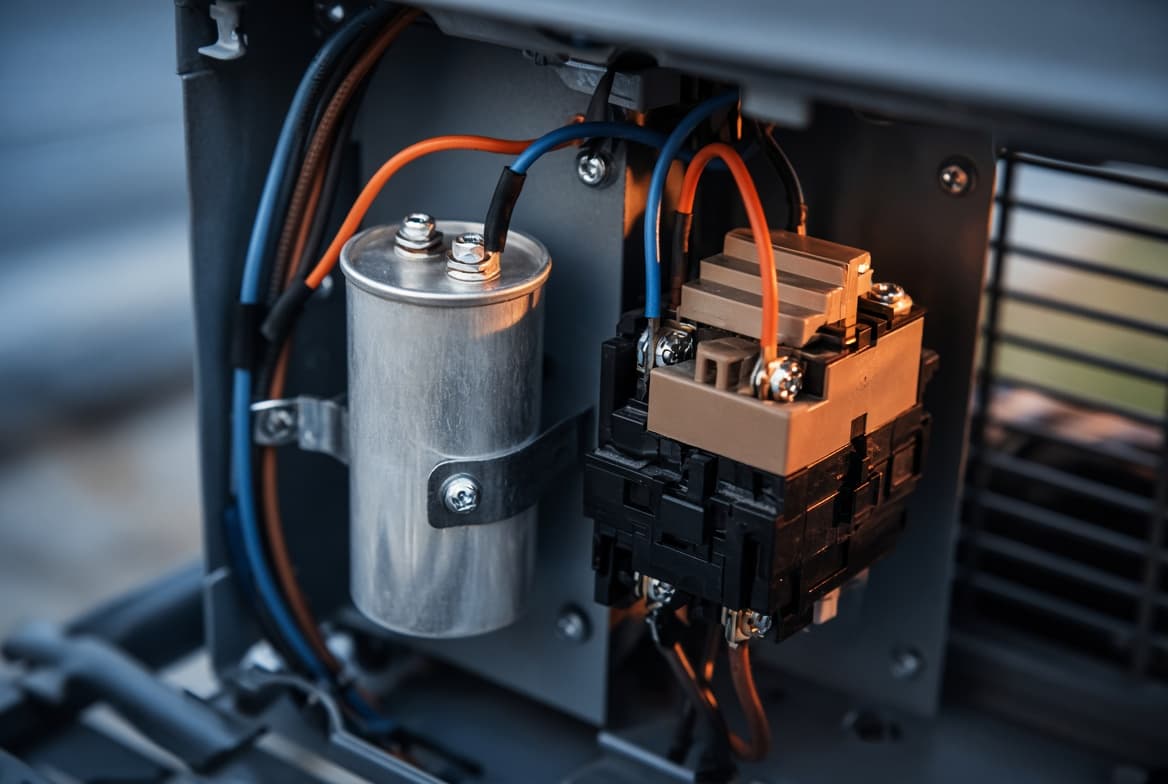
An AC contactor is the electrical switch in your outdoor unit that turns the compressor and condenser fan on and off. When the thermostat calls for cooling, a 24-volt signal energizes a coil inside the contactor, the coil pulls a set of contacts closed, and those contacts carry 240-volt power to the compressor and fan. A worn contactor usually shows up as an outdoor unit that won't start, a loud buzz or chatter, or a unit that keeps running after the thermostat shuts off.
It's an inexpensive part, but it sits in a panel full of line voltage, and its symptoms overlap with the capacitor and the thermostat circuit.
What Does an AC Contactor Do?
Your thermostat can't switch the outdoor unit directly. Its wires carry a low-voltage control signal, about 24 volts, from a transformer in the furnace or air handler. The compressor needs 240 volts and a lot of current. The contactor bridges the two.
Here's the sequence on a call for cooling:
- The thermostat closes the circuit on the Y wire, sending 24 volts out to the contactor coil.
- The energized coil becomes an electromagnet and pulls a movable armature down. You hear a solid click.
- The armature presses copper contacts together, connecting the incoming 240-volt line to the compressor and condenser fan (through the capacitor).
- When the thermostat is satisfied, the 24-volt signal drops, a spring lifts the armature, and the contacts open.
On the side of the contactor you'll find the two small coil terminals for the low-voltage wires, the line terminals where power comes in from the disconnect, and the load terminals that feed the compressor, fan and capacitor. Residential contactors are rated by coil voltage (almost always 24 VAC), number of poles, and a full-load amp rating, commonly 30 or 40 amps. If you want to trace where the signal starts, our guide to thermostat wiring and the Y wire shows the control side.
Single-Pole vs Double-Pole Contactors
| Single-pole | Double-pole | |
|---|---|---|
| What it switches | One leg of the 240-volt supply; the other leg passes through on a fixed bar | Both legs of the 240-volt supply |
| When the unit is "off" | One leg stays connected to the compressor and fan at all times | Both legs are disconnected from the motors |
| Why it's used | Cheaper, and lets a crankcase heater stay powered through the always-live leg | Fully isolates the motors between cycles |
| Can it be swapped for the other type | A double-pole usually can replace a single-pole, but any crankcase heater wiring must be reworked correctly | Replace like for like |
The single-pole design catches people out. With the thermostat off and the contactor open, a motor terminal on a single-pole unit can still read roughly 120 volts to ground. Nothing about an idle outdoor unit tells you that. Commercial and three-phase equipment uses three-pole contactors, which are outside the scope of most homes.
Signs of a Bad AC Contactor
- The outdoor unit won't start. The indoor blower runs, warm air comes out, and the condenser stays silent. Either the coil isn't pulling in, or the contacts close but are too burned to pass power.
- Buzzing or humming from the contactor. A weak coil, low control voltage, or debris between the armature and coil keeps the contactor from seating firmly, and it buzzes like a loose transformer.
- Chattering. The contactor rapidly clicks in and out. This is often a control-circuit problem (low voltage, a loose wire, a thermostat losing power, or a safety switch bouncing), not always the contactor itself.
- The outdoor unit won't shut off. Arcing can weld the contacts together so they stay closed with no call for cooling. The compressor and fan run nonstop, the indoor coil can freeze, and the compressor never rests.
- Pitted, burned or blackened contacts. Each start draws an arc that erodes the contact faces. Heavily pitted contacts heat up, drop voltage, and eventually fail open or weld shut.
- Ants or insects in the contactor. Ants are drawn into the warm, buzzing enclosure. When the contacts close, one crushed in the gap can hold them apart, and a colony can pack the space. Fire ant regions see this constantly.
- Melted or discolored wires at the line or load terminals, which means a loose connection has been overheating.
Is It the Contactor, the Capacitor or the Thermostat Circuit?
A silent outdoor unit gets blamed on the contactor more often than it should. Use what you see and hear to narrow it down.
| What you notice | Most likely cause | How a technician confirms it | Fix |
|---|---|---|---|
| Indoor fan runs, outdoor unit silent, no click | No 24 V at the coil: thermostat, tripped float switch, blown furnace-board fuse, broken wire; or an open contactor coil | Voltage at the coil terminals during a cooling call | Repair the control circuit, or replace the contactor if 24 V is present and it won't pull in |
| Contactor clicks in, but nothing runs outdoors | Burned contacts not passing power, or a power supply problem | Voltage on the line side, then across each closed contact | Replace the contactor if voltage drops across the contacts |
| Contactor pulls in, fan runs, compressor hums | Not the contactor: capacitor or compressor | Capacitance reading, compressor amp draw | See our AC capacitor guide |
| Loud buzz, contacts not fully seated | Weak coil, low control voltage, debris | Coil voltage under load, visual check | Replace the contactor; fix low voltage if found |
| Rapid chattering | Unstable 24 V: loose wire, weak transformer, thermostat power loss, bouncing safety switch | Watch coil voltage while it chatters | Fix the control fault first, then judge the contactor |
| Outdoor unit runs with thermostat off | Welded contacts, or a shorted thermostat wire keeping 24 V on the coil | Check for 24 V at the coil with no call | Kill power at the disconnect; replace contactor or repair wiring |
| Ants or debris visible in the contactor | Insects holding contacts open | Visual check with power off | Replace if contacts are damaged; treat the ants around the pad |
Several rows on that table are not contactor failures at all. If you're still not sure where to look, our AC not cooling troubleshooting guide works through the whole system.
How a Technician Tests an AC Contactor
Testing involves live 240-volt readings, so it's a technician's job. A thorough test includes:
- Visual inspection, power off. Pitting, scorch marks, insects, melted wire insulation, and whether the armature moves freely.
- Coil voltage. With the thermostat calling for cooling, the coil should see about 24 to 28 volts AC. Voltage present but no pull-in means a bad coil. No voltage means the problem is upstream in the thermostat, wiring, safeties or transformer.
- Coil resistance. With power off and the low-voltage wires removed, the coil should show a measurable resistance in ohms that varies by model. An open reading means a broken coil; near zero means a shorted one, which can also blow the low-voltage fuse.
- Line voltage. Roughly 208 to 240 volts across the line terminals confirms power is arriving from the disconnect.
- Voltage across the contacts. With the unit running, the technician measures from the line terminal to the load terminal on the same pole. A good contact reads close to zero. A reading of a few volts or more means the contact faces are pitted and resisting current, which heats them and starves the compressor of voltage.
That last test catches the contactor that "works" but is cooking itself and starving the compressor.
Why the Contactor and Capacitor Are Often Replaced Together
Technicians often quote both on one visit, for sound reasons:
- Same box, same heat, same age. Both parts sit in the condenser's control panel and wear on the same schedule.
- They stress each other. A weak capacitor makes the compressor draw more current at startup, which arcs harder across the contacts and pits them faster. Pitted contacts drop voltage, which makes motors and the capacitor work harder.
- One trip charge. Both are inexpensive parts, and the trip and diagnostic fee is often the largest line on the bill.
None of that proves both parts are actually bad. Ask for the measurement on the part that hasn't failed: a capacitance reading against its rating, or the voltage drop across the contacts. A marginal reading justifies the second part; a healthy one doesn't.
AC Contactor Replacement: What the Job Involves
Once the cause is confirmed, a straightforward residential contactor swap takes a technician well under an hour:
- Pull the disconnect, shut the breaker, and prove zero voltage with a meter.
- Discharge the capacitor in the same panel before working near it.
- Photograph the wiring, then move wires from old to new one at a time.
- Match the replacement: same coil voltage, same number of poles (or a correctly wired upgrade), an amp rating equal to or higher than the original, and a footprint that fits the mounting holes.
- Tighten every terminal, check for chafed wires, restore power, and confirm the contactor pulls in cleanly with near-zero voltage across the contacts.
A good technician also asks why it failed. Insects mean pest control around the pad. Chattering means the control circuit needs attention, or the new contactor will chatter too. Heavy pitting after only a few seasons points at short cycling or a hard-starting compressor, which our AC compressor repair guide covers.
AC Contactor Replacement Cost
The contactor itself is a small share of the bill. A basic single-pole, 24-volt residential contactor sits at the cheap end. Double-pole and higher amp-rated parts cost more, and brand-name OEM parts cost the most.
Most published cost guides put a professional contactor replacement roughly in the $150 to $400 range installed, about the same territory as a capacitor replacement, since both are short jobs where the trip and labor dominate. What moves the price:
- The diagnostic or trip fee, and whether it's credited toward the repair.
- Timing. After-hours and peak-summer calls usually cost more.
- Part type. Double-pole, higher amp ratings and OEM-only parts.
- Access. Rooftop or tightly enclosed units take longer.
- Additional repairs. Burned wires or terminals, a weak capacitor, or a control-circuit fault found during diagnosis.
For context against other repairs, see our AC repair cost by part guide.
Safety: 240 Volts Is Live Even When the Thermostat Is Off
Turning the thermostat off removes only the 24-volt signal. It does nothing to the 240 volts waiting on the line side of the contactor, and on a single-pole contactor one leg stays connected to the motors at all times. The capacitor beside it can also hold a charge after power is removed.
- Pull the outdoor disconnect and switch off the breaker before anyone opens the control panel, then prove the power is off with a meter. The supply side of the disconnect stays live regardless.
- Never push a contactor closed by hand with a stick or screwdriver to "test" the unit. It's a common online tip, it puts you inches from exposed line voltage, and it can draw a heavy arc.
- Don't jumper the coil or the thermostat wires to force the unit on. Safety switches in that circuit exist to protect the equipment.
What a homeowner can safely check: the thermostat is set to Cool with the setpoint below room temperature, the thermostat has power, the breakers for the furnace and outdoor unit are on, the outdoor disconnect is fully seated, the filter isn't clogged, and a condensate float switch hasn't tripped. Anything behind the outdoor unit's service panel belongs to a technician.
What to ask the technician
- Was there 24 volts at the coil, and did the contactor pull in?
- What was the voltage across the contacts under load?
- Single-pole or double-pole, and does the replacement match?
- Why did it fail, and is the cause (insects, chattering, short cycling) fixed?
- What did the capacitor read?
Frequently Asked Questions
How do I know if my AC contactor is bad?
The usual signs are an outdoor unit that won't start while the indoor fan runs, a loud buzz or rapid chattering from the outdoor unit, an outdoor unit that keeps running after the thermostat is turned off, and contacts that look pitted, burned or blackened. A technician confirms it by checking for 24 volts at the coil and measuring voltage across the closed contacts.
What causes an AC contactor to go bad?
Mostly wear. Every time the unit starts, a small arc jumps across the contacts and eats away at the metal, so contacts slowly pit and burn. Low control voltage, loose wires, power surges, heat, corrosion, and insects crawling between the contacts speed that up. A failing capacitor or hard-starting compressor makes it worse, because the higher startup current arcs harder.
How long does an AC contactor last?
There is no fixed lifespan, because wear tracks the number of starts rather than years. Service-company estimates often quote around 5 to 10 years, and many last longer in mild climates. Systems that short cycle, run in extreme heat, or have a weak capacitor wear contactors out faster.
Can I replace an AC contactor myself?
The swap itself is mechanically simple, but the contactor sits in 240-volt wiring that stays live even with the thermostat off, right next to a capacitor that can hold a dangerous charge. Unless you can prove the circuit is dead with a meter and are comfortable working on line-voltage wiring, have a technician do it.
Should I replace the capacitor and contactor at the same time?
Often it makes sense. They sit in the same panel, age in the same heat, and stress each other: a weak capacitor raises startup current that pits contacts, and pitted contacts cause voltage drop that strains the capacitor and motors. If one has failed and the other tests marginal, replacing both on one visit avoids a second trip charge. Ask for the readings on the part that has not failed.
Why does my outdoor AC unit keep running when the thermostat is off?
The most common cause is a contactor whose contacts have welded or stuck closed, so the compressor and fan keep running with no call for cooling. A shorted thermostat wire can do the same thing by keeping 24 volts on the coil. Turn the unit off at the outdoor disconnect or breaker, because a compressor running nonstop can freeze the indoor coil and damage itself.