
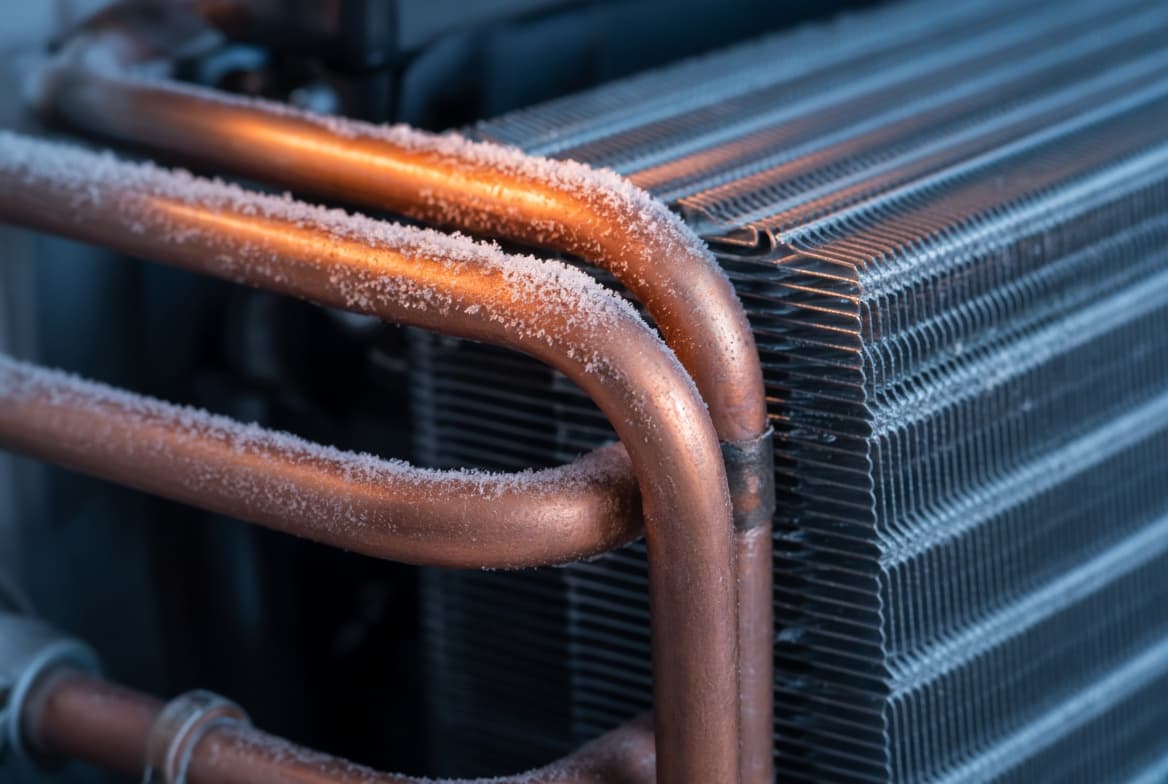
R-410A is the refrigerant in most central air conditioners and heat pumps installed in the US from about 2010 through 2024. It is not banned for use: you can keep running and repairing an R-410A system for as long as it lasts. What changed is new equipment. Since January 1, 2025, new home AC and heat pump systems built for R-410A can no longer be manufactured or imported, and the supply of R-410A refrigerant is shrinking step by step under a federal phasedown.
A lot of articles written in 2024 and 2025 say R-410A systems can't be installed after January 1, 2026. That deadline was removed by an EPA rule finalized in May 2026, as explained below.
What Is R-410A Refrigerant?
R-410A is a blend of two HFCs, R-32 and R-125, in equal parts by weight. It replaced R-22 in new home systems because it contains no chlorine and doesn't deplete the ozone layer. You'll also see it sold as Puron, Carrier's brand name, and as Freon 410A from Chemours. Same refrigerant, different labels. For how the names fit together, see Freon and AC refrigerant types.
A few things set R-410A apart from what came before and after:
- Higher pressure than R-22. R-410A runs at much higher pressures, so its compressors, coils and valves are built heavier. R-22 parts can't be used on an R-410A system.
- Different oil. R-410A systems use synthetic POE oil, which absorbs moisture readily. That's why a technician replaces the filter drier and pulls a deep vacuum whenever the system is opened.
- High global warming potential. R-410A has a GWP of about 2,088, meaning a pound released traps roughly 2,088 times as much heat as a pound of carbon dioxide over 100 years. That figure is why it's being phased down.
R-410A Compared With Older and Newer Refrigerants
| Refrigerant | GWP (approx.) | Flammability class | Status in new US home systems | What it means for a homeowner |
|---|---|---|---|---|
| R-22 | About 1,810 | A1 (nonflammable) | No new R-22 systems since 2010; production ended in 2020 | Service relies on reclaimed refrigerant and is expensive |
| R-410A | About 2,088 | A1 (nonflammable) | New systems not manufactured or imported since January 1, 2025 | Keep it, repair it, plan your next system |
| R-454B | About 466 | A2L (mildly flammable) | Standard in many new ducted systems | Different parts and tools; not mixable with R-410A |
| R-32 | About 675 | A2L (mildly flammable) | Standard in other new systems and many mini-splits | Different parts and tools; not mixable with R-410A |
For a closer look at the two replacements, read R-32 vs R-454B refrigerant.
The R-410A Phase Out: What the Rules Actually Say
Two separate federal programs under the American Innovation and Manufacturing (AIM) Act affect R-410A. People mix them up, which is where most of the confusion comes from.
1. Limits on new equipment (Technology Transitions)
EPA's Technology Transitions rule, finalized in 2023, set a GWP limit of 700 for refrigerants in new residential and light commercial air conditioning and heat pump systems. R-410A is far over that limit. Under the rule:
- Since January 1, 2025, new systems using a refrigerant with a GWP of 700 or more can't be manufactured or imported.
- The original rule let installers finish installing systems built before 2025 until January 1, 2026.
- A reconsideration rule that EPA finalized and published in May 2026 removed that 2026 installation deadline for systems where all the specified components were made or imported before January 1, 2025. EPA's own sector table, updated in August 2026, now lists no installation compliance date for those systems.
In plain terms: factories stopped building R-410A home systems at the start of 2025, but leftover pre-2025 equipment can still be sold and installed until it runs out. Some states have their own HFC rules that can be stricter than the federal ones, so check the rules where you live.
2. Less R-410A refrigerant over time (the HFC phasedown)
The AIM Act also caps how much HFC refrigerant can be produced and imported nationwide. The caps are measured against a historical baseline:
| Years | Allowed production and import (share of baseline) |
|---|---|
| 2024 to 2028 | 60 percent |
| 2029 to 2033 | 30 percent |
| 2034 to 2035 | 20 percent |
| 2036 and later | 15 percent |
The cap covers all HFCs combined, not R-410A by name. But as fewer new R-410A systems go in and the allowances shrink, less new R-410A reaches the market. Recovered and reclaimed R-410A fills part of the gap, which is one reason technicians recover refrigerant instead of venting it (venting is illegal anyway).
What the phase out does not do
- It doesn't require you to replace, convert or stop using an R-410A system.
- It doesn't stop technicians from repairing R-410A systems or buying R-410A for service.
- It doesn't stop the manufacture of repair parts. EPA has said new components can continue to be made and imported so existing systems can be maintained, though availability may lessen over time.
Can You Still Get an R-410A System Installed?
Sometimes, if a distributor still has equipment built before 2025. Before you say yes, weigh it:
Reasons it can work: It may be what a contractor can install fastest, technicians are very familiar with R-410A, and its parts are widely stocked today.
Reasons to be cautious:
- You're buying into a refrigerant whose supply will keep shrinking for the life of the system. A leak repair in year 12 may cost noticeably more in refrigerant than it would today.
- Equipment that sat in a warehouse may already be a year or more old. Ask for the manufacturing date and confirm the full manufacturer warranty still applies from your install date.
- Future replacement parts, such as a matched coil or outdoor unit, may get harder to find late in the system's life.
If you're replacing a whole system, get quotes on both an R-410A unit (if offered) and a current R-454B or R-32 system, and compare price, efficiency rating, warranty and what the contractor stocks for service. Our central AC installation cost guide covers what else drives the price of a new system.
Repairing an Existing R-410A System
You can repair an R-410A system the same way you always could. A few points come up often:
- Replacing one side of the system. If the outdoor unit or indoor coil fails, the replacement has to be an R-410A part listed as a match for the other side. EPA's guidance allows the continued sale of R-410A condensing units, indoor coils and air handlers for servicing existing systems, and R-410A components made after January 1, 2025, must be labeled for servicing existing equipment only. EPA treats replacing the condensing unit and indoor coil together as installing a new system, even if the old refrigerant lines stay, so that is usually the point to switch to a current refrigerant. See replacing the outdoor condenser for the matching rules.
- Refrigerant leaks. A system that needs refrigerant has a leak. Topping off without a leak search means paying for refrigerant again later. Read how AC refrigerant leaks are found and fixed before you approve a recharge.
- Refrigerant cost. Published cost guides in 2026 commonly list R-410A at roughly $50 to $80 per pound installed, and prices vary widely by region and contractor. Ask how many pounds your system needs and what the per-pound price is.
- No federal repair mandate for homes. EPA's newer leak repair requirements apply to larger appliances holding 15 pounds or more of HFC refrigerant, and they specifically exclude residential and light commercial air conditioners and heat pumps. Whether to fix a leak in your home system is your call.
Repair or replace an R-410A system?
| Situation | Usually the better move |
|---|---|
| Under about 10 years old, single repairable leak or failed part | Repair it |
| Major part (compressor or coil) failed, still under parts warranty | Repair it; you pay labor and refrigerant |
| 12 to 15 years old, repeated leaks or a major part out of warranty | Get a replacement quote alongside the repair quote |
| Compressor failed out of warranty on an older system | Replace the system with a current refrigerant |
| Both indoor and outdoor sections need replacing | Replace with a new R-454B or R-32 system |
Can You Convert an R-410A System to a New Refrigerant?
No. R-454B and R-32 are classified A2L, mildly flammable, and they're approved for new equipment designed, tested and listed for them. That equipment includes things an R-410A system lacks, often including a refrigerant leak sensor that shuts down the compressor and runs the blower to disperse a leak. Charging an R-410A system with an A2L refrigerant isn't an approved retrofit, and mixing refrigerants contaminates the charge.
The reverse is also off the table: you can't put R-410A in an R-22 system. The R-22 phase out guide covers the options for older systems.
What Homeowners Should Not Do
- Don't add R-410A yourself. Sales of R-410A for home systems are restricted to technicians certified under EPA Section 608 and their employers. You'll see "DIY" kits and cylinders advertised online. Buying around the rule doesn't make the job safe or legal, and connecting gauges to an R-410A system at its operating pressures can cause frostbite and eye injuries.
- Don't use car AC recharge cans or leak sealers. Car cans contain a different refrigerant. Sealers can clog the metering device and complicate warranty claims.
- Don't charge by guesswork. Proper charging uses the manufacturer's method, superheat or subcooling readings, or weighing in the charge listed on the data plate. Overcharging can damage the compressor as surely as undercharging.
- Don't let anyone mix refrigerants. If a technician suggests adding a different refrigerant to an R-410A system, get a second opinion.
What you can do: change the filter on schedule, keep the outdoor coil clear, register your equipment for warranty, and keep a record of the refrigerant type, charge amount and every service visit.
Questions to Ask a Contractor
- Is my system R-410A, and how many pounds does it hold?
- Where is the leak, and how did you confirm it?
- If you're replacing one side, is the new part an AHRI-listed match for the other side?
- If you're quoting a new R-410A system, when was it manufactured, and does the full warranty start at installation?
- What would a comparable R-454B or R-32 system cost, and what efficiency rating does each quote carry?
Frequently Asked Questions
Is R-410A being phased out?
Partly. Since January 1, 2025, new home air conditioners and heat pump systems that use R-410A can no longer be manufactured or imported in the US. Existing systems can keep running and be repaired, and R-410A is still produced for service, but in shrinking amounts under the federal HFC phasedown.
Can I still buy a new R-410A air conditioner?
Sometimes. A rule EPA finalized in May 2026 removed the deadline for installing R-410A systems whose components were all made or imported before January 1, 2025, so leftover stock can still be installed while it lasts. Some states have their own rules, so ask the contractor what applies locally.
Will R-410A be available to repair my AC?
Yes. Nothing in the federal rules stops technicians from servicing existing R-410A systems, and replacement parts can still be made for them. The catch is cost: production and import allowances for HFCs keep stepping down, so R-410A is likely to get more expensive over time.
Can R-454B or R-32 be used in an R-410A system?
No. R-454B and R-32 are mildly flammable A2L refrigerants approved for new equipment designed and listed for them. An R-410A system was not built with the safety features and components they require, so they are not a retrofit or top-off option.
Do I have to replace my R-410A air conditioner?
No. No federal rule requires you to replace or convert a working R-410A system. Keep it maintained and repair it as long as the repairs make financial sense, then replace it with a current system when it fails or becomes too costly to fix.
Is R-410A the same as Puron?
Yes. Puron is Carrier's brand name for R-410A, and Chemours sells it as Freon 410A. The refrigerant inside is the same R-410A regardless of the name on the cylinder or the outdoor unit.