
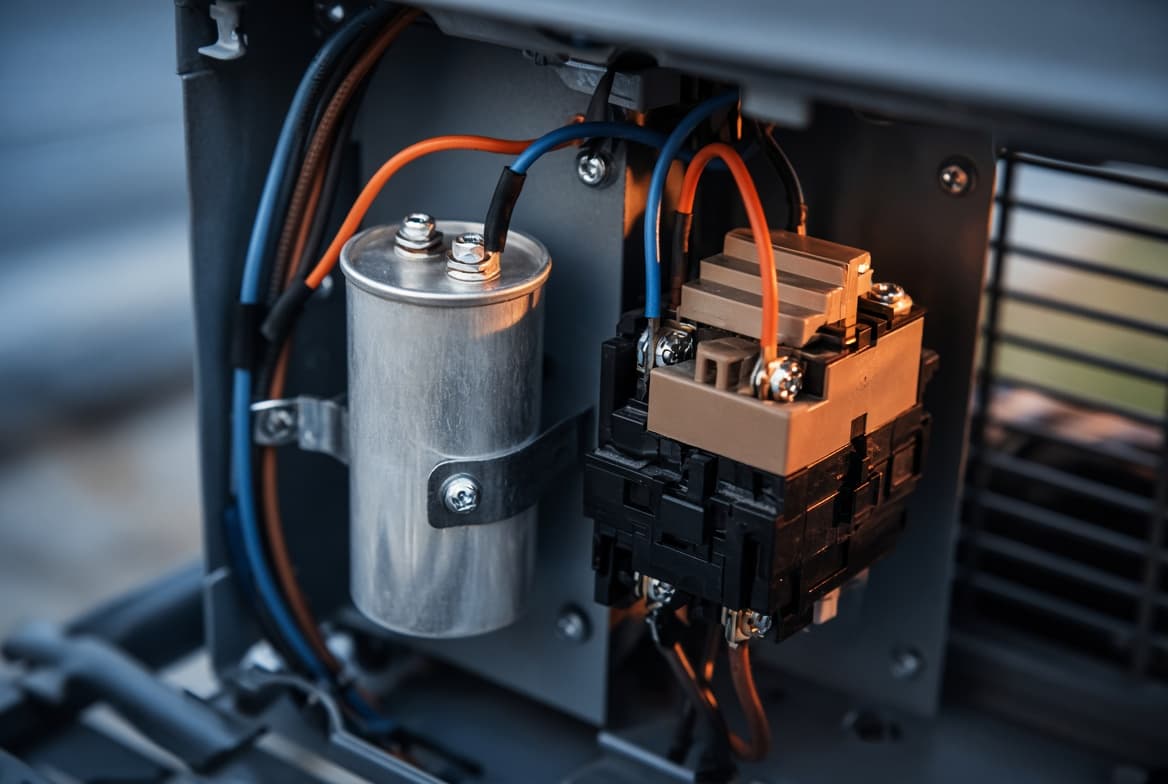
A condenser fan motor spins the large fan on top of your outdoor AC unit, pulling outdoor air through the condenser coil so the refrigerant can shed the heat it carried out of the house. When it fails, the giveaway is a compressor humming or running while the fan sits still. That's a shut-it-off-now problem, because the compressor overheats fast without airflow, and the cause is often a cheap capacitor rather than the motor itself.
What Does a Condenser Fan Motor Do?
The outdoor unit holds the compressor, the condenser coil and the fan. Hot, high-pressure refrigerant from the compressor runs through the coil, and the fan draws air in through the fins on the sides and blows it out the top. That airflow is what turns the refrigerant back into a liquid. No airflow, no heat rejection, and the AC condenser stops doing its job within minutes.
On most residential units the motor hangs shaft-down from the top grille with the fan blade below it. It's separate from the indoor blower motor that moves air through your ducts. "AC fan motor" can mean either; if the fan inside your furnace or air handler has stopped, this isn't your part.
Condenser Fan Motor Problems: Symptoms of a Failing Motor
| Symptom | What it usually means |
|---|---|
| Fan not spinning while the compressor hums or runs | Failed capacitor (fan side), dead motor, seized bearings, or a jammed blade |
| Fan spins slowly or struggles to get up to speed | Weak capacitor or worn bearings |
| Fan starts, runs a while, then stops, then restarts later | Motor overheating and tripping its internal thermal overload |
| Grinding, screeching or a loud hum from the top of the unit | Worn bearings, a blade hitting the grille, or a loose blade on the shaft |
| Burning or hot electrical smell at the outdoor unit | Overheating motor windings or wiring; shut it off |
| Compressor shuts off on hot afternoons, warm air inside | Fan not moving enough air, so the compressor overload or high-pressure switch trips |
| Fan keeps running after the thermostat is satisfied | Usually a stuck contactor or control problem, not the motor |
The last two rows matter. A compressor that keeps tripping on its overload is often blamed on the compressor, when the real cause is a fan that's weak or dead. And a fan that won't shut off almost always points at the AC contactor, not the motor.
Two Times a Stopped Fan Is Normal
Before you diagnose anything, rule these out:
- Heat pump defrost. In heating season, a heat pump periodically reverses to melt frost off the outdoor coil. During defrost the outdoor fan stops for a few minutes, and you may see steam rising from the unit. That's normal.
- Low-ambient fan control. Some variable-speed units, and units with low-ambient kits, slow or cycle the outdoor fan when it's cool outside to keep pressures up. A slow fan on a mild morning can be by design.
Condenser Fan Motor Gets Hot and Stops
If the condenser fan motor gets hot and stops, then restarts later, it is tripping its internal thermal overload. The motor shuts itself off to protect the windings and restarts once it cools.
Common causes:
- A weak capacitor.
- Worn or dry bearings.
- Failing windings.
- A dirty condenser coil, which makes the motor run hotter.
- The wrong replacement motor or blade, such as an RPM mismatch.
Motors normally run warm, so heat alone is not the problem. The stopping is. Do not touch the motor or reach into the unit. While the fan is cycling on overload, turn the system off at the thermostat, because the compressor overheats without the fan.
When you call a technician, say when the fan stops and how long it takes to restart. Ask for a capacitor test before the motor is condemned.
AC Fan Not Spinning: Diagnostic Table
If the outside fan isn't spinning in cooling mode, set the thermostat to Off first. Then use what you can see and hear to narrow it down.
| What you observe | Likely cause | What you can safely check | Fix |
|---|---|---|---|
| Compressor hums or runs, fan still, no grinding | Fan side of the run capacitor failed or weak | Look for a capacitor with a domed or bulging top or leaked oil (look only) | Technician tests and replaces the capacitor; motor may be fine |
| Fan still, blade hard to turn by hand with power off | Seized motor bearings | With the disconnect pulled, turn the blade by hand: it should spin freely and coast | Replace the motor (sealed bearings can't be serviced) |
| Fan still, blade spins freely by hand, capacitor tests good | Open motor winding or failed motor | Nothing beyond the free-spin check | Replace the motor |
| Nothing outside runs at all | Tripped breaker, pulled disconnect, failed contactor, or no thermostat signal | Reset the breaker once; check the disconnect | Technician if the breaker trips again or the contactor isn't pulling in |
| Contactor pulled in, compressor runs, fan dead, burnt smell | Burnt fan motor wire or connection | Look only | Technician repairs wiring and checks the motor |
| Sticks, leaves or a wasp nest in the blade or grille | Debris jamming the blade | With the power off, clear what you can reach through the top | Remove debris, check blade for damage |
| Fan runs for a while, then stops, restarts later | Motor tripping its thermal overload from heat, a weak capacitor or failing windings | Note when it stops and restarts; don't touch the motor, it runs hot | Usually capacitor or motor replacement |
| Variable-speed unit, fan still, flashing light or code on the outdoor board | ECM motor failure or inverter/control board fault | Note the flash code or error display | Technician; parts are often brand-specific |
Most outdoor units share one dual run capacitor between the compressor and the fan, marked HERM, FAN and C. When only the fan side fails, you get the most common version of this problem: compressor running, fan dead. The AC capacitor guide explains how that part fails and why it's usually replaced on sight.
Why You Shouldn't Push the Fan Blade With a Stick
The well-known trick: when the fan hums but won't start, push the blade with a stick and it spins up. It often works, because a motor with a weak capacitor lacks starting torque but can run once turning. That's why people keep repeating it.
Don't do it. You're reaching toward a blade on a live 240-volt circuit, and when the motor catches it hits full speed instantly and can snap or throw the stick. The weak capacitor is still there, so the motor runs hot and fails sooner, and next time the compressor runs without airflow again. The trick confirms a capacitor problem and fixes nothing.
Safety: What Not to Do Yourself
- The outdoor unit runs on 240 volts. Turn the thermostat to Off and pull the disconnect next to the unit before you touch anything. Turning off the thermostat alone leaves line voltage at the contactor.
- Capacitors hold a charge after the power is off and can injure you. Don't touch the terminals, don't short them with a screwdriver, and don't handle a capacitor unless you know how to discharge it safely and verify it with a meter.
- Don't bypass a pressure switch, overload or contactor to make the unit run. Those parts are what protect the compressor.
- Don't run cooling with a dead fan hoping it'll cool the house a little. It won't, and each overload trip shortens the compressor's life.
- A fan motor swap never involves refrigerant. If someone says it does, ask why; refrigerant work requires EPA Section 608 certification.
PSC vs ECM Condenser Fan Motors
| PSC (permanent split capacitor) | ECM (electronically commutated) | |
|---|---|---|
| Where you'll find it | Most single-stage and many two-stage units | Many high-efficiency, two-stage and variable-speed units |
| Speed | One fixed speed | Variable, set by the unit's control board |
| Needs a run capacitor | Yes | No |
| Efficiency | Lower | Higher, especially at reduced speeds |
| Replacement parts | Universal replacements widely available | Often OEM or brand-specific, sometimes programmed for the unit |
| Relative cost | Lower | Higher, often several hundred dollars more |
| DIY-friendly | Moderately, with the safety limits above | Rarely; diagnosis needs the unit's control logic |
To tell which you have, check the motor label. A PSC nameplate lists HP, RPM and a capacitor rating, and the motor has a wire to the run capacitor. An ECM usually has a multi-pin control plug and a label saying ECM or variable speed.
How to Match a Replacement Condenser Fan Motor
Read the nameplate on the old motor before you remove it, and photograph it along with the wiring. A replacement has to match:
- Horsepower. Residential condenser fans commonly run 1/8 to 1/2 HP. Don't go lower; going one size up is sometimes acceptable if amperage and the wiring allow, but matching is the rule.
- RPM. Common ratings are around 825, 1075 and 1100 RPM. The speed is matched to the blade pitch. The wrong RPM moves the wrong amount of air and can overload the motor or raise head pressure.
- Voltage and phase. Most homes use 208/230-volt single-phase motors.
- Rotation. Clockwise or counterclockwise, and note whether the label reads it from the shaft end or the lead end. Many universal motors are reversible by moving a lead.
- Shaft. Diameter (often 1/2 inch) and length, with a flat for the blade's set screw.
- Frame size and mounting. Motor diameter and the mounting bracket or studs for your grille.
- Mounting position and weather protection. A motor hanging shaft-down outdoors needs to be rated for that position, usually with a rain shield and drain holes.
- Capacitor rating. Install a new capacitor rated in MFD (microfarads) and voltage to match the new motor's label. On a dual run capacitor, the HERM side must still match the compressor.
Before pulling the blade, measure where it sits on the shaft and set the new one at the same height; it matters for airflow and noise.
Condenser Fan Motor Replacement Cost
Most published cost guides put a standard PSC condenser fan motor replacement, installed by a technician, at around $200 to $700. The motor itself commonly runs about $100 to $300 for typical residential sizes, and the rest is labor and the service call. Variable-speed ECM motors commonly cost several hundred dollars more, and brand-specific ECM replacements can approach or pass $1,000 installed.
What moves the price:
- Motor type and size. Larger horsepower and ECM motors cost more; OEM parts cost more than universal replacements.
- The capacitor. Often replaced at the same visit, which adds a modest part cost.
- A seized or rusted blade. Sometimes the old blade won't come off the shaft and has to be replaced too.
- Warranty. Many manufacturers cover parts for 10 years on registered units. Labor usually isn't included.
- Access and timing. Rooftops, tight side yards, after-hours visits and peak-season demand raise the bill.
When to Replace the Whole Unit Instead
A fan motor is a normal repair, even on a 12- or 15-year-old unit. It makes less sense when:
- The system uses R-22. Supply is limited to reclaimed refrigerant, and any leak or compressor problem will be expensive. A fan motor may be the last money worth putting in.
- The compressor is struggling too. If the dead fan let the compressor overheat repeatedly, have it checked for high amp draw or a hard start before you approve the motor.
- The coil is leaking or badly corroded. A new fan won't help a unit losing its charge.
- Several parts have failed in a short span on a unit near the end of its expected life.
Then compare the repair price with a matched new system. The AC compressor repair guide has a repair-vs-replace table that applies here too.
Questions to Ask the Technician
- Did you test the capacitor, and what did it read against its rating?
- Is the motor dead, or did it overheat because of something else (capacitor, dirty coil, bad wiring)?
- Is the replacement an OEM or universal motor, and does it match HP, RPM and rotation?
- Are you replacing the capacitor too, and is it rated for both the fan and the compressor?
- Did you check the compressor's amp draw after the repair?
If the fan is running again but the house still isn't cooling, work through AC not cooling or blowing warm air for the other causes.
Frequently Asked Questions
How do I know if my condenser fan motor is bad?
The classic sign is a compressor humming or running while the fan on top of the outdoor unit sits still. Other signs are a fan that turns slowly, starts and stops on its own, grinds or screeches, or smells hot. A weak capacitor causes the same no-start symptom, so it should be tested before the motor is condemned.
Can an AC run without the condenser fan?
Not safely. Without the fan, the condenser coil can't shed heat, so refrigerant pressure and compressor temperature climb quickly. The compressor's internal overload or a high-pressure switch will shut it off, but repeated trips stress the most expensive part in the system. If the outside fan isn't spinning, set the thermostat to Off until it's repaired.
Why is my AC fan not spinning but the compressor is running?
The most common cause is the fan side of the run capacitor failing, which leaves the fan motor without its starting boost while the compressor keeps going. Seized bearings, a burnt-out winding, a loose wire, debris in the blade or a control board fault on variable-speed units can do the same. Turn the system off so the compressor doesn't overheat.
How long does a condenser fan motor last?
Many last 10 years or more, and some last as long as the outdoor unit. Heat, a dirty coil that makes the motor run hotter, a weak capacitor, water getting into the motor and long cooling seasons shorten that. A motor that has been running on a failing capacitor for a summer often fails soon after.
Can I replace a condenser fan motor myself?
It's a common job for experienced DIYers, but it involves a 240-volt circuit and a capacitor that can hold a dangerous charge after the power is off. You also have to match the motor's specs and set the blade height correctly. If you can't verify zero voltage with a meter and discharge a capacitor safely, leave it to a technician.
Should I replace the capacitor when I replace the condenser fan motor?
Usually yes on a standard PSC motor. A replacement motor specifies its own capacitor rating, and an old or weak capacitor is often what overheated the original motor. On units with a dual run capacitor that also serves the compressor, the new capacitor must match the compressor rating as well. ECM fan motors do not use a run capacitor.
What is a condenser fan motor and where is it?
It is the motor that turns the large fan on top of the outdoor AC or heat pump unit, pulling air through the condenser coil so refrigerant can shed heat. On most residential units it hangs shaft-down from the top grille. It is separate from the indoor blower motor in the furnace or air handler.