
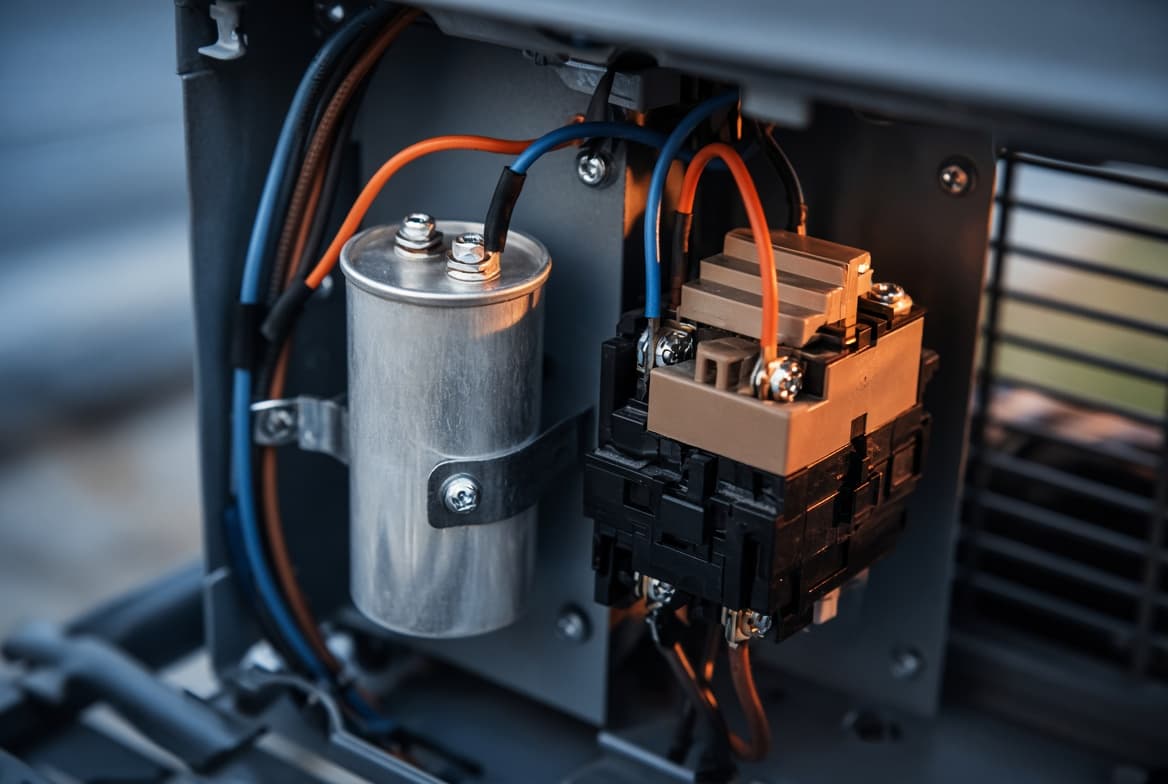
An AC capacitor is the metal can in your outdoor unit that stores and releases an electrical charge so the compressor and outdoor fan motor can start and keep running efficiently. When it weakens, you typically get a humming outdoor unit, a fan that won't spin, or warm air at the vents. It's one of the most frequently replaced parts on a central air conditioner, and the part is cheap, but it can hold a dangerous charge after the power is off, which is why replacement is normally a technician's job.
What Does an AC Capacitor Do?
Your home runs on single-phase power, and a single-phase motor has no built-in way to start turning in a set direction. The capacitor feeds a second winding in the motor with current that is shifted out of step with the main winding. That offset creates the rotating magnetic field that starts the motor and keeps it running efficiently.
Run, start and dual run capacitors
- Run capacitor. Stays in the circuit the whole time the motor runs, and fails more often than any other kind. Your furnace or air handler may have one for the blower if it uses a PSC motor (see our furnace blower motor guide).
- Start capacitor. Gives the compressor a large, brief boost, then a relay or thermistor drops it out within about a second. Most residential split-system air conditioners don't ship with one; when you find one, it's usually part of a hard start kit added later.
- Dual run capacitor. Two run capacitors in one can, sharing a common terminal. It's the usual setup in residential condensers and heat pumps. A label reading 45/5 means 45 microfarads for the compressor and 5 for the fan.
| Type | Typical rating | Case | Where you find it |
|---|---|---|---|
| Run (single) | Fan: single digits of µF. Compressor: roughly 20 to 60 µF. 370 or 440 VAC | Round or oval metal can | Condenser, furnace or air handler blower |
| Dual run | Two values, such as 35/5 or 45/5 µF. 370 or 440 VAC | Metal can with three terminal groups | Most residential condensers and heat pumps |
| Start | Much larger values, often 88 µF and up | Usually black plastic | Hard start kits, some older or larger units |
Capacitance is printed as µF, uF or MFD. One thing most guides leave out: many newer variable-speed condensers and most ductless mini splits use inverter-driven compressors and electronically commutated fan motors with no run capacitor at all. On those systems, a "bad capacitor" diagnosis deserves a second look.
Capacitors in the furnace, air handler and heat pump
A heat pump's outdoor unit uses the same run capacitor in heating mode. A "heater capacitor" on a heat pump is usually this part, and when it fails it stops heating as well as cooling.
Furnaces and air handlers with a PSC blower motor have their own, smaller blower capacitor. ECM blower motors do not use one. The furnace blower motor guide covers the difference.
The same matching rules apply to any HVAC capacitor: the microfarad rating and the voltage rating from the old label, as covered in the matching section below.
Signs of a Bad AC Capacitor
- The outdoor unit hums but doesn't start. The compressor gets power but can't turn over, trips its internal overload, then tries again later.
- The outdoor fan doesn't spin while the compressor hums or runs.
- Slow or delayed start. A click, a moment of humming, then the unit catches. Lights may dim.
- Warm air indoors while the indoor blower runs normally.
- The unit shuts itself off or trips the breaker. A motor straining against a weak capacitor overheats and draws extra current.
- A domed top or leaking oil. Many run capacitors have a pressure interrupter: when the can overheats, the top pushes up and disconnects the internal element. A bulging top means it has failed or is about to, even if the unit still runs.
- A burning smell from the outdoor unit. Shut the system off.
Which side of the capacitor failed?
On a dual capacitor, the compressor (HERM) and fan (FAN) sections fail independently. What still runs tells you which, or that the capacitor isn't the problem.
| What you see or hear | Likely capacitor section | Other causes to rule out | What to do |
|---|---|---|---|
| Compressor hums or runs, outdoor fan still | FAN | A seized fan motor (see condenser fan motor problems) | Thermostat to Off now; the compressor overheats without the fan |
| Fan spins, compressor hums and clicks off | HERM | Locked or hard-starting compressor, low voltage | Shut cooling off; repeated attempts strain the compressor |
| Slow start, lights dim | Weak HERM | Aging compressor, low supply voltage | Have it read; ask whether a hard start kit makes sense |
| Nothing runs outdoors, indoor fan runs, no hum | Probably not the capacitor | Breaker, disconnect, low-voltage fault, or a failed AC contactor | Check the breaker and disconnect, then call a technician |
| Domed top or oil, unit still runs | Either, at end of life | None: it has visibly failed | Replace before it quits on the hottest day |
Don't keep running the system with a bad capacitor. A compressor that can't start heats its windings on every attempt, and one running with a dead fan has nothing pulling heat off the coil. The capacitor is cheap; the compressor it protects is not, as our guide to AC compressor repair and replacement explains.
What Makes AC Capacitors Fail
Heat is the main one, since the capacitor sits in a metal box in the sun next to a hot compressor. Age, lightning, utility surges and short cycling account for most of the rest. Two causes get missed: a dragging fan motor or compressor that overworks the capacitor, and a wrongly rated capacitor from an earlier repair. Manufacturer guides commonly quote 10 to 20 years of life, but plenty fail far sooner in hot climates.
How a Technician Tests an AC Capacitor
- Power off and verified. The technician pulls the disconnect, shuts the breaker, and confirms with a meter that no voltage reaches the unit.
- Discharge. With an insulated tool that has a resistor built in, they bleed off stored charge across each pair of terminals, then confirm zero volts before touching anything.
- Inspection. They look for a domed top, oil, rust, and burned or loose terminals.
- Capacitance reading. With the wires labeled and removed, they measure each section: C to HERM for the compressor, C to FAN for the fan.
- Compare against the label. The label lists a tolerance, commonly ±5% or ±6%. A 45/5 µF capacitor at ±6% should read about 42.3 to 47.7 on HERM and 4.7 to 5.3 on FAN. Either side outside its window means replacing the whole capacitor.
Some technicians also test under load: with the unit running, they measure the current through the capacitor lead and the voltage across it, then calculate microfarads (at 60 Hz, amps times 2,652, divided by volts). That catches a capacitor that reads fine cold but sags when hot. A good technician also checks motor amp draw, because a capacitor killed by a dying fan motor will fail again.
Dual Capacitor Terminals: HERM, FAN and C
- C (common): Fed from the load side of the contactor. Both sections share it.
- HERM: Goes to the compressor. The name comes from "hermetic," since residential compressors are sealed in a welded shell.
- FAN: Goes to the outdoor fan motor.
Wire colors vary, so trust the markings on the can and the wiring diagram inside the panel cover. Swapping HERM and FAN puts the large compressor value on the small fan motor and overheats it.
How to Match a Replacement Capacitor
| Spec | Rule | Why it matters |
|---|---|---|
| Capacitance (µF) | Match exactly; on a dual, match both numbers | Too high or too low makes the motor run hot. Going higher does not add "more power" |
| Voltage rating | Equal or higher: 440 V can replace 370 V, never the reverse | The rating is the maximum the capacitor can safely handle |
| Type | Run replaces run, start replaces start | Built for different duty cycles |
| Shape and size | Round or oval, sized to fit the bracket with clearance to the cover | A loose can vibrates and rubs through wire insulation |
| Terminals | Enough tabs for every wire on each terminal | Avoids piggybacked connectors that loosen and burn |
Two points the parts listings skip. Check the rating against the equipment's wiring diagram or data plate, not only the old capacitor, because copying a wrong value from an earlier repair repeats the mistake. And a dual capacitor can be replaced with two single capacitors when space and wiring allow, which technicians do when the exact dual value isn't on the truck.
AC Capacitor Replacement Cost
The part. Most published cost guides put a standard run or dual run capacitor at roughly $10 to $50. Brand-name OEM parts cost more than universal supply-house equivalents.
Installed. Most published cost guides put a professional capacitor replacement somewhere around $100 to $400, with the national averages they report a little under $200. The capacitor is a small slice of that; you're mainly paying for the trip, the diagnosis and the technician's time.
What moves your price within that range:
- The diagnostic or trip fee, and whether it's credited toward the repair.
- Timing. Nights, weekends and heat waves often cost more.
- OEM versus universal part. Some contractors won't install a part you bought yourself.
- Access. Rooftop units and cramped side yards add time.
- Bundled work, such as a pitted contactor or hard start kit found on the same visit.
- Warranty. Many manufacturer warranties cover the part but not the labor.
Replacing a capacitor on an older AC is almost always worth it. It's the cheapest repair on the system and often restores normal operation completely. The exception is a compressor damaged by repeated failed starts: if a new capacitor doesn't get it running, the conversation moves to repair versus replacement. Our AC repair cost by part guide shows where a capacitor falls against bigger jobs.
Hard Start Kits: When They Help
A hard start kit adds a start capacitor and a relay or thermistor that gives the compressor an extra push during the first second of startup. It helps aging compressors that start slowly and units on low supply voltage. It isn't a fix for a failing compressor, and manufacturers differ on which kits they approve, so if one is recommended, ask what reading led to it.
Changing an AC Capacitor Yourself: The Safety Picture
Capacitor replacement doesn't involve refrigerant, so EPA Section 608 rules don't apply, and the part is held by one strap and a few push-on wires. That's why videos on changing an AC capacitor are everywhere. What they tend to underplay:
- Stored charge. A run capacitor stores energy, and many have no internal bleed resistor to drain it, so it can stay charged long after the power is off. Touching the terminals can deliver a shock that injures or kills, and shorting them can throw an arc that burns skin and eyes.
- Live circuits nearby. Pulling the disconnect kills power to the unit, but its supply side stays live, and many contactors break only one leg of the 240-volt supply, leaving the other connected to the motors at all times.
- How professionals handle it. A technician proves the power is off with a meter, discharges each section with an insulated resistor tool, and re-checks for zero volts before touching a terminal. Shorting the terminals with a screwdriver, a shortcut shown online, throws sparks and pits the terminals.
- The stick trick. Pushing a stalled fan blade with a stick to get it spinning puts your hands over a fan that can start at any moment, and it fixes nothing.
Leave it to a technician if any of these apply:
- You don't own a meter that reads AC voltage and capacitance, or aren't sure how to use one.
- You aren't certain which breaker and disconnect feed the outdoor unit.
- The capacitor, wires or terminals show burn marks, soot or melted insulation.
- The breaker has been tripping.
- The compressor still hums without starting after a new capacitor.
- The unit is on a roof, or its warranty terms call for licensed service.
What to ask the technician
- What did each section of the old capacitor read, against its rating?
- Does the replacement match the equipment's wiring diagram, not just the old part?
- Did you check the fan motor and compressor amp draw?
- What condition is the contactor in?
- What warranty covers the part and the labor?
A specific answer to the first question is the best sign the diagnosis was real. If the outdoor unit still misbehaves after a new capacitor, our guide on why your AC is not cooling covers the next likely causes. To catch a weak capacitor before it strands you, have it read during annual AC maintenance and keep 2 feet of clearance around the condenser so it runs cooler.
Frequently Asked Questions
How do I know if my AC capacitor is bad?
Common signs are an outdoor unit that hums but won't start, an outdoor fan that sits still, a slow or clicking start, warm air at the vents, and a capacitor with a domed top or leaking oil. Only a capacitance reading confirms it: a technician measures each section in microfarads and compares it with the rating and tolerance on the label.
How much does it cost to replace an AC capacitor?
Most published cost guides put a standard run or dual run capacitor at roughly $10 to $50 for the part alone. Installed by a technician, most land somewhere around $100 to $400, with reported national averages a little under $200. The trip fee, labor, timing and access make up most of the bill.
Can I replace my AC capacitor myself?
The part is simple, but a run capacitor can hold a charge after the power is off that can injure or kill you, and the panel around it carries 240 volts. Unless you own a meter that reads voltage and capacitance, know how to prove the circuit is dead, and are comfortable around line-voltage wiring, leave it to a technician.
Can an AC run without a capacitor?
A conventional single-phase compressor or condenser fan motor can't start properly without its run capacitor. The compressor hums, draws heavy current and trips its overload. Some newer variable-speed systems use inverter-driven compressors and electronic fan motors that have no run capacitor at all.
How long does an AC capacitor last?
Manufacturer guides commonly quote around 10 to 20 years, but heat, voltage surges, a struggling motor or a wrong rating can kill one in a few seasons. Units in hot climates that run most of the year tend to need one sooner. A yearly capacitance reading catches a weakening capacitor early.
Does a furnace have a capacitor?
Many do. A furnace or air handler with a PSC blower motor has a run capacitor for that motor, and a failing one causes a humming blower that will not start or runs slowly. Furnaces with ECM blowers have none. Replacement is a technician job for the same stored-charge reasons given on this page.