
When an AC unit is not turning on, the cause is usually a power or control problem rather than a dead air conditioner. Check the thermostat, the two breakers, the disconnect box next to the outdoor unit, the condensate float switch, and the furnace or air handler door in that order. Those checks take about 15 minutes and fix a large share of no-start calls. If the outdoor unit still won't run, or it hums without starting, the likely causes are a capacitor, contactor or compressor problem that a technician should handle.
First, Which Part Won't Turn On?
"AC not turning on" covers three different situations, and each points to different parts. Go to the thermostat, set it to COOL a few degrees below room temperature, then listen inside and out.
| What happens | What it points to | Start here |
|---|---|---|
| Nothing at all: thermostat blank, no indoor fan, no outdoor unit | Thermostat power, indoor breaker or service switch, blown control board fuse, float switch, furnace door switch | Checks 1 to 6 below |
| Thermostat on, nothing runs inside or out | Float switch, door switch, control board fuse, thermostat wiring | Checks 4 to 6 below |
| Indoor fan runs, outside AC unit not running | Outdoor breaker, disconnect, capacitor, contactor, cut wire, compressor overload | "Outside AC unit not running" below |
| Outdoor unit hums or buzzes but fan doesn't spin | Failed capacitor, seized fan motor, stuck compressor | Turn it off; technician |
| Outdoor unit clicks, starts, then stops | Overload, pressure switch, failing capacitor | See AC short cycling |
Check These 7 Things First
- Thermostat setting and power. Mode on COOL, setpoint below room temperature, fan on AUTO. If the screen is blank or dim, replace the batteries. Smart thermostats that draw power from the system may go dark when the system loses power, so a blank screen can be a symptom, not the cause. Check for a schedule or hold that overrides your setting.
- The compressor delay. Many thermostats and control boards wait several minutes before starting the outdoor unit after a setting change or power loss. Some show "wait" or a flashing snowflake. Give it 5 minutes before moving on.
- Both breakers. Central air usually has a 240-volt double breaker for the outdoor unit and a separate breaker for the furnace or air handler. A tripped breaker sits in the middle position. Push it fully off, then on. Reset once. If it trips again, leave it off.
- The indoor service switch. A light-switch-style switch on or near the furnace or air handler. It's easy to flip off by mistake.
- The furnace or air handler door. Most units have a door safety switch, a small push button that cuts power when the blower door is off. If the panel wasn't seated after a filter change, the whole system stays off. Push the door firmly into place.
- The condensate float switch. Look for a small switch in the drain pan, on the drain line near the indoor unit, or in a secondary pan under an attic unit. If the pan or line is full of water, the switch cuts the cooling call. See clogged AC drain line for how to clear it.
- The outdoor disconnect. A gray box on the wall near the outdoor unit. It may have a pull-out block, a lever or a breaker. Make sure the block is inserted the right way and fully seated, or the breaker is on. Some disconnects have fuses that can blow even when the main breaker is fine; testing those is a job for someone with a meter.
If the system starts after one of these, watch it for a full cycle. A float switch that tripped once will trip again unless the drain is cleared, and a breaker that trips again means an electrical fault.
Outside AC Unit Not Running but Inside Is
This is the most common version of the problem. The indoor blower moves air, but it's not cold, and the outdoor unit is silent. The thermostat is calling, the indoor unit is answering, and the outdoor unit isn't getting power or isn't getting the 24-volt signal that tells it to start.
| What you notice outside | Likely cause | Who fixes it |
|---|---|---|
| Completely silent, breaker and disconnect on | Burnt or stuck contactor, cut or chewed low-voltage wire, blown disconnect fuse | Technician |
| Hums or buzzes, fan not spinning | Failed run capacitor, seized fan motor | Technician |
| Fan spins, compressor silent | Weak capacitor, compressor overload tripped, failing compressor | Technician |
| Fan and compressor start, then shut off after minutes | Compressor overheating, dirty condenser coil, refrigerant problem, pressure switch | Technician |
| Silent after a storm or surge | Tripped breaker, damaged capacitor, contactor or board | Check breaker yourself; then technician |
Look along the thin wire. A low-voltage cable (about the thickness of a phone charger cord) runs from the indoor unit to the outdoor unit. A string trimmer, lawn mower, landscaping work or rodents can cut it. If you see a nicked or broken section near the unit, that's very likely your answer. Don't splice it yourself while the system is powered; turn off both breakers and have it repaired properly.
Give the compressor time to cool. A compressor that overheats trips an internal overload and won't restart until it cools down, which can take an hour or more on a hot day. If the unit was running and then stopped, turn the system off for a while before deciding it's dead. Repeated overload trips have a cause, such as a dirty condenser coil, a weak capacitor or low refrigerant.
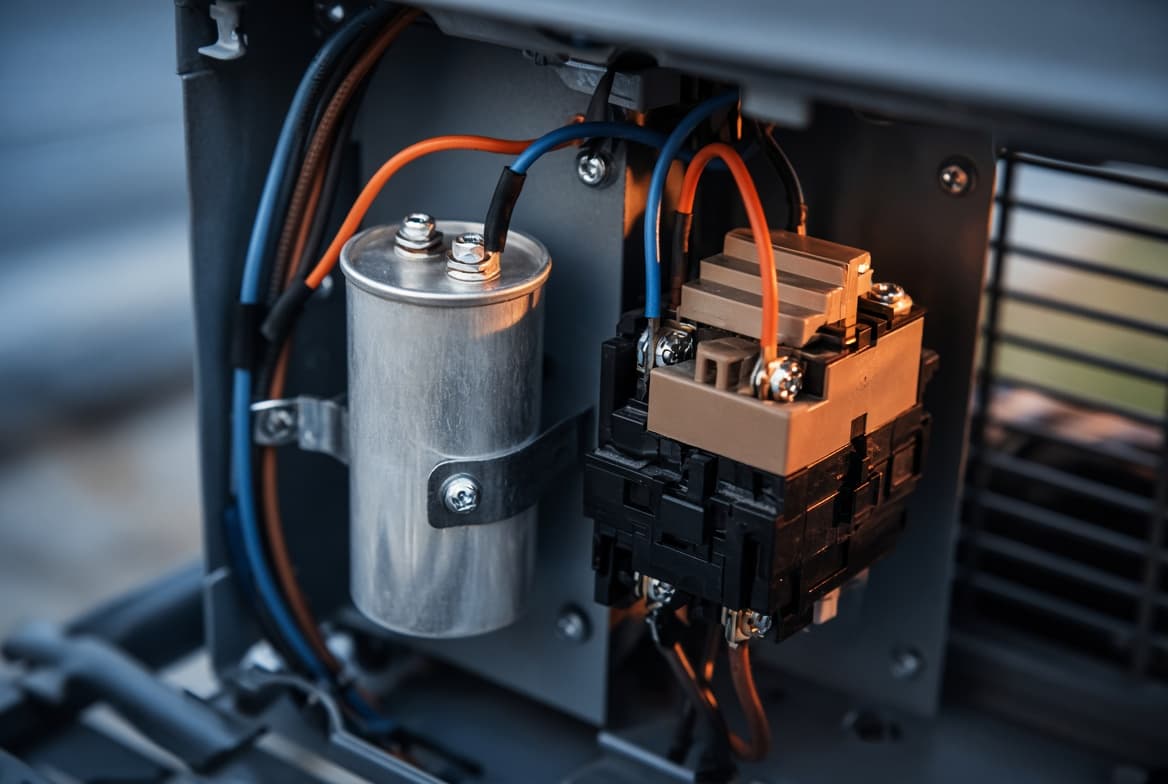
The two most common failed parts here are the bad AC capacitor and a burnt or pitted AC contactor. Both are cheap parts, but both sit next to 240-volt wiring, and a capacitor can hold a dangerous charge after the power is off. If you'd rather hand it to a pro, see what AC repair costs, and on a dangerously hot day, how emergency AC repair pricing and response times work.
AC Trying to Kick On but Won't Start
When the AC is trying to turn on but won't, what you hear points to the cause. Three patterns come up most:
- It hums or buzzes, but the fan does not spin. Suspect the capacitor, a seized fan motor or a stuck compressor.
- It clicks once and nothing follows. The contactor is not pulling in, or no 24-volt call is reaching it.
- It starts and stops within seconds. Suspect an overload, a pressure switch or a failing capacitor. The short cycling guide linked in the table above covers that pattern.
If your AC has power but won't turn on, remember that power at the unit does not mean the contactor is closing or the capacitor is good. A unit can sit live and still never start.
A compressor that tripped its internal overload after running hot can stay off until it cools. Do not keep cycling the breaker on a humming unit, because that stresses the compressor and the wiring.
Capacitor and contactor work is for a technician, since both sit next to 240-volt wiring and a capacitor can hold a charge with the power off.
When the Whole System Is Dead
If the thermostat is blank and nothing runs anywhere, the 24-volt control circuit is the usual suspect. It's powered by a transformer in the furnace or air handler and protected by a small fuse on the control board, often 3 or 5 amps. A short in the thermostat wire, often from a nicked wire, a miswired new thermostat or a cut outdoor cable, blows that fuse.
If you recently installed a new thermostat, double-check the wiring against the old labels and the thermostat wiring guide. A wire touching the wrong terminal, or bare wire ends touching each other, can blow the board fuse instantly. A technician will find the short before replacing the fuse, because a new fuse on an existing short just blows again.
How to Reset an AC Unit
There's usually no single reset button on a central AC. A power reset clears many control lockouts:
- Set the thermostat to OFF.
- Turn off the outdoor unit's breaker and the indoor unit's breaker or service switch.
- Wait about 5 minutes.
- Turn the breakers back on.
- Set the thermostat to COOL a few degrees below room temperature.
- Wait at least 5 minutes for any compressor delay.
Some outdoor units have a control board with a reset button or a lockout that clears when power is cycled. Check the unit's manual. If a reset brings it back but it fails again within a day, the reset only cleared the symptom.
What Not to Attempt Yourself
- Don't open the outdoor unit's electrical panel unless the disconnect is off, you've proven there's no voltage with a meter, and you know how to discharge a capacitor safely.
- Don't push the fan blade with a stick to start it. It doesn't fix the capacitor and puts your hands near a fan that can start at any moment.
- Don't press in the contactor to force the unit on. It bypasses controls and exposes you to 240 volts.
- Don't keep resetting a breaker that trips. That's an electrical fault, and repeated resets can damage the compressor or wiring.
- Don't jumper the float switch to get cooling back. It's there to prevent water damage.
- Don't add refrigerant. Handling refrigerant requires EPA Section 608 certification, and low refrigerant means a leak that needs finding.
What to Tell the Technician
Describe what happens step by step: whether the thermostat screen is on, whether the indoor fan runs, what the outdoor unit does (silent, humming, clicking, starting then stopping), and whether anything happened before it stopped, such as a storm, a power outage, a new thermostat or yard work. Ask what the capacitor read against its rating, and what condition the contactor is in.
If the unit turns on but the air isn't cold, the AC not cooling troubleshooting guide picks up from there.
Frequently Asked Questions
Why is my AC unit not turning on?
Start with the simple causes: the thermostat set wrong or without power, a tripped breaker, the outdoor disconnect pulled or its fuses blown, the indoor service switch off, a tripped condensate float switch, or a furnace door that isn't seated on its safety switch. If those check out, a failed capacitor, contactor, control board fuse or compressor is likely, and that's a technician job.
Why is my outside AC unit not running but the inside is?
If the indoor blower runs but the outdoor unit is silent, the outdoor unit isn't getting power or isn't getting the signal to start. Check the outdoor breaker and the disconnect box. If both are on, the usual causes are a failed capacitor, a burnt or stuck contactor, a cut low-voltage wire, or a compressor that has tripped its internal overload.
How do I reset my AC unit?
Turn the thermostat off, switch off the outdoor breaker and the indoor breaker or service switch, and wait about 5 minutes. Restore power, then set the thermostat to cool a few degrees below room temperature. Many systems wait several minutes before starting the compressor. If it still won't run, or a breaker trips again, stop and get it diagnosed.
Can a clogged drain line stop my AC from turning on?
Yes. Many systems have a float switch in the drain pan or drain line that cuts power to the cooling call when water backs up, so it doesn't overflow. The system looks dead even though nothing is broken. Clearing the drain line and letting the switch drop usually brings it back.
Why won't my AC turn on after a power outage?
Breakers can trip from the surge when power returns, smart thermostats may need to reconnect or reboot, and many systems hold a compressor delay of a few minutes after power comes back. Check the breakers and wait at least 5 to 10 minutes. If the outdoor unit still won't start, the surge may have damaged a capacitor, contactor or control board.
How long should I wait after resetting my AC?
Wait at least 5 minutes after restoring power before expecting the compressor to start. Many thermostats and control boards build in a delay to protect the compressor from restarting against high pressure. If it hasn't started after 10 to 15 minutes with the thermostat calling for cooling, something else is wrong.
Why did my AC turn off and won't turn back on?
It is usually a safety device or a power problem: a tripped breaker, a condensate float switch that cut the system, a compressor overload that needs time to cool, a thermostat delay, or a control board lockout after repeated failures. Try the reset steps on this page once. If it shuts off again, a technician needs to find what tripped it.