
AC short cycling means your air conditioner turns on, runs for only a few minutes or less, shuts off, and starts again, over and over, without finishing a normal cooling cycle. The usual causes are a clogged filter or frozen coil, a badly placed thermostat, an oversized unit, low refrigerant, an overheating compressor, or an electrical fault. Start with the filter, the vents, the thermostat location and the outdoor unit. If it keeps happening, have it checked soon, because frequent starts wear out the compressor.
What Counts as Short Cycling?
An air conditioner is supposed to cycle. It runs until the thermostat is satisfied, shuts off, and starts again when the temperature rises. The question is how short the runs are.
- Normal: many thermostats are set up to allow about three cooling cycles per hour for a single-stage air conditioner, and a common rule of thumb is a run of roughly 10 to 20 minutes on a warm day. On the hottest afternoons a healthy system may run almost continuously.
- Short cycling: runs of only a few minutes, or less than a minute, repeated many times an hour, especially when the house isn't reaching the setpoint or feels humid.
A note on variable-speed systems. Inverter-driven and variable-speed air conditioners and heat pumps are designed to run long and slow, ramping down instead of shutting off. If one of these turns fully on and off frequently, that's more unusual than it would be on a single-stage unit, and worth a technician's look.
Read the Pattern: Timing and What Shuts Off
Most guides list short cycling causes without telling you how to sort them. Two observations narrow it down fast: how long each run lasts, and whether the whole system stops or only the outdoor unit.
Time a few cycles with your phone, and on one of them go outside to see what stops first.
| What you observe | Likely causes | Where to look |
|---|---|---|
| Runs only seconds, clicks on and off | Loose wire, failing contactor, thermostat losing power, compressor overload or failing compressor | Technician; electrical diagnosis |
| Runs a few minutes, outdoor unit stops, indoor fan keeps going | Compressor overheating on its internal overload, high or low pressure switch tripping, weak capacitor | Outdoor coil, refrigerant, capacitor |
| Runs a few minutes, everything stops, house not yet cool | Thermostat misreading (location or settings), frozen coil, float switch tripping | Thermostat, filter, drain |
| Runs a few minutes, house cools fast but feels clammy | Oversized air conditioner | Equipment sizing |
| Started after a thermostat change | Cycle rate setting, wiring, thermostat losing power without a C wire | Thermostat setup |
| Started after a hot spell or with a dirty, blocked outdoor unit | Compressor overheating, high pressure switch | Outdoor coil and clearance |
How to Fix AC Short Cycling: Check These Things First
- The filter. Replace it if it's dirty. A clogged filter can freeze the coil and trigger safety shutdowns.
- Ice on the lines. Look at the large insulated copper line at the indoor and outdoor units. If there's frost or ice, turn cooling off and follow the thawing steps in AC freezing up.
- All vents and returns open. Closed registers and blocked returns cut airflow.
- Thermostat location. If it's in the path of a supply register, in direct sun, near a lamp, TV or kitchen, or on an outside wall, it may read the wrong temperature. Cold supply air blowing on it ends the cycle early.
- Thermostat settings and power. Replace batteries. On smart thermostats, check the cooling cycle rate or "cycles per hour" setting and any "swing" or differential setting. A thermostat that resets or goes blank during cycles may be losing power, often from a missing C wire.
- The outdoor unit. Clear leaves, grass and anything within about 2 feet. Look at the coil. If it's matted with dirt, cottonwood or dryer lint, the compressor can overheat. Gently rinsing the coil from inside out with a garden hose (power off at the disconnect) is a common homeowner task; pressure washers bend fins.
- The condensate drain. A float switch that keeps tripping from a partly clogged drain makes the system stop and start. Check for water in the pan or at the switch.
Common Causes of AC Short Cycling
Airflow problems and a freezing coil
A dirty filter, closed vents, a dirty evaporator coil or a weak blower reduces airflow. The coil can freeze, and as it does, the system may trip a safety, shut off, thaw a bit, and restart. The fix is restoring airflow, and if the coil keeps freezing, finding the root cause.
Thermostat location and settings
A thermostat that sees the wrong temperature ends cycles early. Moving it is a wiring job, but often you can block or redirect a nearby register, or shade a window, to test whether it helps. On digital thermostats, an installer setting for cycles per hour that's set too high allows short runs.
Oversized air conditioner
An AC that's too big for the house cools the air near the thermostat quickly and shuts off before the rest of the house catches up or the coil has time to remove much moisture. The signs are short cycles that have happened since the system was installed, uneven temperatures between rooms, and a house that feels cool but sticky. There's no simple fix for an existing oversized unit; a two-stage or variable-speed system can sometimes be set to run at lower capacity, and correct sizing with a Manual J load calculation is the long-term answer. See what size AC unit you need. Fixing an oversized system usually means replacing it with a properly sized one; AC replacement cost covers the price and why a Manual J load calculation should set the new size.
Low refrigerant
A leak lowers system pressure. The low pressure switch may stop the compressor until pressure rises, then let it restart, producing a repeating cycle. Low refrigerant can also freeze the indoor coil. The fix is finding and repairing the leak.
Compressor overheating
A dirty outdoor coil, a failing AC condenser fan, a weak capacitor or very high outdoor temperatures can make the compressor overheat. Its internal overload shuts it off, often while the indoor fan keeps running, and it restarts once it cools. Repeated overload trips shorten compressor life.
Electrical problems
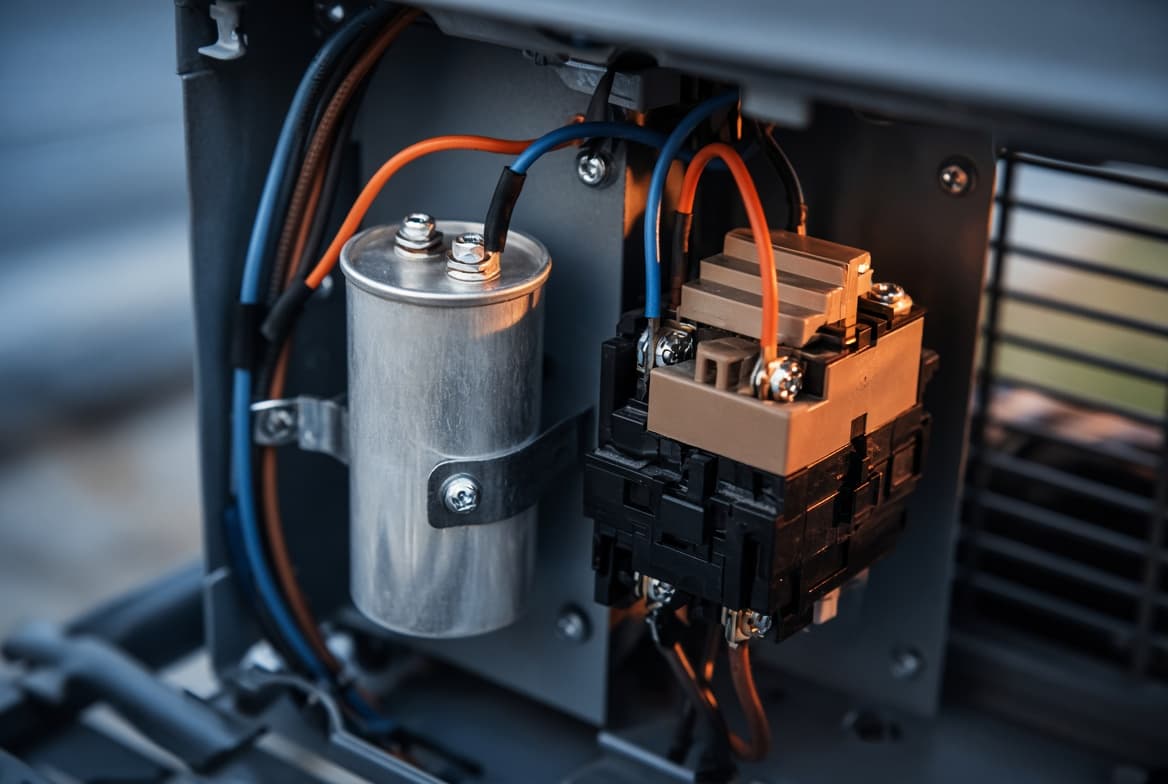
A failing AC capacitor, a pitted contactor that chatters, loose wire connections, or a low-voltage wire with a short can all make the outdoor unit start and stop erratically. These need a meter and a technician because the outdoor unit runs on 240 volts.
Undersized ducts or a restrictive system
Restricted ductwork raises pressure and reduces airflow. It can cause freezing and safety trips, and it's common on systems where a larger unit was installed on old ducts.
How Technicians Fix Compressor Short Cycling
To fix compressor short cycling, a technician matches the repair to the cause:
- Dirty condenser coil. The coil is cleaned, so the compressor stops tripping on heat or high pressure.
- Low refrigerant. The leak is found and repaired, then the system is charged by superheat or subcooling. A top-off alone is not a fix.
- Weak capacitor or pitted contactor. The part is tested against its rating and replaced.
- Overheating compressor. Supply voltage and amp draw are checked. A hard start kit is added only after diagnosis, and the capacitor guide linked above covers that part.
- Pressure switch trips. The cause is found. Switches are never bypassed.
- Oversized system. The thermostat cycle rate and placement can be adjusted as a stopgap. The real fix is correct sizing, or a two-stage or variable-speed unit at replacement.
Why Short Cycling Matters
- Compressor wear. Starting is the hardest moment for a compressor, contactor and capacitor. More starts mean faster wear.
- Humidity. The coil needs several minutes of running before it removes much moisture. Short runs leave the house clammy.
- Energy use. A system that starts repeatedly spends more of its time at inefficient startup conditions.
- Uneven comfort. Rooms far from the thermostat never get a full cycle's worth of air.
What Not to Attempt Yourself
- Don't open the outdoor electrical panel unless the disconnect is off and you know how to verify zero voltage and discharge a capacitor.
- Don't add refrigerant. It requires EPA Section 608 certification, and low charge means a leak.
- Don't jumper the pressure switches, float switch or thermostat to keep the unit running.
- Don't use a pressure washer on the condenser coil.
- Turn the system off if you hear grinding or loud clicking, smell burning, or the breaker trips.
If the unit eventually stops starting at all, see AC unit not turning on. If it runs but doesn't cool well, the AC not cooling troubleshooting guide covers the next steps.
What to Ask the Technician
- What shut the system off each time: the thermostat, a pressure switch, the compressor overload or a float switch?
- What were the refrigerant pressures, superheat and subcooling?
- What did the capacitor read against its rating, and what condition is the contactor in?
- Is the system sized correctly for the house?
- Is the thermostat location or setup part of the problem?
Frequently Asked Questions
What causes AC short cycling?
The most common causes are a clogged filter or frozen coil, a thermostat placed near a supply register or heat source, an oversized air conditioner, low refrigerant from a leak, a dirty outdoor coil making the compressor overheat, and electrical faults such as a failing capacitor, a worn contactor or a loose wire. A tripping condensate float switch can also make the whole system stop and start.
How many times per hour should an AC cycle?
There's no single correct number, because it depends on the weather, the house and the equipment. Many thermostats are set up to allow about three cooling cycles per hour for a single-stage air conditioner, and a common rule of thumb is a run of roughly 10 to 20 minutes on a warm day. Runs of only a few minutes, repeated many times an hour, point to a problem.
Can a dirty air filter cause short cycling?
Yes. A clogged filter starves the indoor coil of air, which can freeze it and trip safety controls, and it makes the whole system work harder. Replacing the filter is the first thing to try when an AC starts turning on and off frequently.
Is short cycling bad for my AC?
Yes. Every start puts the most electrical and mechanical stress on the compressor, contactor and capacitor, so frequent starts wear them out sooner. Short runs also remove less humidity, leaving the house cool but clammy, and starting repeatedly uses more energy than running steadily.
Can low refrigerant cause short cycling?
Yes. Low refrigerant can trip the low pressure switch, which stops the compressor until the pressure recovers, then lets it restart. It can also freeze the indoor coil. Low refrigerant means there's a leak, which needs finding and repairing by an EPA-certified technician.
How do I stop my AC from short cycling?
Replace the filter, open every vent, clear debris from around the outdoor unit, check that the thermostat isn't in a supply air stream or direct sun, and check for ice on the copper lines. If it still short cycles, a technician needs to check refrigerant pressures, electrical parts and the system's size compared with the house.