
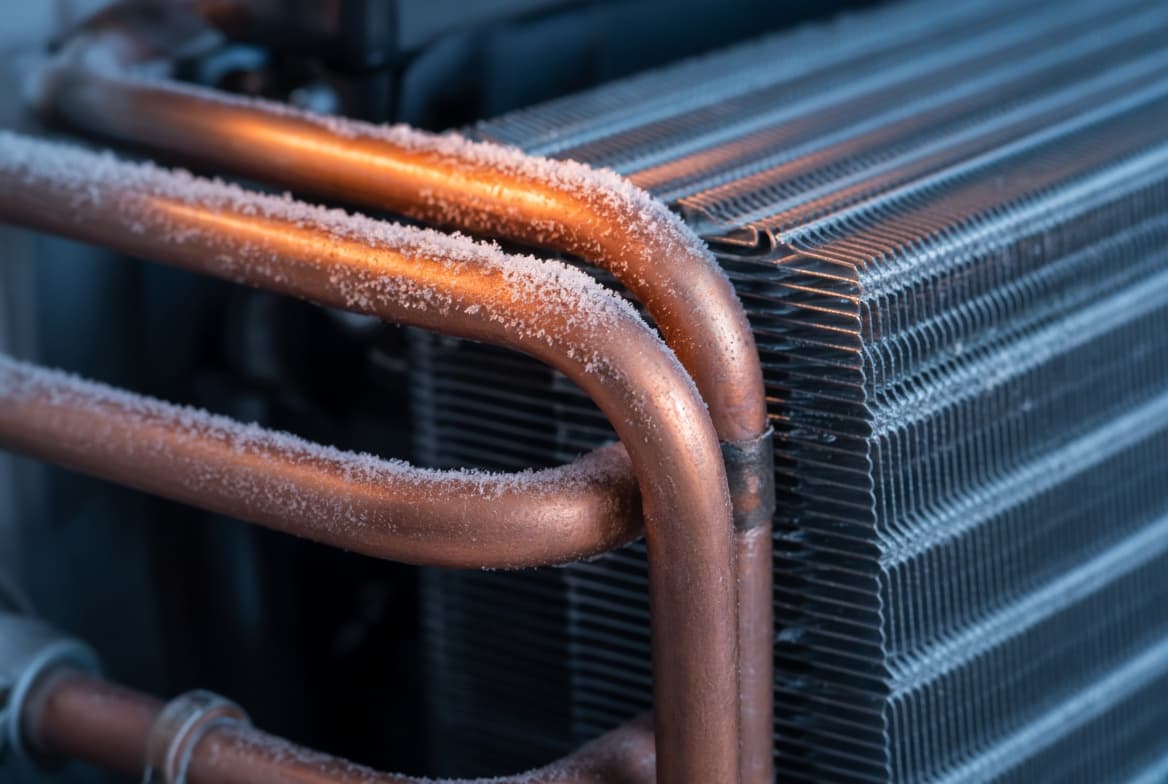
An AC freezing up means the indoor evaporator coil has dropped below 32 degrees F, so the moisture it pulls out of the air freezes on the coil instead of draining away. The ice then spreads along the copper refrigerant lines, sometimes all the way to the outdoor unit. The two main causes are weak airflow across the coil and low refrigerant from a leak. Turn the cooling off, run the fan to thaw it, replace the filter, and if it freezes again, it needs a technician.
Why an Air Conditioner Freezes
Your AC's evaporator coil normally runs a little above freezing. Warm house air blowing across it keeps it there while refrigerant inside the coil absorbs the heat. Moisture condenses on the cold fins and drips into the drain pan.
Two things can push the coil below freezing:
- Too little heat reaching the coil. If not enough warm air moves across it, the refrigerant has less heat to absorb, and the coil gets colder. This is an airflow problem.
- Too little refrigerant pressure. When the system is low on refrigerant, the pressure in the coil drops, and lower pressure means lower temperature. This is a refrigerant problem, and it almost always means a leak.
Once a thin layer of frost forms, it insulates the coil and blocks airflow even more, so ice builds on itself. A frozen AC unit can go from a little frost to a solid block in a day.
Quick Fix for an AC Freezing Up: How to Thaw It Right Now
- Turn cooling off. Set the thermostat to OFF. Running a frozen system can push liquid refrigerant back toward the compressor, which can damage it.
- Run the fan. Set the fan to ON (with cooling off). Moving room air across the coil speeds up the thaw.
- Protect against water. As the ice melts, the drain pan fills fast. Put towels around the indoor unit, and if it's in an attic, check the secondary pan. Make sure the drain line is flowing. See clogged AC drain line if water backs up.
- Don't chip or scrape the ice. Coil fins and tubing are thin and puncture easily.
- Wait. Usually a few hours. Heavy ice can take most of a day. The copper lines outside should be dry and ice-free before you restart.
- Replace the filter and open every supply register and return while you wait.
- Restart and watch. Run cooling and check the large copper line and the coil (if visible) after 30 to 60 minutes. If frost starts forming again, turn it off and book a technician.
Where Is the Ice? What the Location Tells You
Most guides treat "ice on the AC" as one symptom. Where the ice sits is actually a useful clue.
| Where you see ice | What it usually means | Likely cause |
|---|---|---|
| Indoor coil, and the large insulated copper line leaving it | Evaporator coil running below freezing | Airflow restriction or low refrigerant |
| Large copper line at the outdoor unit, in summer | Ice from the indoor coil has spread along the suction line | Same as above, more advanced |
| Small, uninsulated copper line only, frosted at one spot | A restriction in the liquid line | Clogged filter drier, kinked line, metering device problem |
| Outdoor coil of a heat pump in winter, light frost | Normal; the defrost cycle clears it periodically | Nothing |
| Outdoor heat pump coil encased in solid ice in winter | Defrost isn't working | Defrost control, sensor, reversing valve; technician |
| Ice only after cool nights or in spring | Running cooling when it's too cool outside | Outdoor temperature below the unit's design range |
Frost at a single point on the small line is a restriction, which is a different repair from a leak. A technician confirms it by measuring the temperature on each side of the suspected spot. If the frost points to a leak or restriction, our AC repair cost guide shows what drives the bill, and choosing an AC repair company covers what to ask before you approve the work.
Common Causes of an AC Freezing Up
Dirty air filter
The most common cause, and the cheapest fix. A clogged filter cuts airflow across the coil. Replace it, and if your system uses a very high-MERV filter that it wasn't designed for, check whether it's too restrictive. See changing your HVAC filter for sizes and schedules.
Closed or blocked vents and returns
Closing registers in unused rooms, or blocking returns with furniture, cuts total airflow. Open them all.
Dirty evaporator coil
Even with a good filter, dust and biological growth build up on the coil over the years, especially if filters were skipped or fit poorly. A matted coil restricts air just like a dirty filter. Cleaning it is a technician job on most systems. See the evaporator coil guide.
Blower problems
A failing blower motor, weak capacitor, dirty blower wheel or slipping belt (on older systems) moves less air. So does a blower set to a low speed meant for heating. If the airflow at the registers feels weaker than it used to, this is a strong suspect.
Duct problems
Crushed, kinked, disconnected or undersized return ducts starve the system of air. Systems installed with too little return air are prone to freezing from day one.
Low refrigerant from a leak
A refrigerant leak drops coil pressure and temperature. Other signs: weak cooling, longer run times, a hissing sound, or oily residue at a joint. Air conditioners don't use up refrigerant, so low refrigerant means a leak. Topping it off without repairing the leak just delays the next freeze. The AC not cooling troubleshooting guide covers other signs of low charge.
Running when it's cool outside
Many central air conditioners aren't designed to cool when outdoor temperatures are low, often somewhere around 60 degrees F or below, unless they have low-ambient controls. At night in spring or fall, the system can freeze even with good airflow and a full charge. Check your manual for the minimum outdoor operating temperature.
Metering device or restriction
A stuck expansion valve or clogged filter drier limits refrigerant flow into the coil and can cause freezing with a normal charge. A technician diagnoses this with pressure and temperature readings.
Why You Shouldn't Keep Running a Frozen AC
- It can't cool. Ice blocks the coil, so you're paying to run the system for no benefit.
- It can damage the compressor. Liquid refrigerant that doesn't boil off in the iced coil can return to the compressor, which is designed to pump vapor.
- It can cause water damage. A big ice load melts all at once and can overflow the drain pan, especially in attics.
- It strains other parts. A freezing system often short cycles as safety switches trip.
What Not to Attempt Yourself
- Don't add refrigerant. Handling refrigerant requires EPA Section 608 certification, and DIY recharge cans sold for cars aren't meant for home systems.
- Don't chip, pick or scrape ice off the coil or lines.
- Don't use a torch or heat gun on the coil or copper lines.
- Don't spray water on an indoor coil with electrical parts nearby.
- Don't remove panels on the indoor unit unless the power is off at the switch or breaker.
- Don't ignore a repeat freeze. If it freezes again within days of a filter change, the cause needs finding.
What to Ask the Technician
- Was it airflow or refrigerant? What were the static pressure and refrigerant readings?
- If refrigerant was low, where is the leak, and was it repaired or only recharged?
- What condition is the evaporator coil in?
- Is the blower set to the right cooling speed?
- Is the return duct sized correctly for the system?
If the system won't start at all after thawing, see AC unit not turning on. A float switch tripped by meltwater is a common reason.
Frequently Asked Questions
Why is my AC freezing up?
An AC freezes when the indoor evaporator coil drops below 32 degrees F and the moisture it pulls from the air turns to ice. The two main causes are not enough warm air moving across the coil, from a dirty filter, closed vents, a dirty coil or a weak blower, and low refrigerant from a leak. Running the AC when it's cool outside can also do it.
How long does it take a frozen AC to thaw?
Usually a few hours with the cooling off and the fan on, but a heavily iced coil can take most of a day. Don't restart cooling until all the ice on the coil and the copper lines is gone, and check that the drain pan isn't overflowing as it melts.
Can I pour hot water on a frozen AC?
Don't. Hot water on an indoor coil can soak electrical parts and insulation and overflow the drain pan, and chipping or scraping ice can puncture the thin coil tubing. Turn cooling off, run the fan, and let the ice melt on its own. A hair dryer on a low setting is sometimes used on exposed outdoor lines, but patience is safer.
Should I turn off my AC if it's frozen?
Yes. Switch the thermostat from COOL to OFF, or set it to fan only. A frozen coil can't cool the house, and continued running can send liquid refrigerant back to the compressor, which can damage it. Running just the fan helps the ice melt faster.
Can low refrigerant cause my AC to freeze?
Yes. With too little refrigerant, pressure in the evaporator coil drops and so does its temperature, often below freezing. Low refrigerant almost always means a leak, so the fix is finding and repairing the leak, then recharging to the manufacturer's specification. Refrigerant work requires an EPA-certified technician.
Why is there ice on my AC lines outside?
Ice on the larger insulated copper line at the outdoor unit usually means the indoor coil is frozen and the ice has spread along the suction line. Frost on the smaller, uninsulated line points instead to a restriction such as a clogged filter drier or kinked line. Either way, turn cooling off and have the cause found if it returns.
Is it normal for a thawing AC to leak water everywhere?
A lot of water is normal while ice melts, but it should go down the condensate drain. If it overflows the pan, put towels down, check the drain line and float switch, and keep the system off. Water spreading from an attic or closet unit is a reason to call a technician. The AC leaking water guide on this site covers the causes in more detail.