
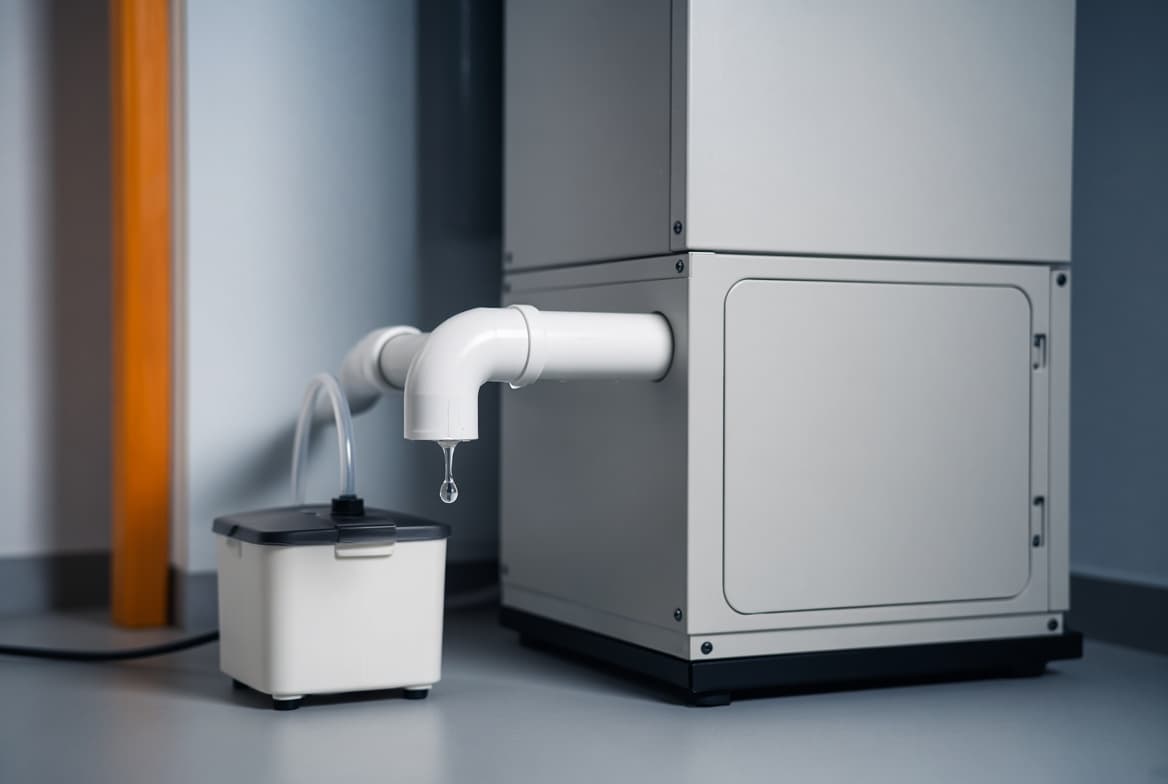
When your AC drain line is clogged, water backs up into the drip pan under the indoor coil until it overflows or trips a float switch that shuts the cooling off. You can usually clear it yourself in about 20 minutes: turn the power off, pull the clog out of the outdoor end with a wet/dry vac, then flush the line from the cleanout near the indoor unit with water and a cup of vinegar. The clog is almost always a slime of algae, mold, and dust, and keeping it away takes five minutes every few months.
If water has already reached a ceiling, wall, or finished floor, start with AC leaking water inside, which covers shutting the system down and tracing the source. This guide is the maintenance job itself.
Signs Your AC Drain Line Is Clogged
- Standing water in the drip pan. A little moisture after a cycle is normal. A pan holding water, or any water in the secondary pan under the unit, is not.
- The AC shuts off on its own or will not start. A float switch opens when water rises and stops the outdoor unit while the thermostat still calls for cooling.
- No drip at the outdoor end. On a humid day with the AC running, a working line drips steadily within 15 to 30 minutes.
- Water from the secondary drain. A pipe dripping from an eave, soffit, or above a window is the backup drain, and it only runs when the primary line is blocked.
- A musty smell at the registers, gurgling at the indoor unit, or rising indoor humidity as the system keeps tripping off.
Where Is the AC Drain Line and Cleanout?
The primary drain leaves the drip pan through a fitting on the coil cabinet, usually on top of a furnace or on an air handler in a closet or attic. It is most often 3/4 inch white PVC. Within a foot or two of the cabinet you will usually find a trap (a U-shaped bend that holds water as a seal), a cleanout or vent tee with a removable cap where you pour in water and cleaner, and on many systems a float switch clipped into the line. A second, slightly higher fitting on the pan is the secondary outlet, piped to its own drain or protected by a float switch.
Where the line ends decides where you work from:
| Where your drain line ends | Where to apply suction | Where to flush |
|---|---|---|
| A PVC stub outside, near the foundation or outdoor unit | The outdoor stub | The cleanout tee |
| A floor drain or utility sink | The open end of the pipe | The cleanout tee |
| A plumbing connection under a sink or into a standpipe | Usually not practical; flush only | The cleanout tee |
| A condensate pump | Not needed; clean the pump reservoir instead | The cleanout tee, watching that the pump runs |
For pumps, see how a condensate pump works and fails.
How to Unclog an AC Drain Line Step by Step
You need a wet/dry vac, a towel or duct tape, a funnel, warm water, distilled white vinegar or an approved cleaner, a flashlight, and a bucket.
- Turn the system off at the thermostat, then switch off the breaker or the service switch on the furnace or air handler. You will be working around water next to electrical parts.
- Remove standing water from the pans with the vac or towels.
- Clear the outdoor end of grass, mulch, mud, or insect nests. Mud dauber nests and spider webs are common culprits.
- Vacuum from the outdoor end. Remove the vac's paper filter or fit a wet filter. Seal the hose over the stub with a damp towel or duct tape and run it for one to two minutes. Repeat until you pull out a slug of slime or a rush of water.
- Open the cleanout near the indoor unit and look in. A flexible condensate line brush can reach slime near the top.
- Flush with water. Pour warm water slowly through a funnel while someone watches the outdoor end. If it backs up in the tee, vacuum again.
- Treat the line. Pour in about a cup of vinegar (or the approved cleaner, per its label), wait about 30 minutes, and flush again with water.
- Reset and test. Recap the cleanout if your system uses a cap, restore power, and run cooling. A tripped float switch usually resets once the water drains past it; some have a reset button. Confirm the outdoor end drips within half an hour on a humid day.
What Not to Do
- No compressed air or CO2 cartridges. They can blow apart a glued joint hidden in a wall or attic, or push the clog back toward the pan and coil.
- No garden hose at full pressure into the cleanout. Water that cannot get past the clog goes into the pan.
- No caustic chemical drain openers made for sinks and toilets.
- No metal plumbing snake through PVC fittings; a flexible condensate brush is fine.
- Never tape down, jumper, or remove the float switch to get the system running.
Vinegar, Bleach, or a Commercial Cleaner?
Distilled white vinegar is the common choice because it kills biofilm without being harsh on PVC. Commercial condensate line cleaners also work; use one your equipment maker approves, or plain warm water if the manual allows nothing else.
Bleach is where advice splits. It works, and many technicians use it diluted, but some manufacturers discourage it because chlorine can corrode galvanized pans, copper, and the aluminum fins of the coil. Check the owner's manual for your indoor unit. Whatever you use, keep it out of the coil, flush with water afterward, and never mix cleaners: bleach and vinegar release chlorine gas, and bleach and ammonia-based products release chloramine vapor. Flush with water between products.
The AC Drip Pan: What It Does and How to Check It
The AC drip pan catches the water that falls off the evaporator coil and feeds it into the drain line. Most systems in attics or above finished ceilings have two pans.
| Primary drip pan | Secondary (auxiliary) drip pan | |
|---|---|---|
| Where it is | Inside the coil cabinet, under the coil | Under the whole furnace or air handler |
| Can you see it | Usually not without removing an access panel | Yes |
| Should it hold water | A thin film or a few drops after a cycle | Never. Any water means the primary side failed |
| Drains to | The primary drain line | Its own drain line, or protected by a float switch |
| Common failures | Rust-through, cracks, poor pitch | Rust, a clogged or disconnected drain, an untested float switch |
Rust and Cracks
Older galvanized steel pans rust through; newer plastic pans can crack or warp with age and heat. Rust flakes in the drain line, rust streaks on the cabinet, or a leak while the line flows freely all point to the pan. A rusted secondary pan can be replaced or temporarily sealed, but a failed primary pan usually means pulling the coil, which is covered under evaporator coil problems and replacement.
Do AC Pan Tablets Work?
Pan tablets release a biocide that keeps slime from forming, and they help in the primary pan, where condensate flows over them. A tablet dropped in the secondary pan does almost nothing, because water only reaches that pan after something has already failed. If you cannot reach the primary pan, drain line tablets made to sit in the cleanout tee do the same job. Keep tablets away from the drain opening so an undissolved piece cannot block it, and check your manual, since some manufacturers limit what goes in the pan.
Float Switches
A float switch is a small sensor wired into the 24 volt control circuit, mounted in the secondary pan, in the primary pan's overflow outlet, or in a tee on the drain line. When water lifts the float, the switch opens and the cooling call stops.
Test it each season. With the system cooling, lift the float on a line-mounted switch, or pour water into the secondary pan until the float rises. The outdoor unit should stop within seconds. If it keeps running, the switch is not wired or not working, and that needs a technician before the next clog.
Prevention Schedule: An AC Drain Line Checklist
| When | Task |
|---|---|
| Every filter change | Look in the secondary pan and at the float switch, and confirm the outdoor end drips while cooling |
| Start of cooling season | Vacuum the outdoor end, flush with water and vinegar, test the float switch, clear the outdoor opening |
| Every 1 to 3 months while cooling | Pour a cup of vinegar into the cleanout and flush with water; monthly in hot, humid climates |
| End of cooling season | Flush the line and check the pan area for rust or cracks |
| Yearly tune-up | A technician vacuums the line, cleans the pan, checks pitch and trap, and tests the float switch |
The full seasonal routine is in the AC unit maintenance checklist, and the professional side is covered under annual AC maintenance and tune-up.
Why Does My AC Drain Line Keep Clogging?
A line that clogs again within weeks of a good cleaning usually has an installation problem.
| Problem | What you notice | Fix |
|---|---|---|
| Not enough slope | Line sags between supports or runs level in the attic | Re-hang it. Model codes call for at least 1/8 inch of drop per foot, and many installers use 1/4 inch |
| Missing or dry trap on a draw-through unit | Pan will not drain even with a clear line | Add a trap per the manufacturer's instructions, and prime it with water each spring |
| No vent, or a vent in the wrong place | Slow, gurgling drainage | Add a vent after the trap, per the unit's instructions |
| Dirty filter or coil | Lots of dust and fibers in what you vacuum out | Change filters on schedule and have the coil cleaned |
| Undersized or crushed line | Line narrower than the pan outlet, or flattened tubing | Re-pipe at full size, at least 3/4 inch for most systems |
| Blocked termination | Mulch, soil, or insects at the outdoor stub | Raise or relocate the end and keep it clear |
| Line feeds a dirty condensate pump | Pump reservoir full of sludge | Clean the pump on the same schedule |
The trap confuses a lot of homeowners. On a draw-through air handler, where the blower pulls air across the coil, the drip pan sits under negative pressure. Without water sealing a trap, the blower sucks air up the drain and holds condensate in the pan until it overflows, even with a perfectly clear pipe. A vent belongs on the outlet side of the trap; an open tee between the pan and the trap lets the blower pull air through it and defeats the trap. On a furnace with the coil on top, the coil is on the pressure side of the blower, so a missing trap blows air out of the drain instead. Either way, follow the coil or air handler's installation instructions.
When to Call a Pro
Bring in an HVAC technician when:
- The line clogs again within a few weeks of a thorough cleaning
- The pan is rusted through, cracked, or holds water with a clear drain line
- The float switch does not stop the system when tested, or an attic unit has no overflow protection
- Water reached drywall, insulation, or a ceiling, or you suspect a broken joint inside a wall
- The air handler sits in an attic you cannot move around in safely
Ask the technician to show you the pitch and trap and to test the float switch in front of you. Clearing a drain is usually one of the cheaper service calls; attic access, re-piping, a new float switch, or a pan replacement raise the bill.
Frequently Asked Questions
How do I know if my AC drain line is clogged?
The clearest signs are standing water in the drip pan, an AC that shuts itself off or will not start because a float switch tripped, and no water dripping from the outdoor end of the drain on a humid day while cooling. A musty smell at the vents and water from a secondary drain pipe point the same way.
Can I pour vinegar down my AC drain line?
In most systems, yes. Pour a cup of distilled white vinegar into the cleanout near the indoor unit, wait about 30 minutes, then flush with water. Check your owner's manual first, since a few manufacturers allow only water or a specific cleaner, and never mix vinegar with bleach or any other cleaner.
Is it OK to put bleach in an AC drain line?
Many technicians use diluted bleach, but some manufacturers discourage it because chlorine can corrode metal parts such as galvanized pans and aluminum coils. Vinegar or a manufacturer-approved cleaner is the safer default. If you use bleach, dilute it, keep it out of the coil, flush with water afterward, and never combine it with vinegar, ammonia, or another cleaner.
How often should you clean your AC drain line?
Flush it at the start of every cooling season and check it each time you change the air filter. In hot, humid climates, flush it every one to three months while the AC is running. A yearly tune-up should include vacuuming the line and inspecting the pan.
Should there be water in my AC drip pan?
A thin film or a few drops in the primary pan right after a cooling cycle is normal. Water covering the bottom of the pan, water that stays after the system has been off a while, or any water in the secondary pan means the drain is slow or blocked.
Can a clogged AC drain line stop the AC from cooling?
Yes. Most systems have a float switch that cuts the cooling call when water backs up, so the outdoor unit stops even though nothing else is wrong. Once the line is cleared and the water drains past the float, the system usually restarts on its own.