
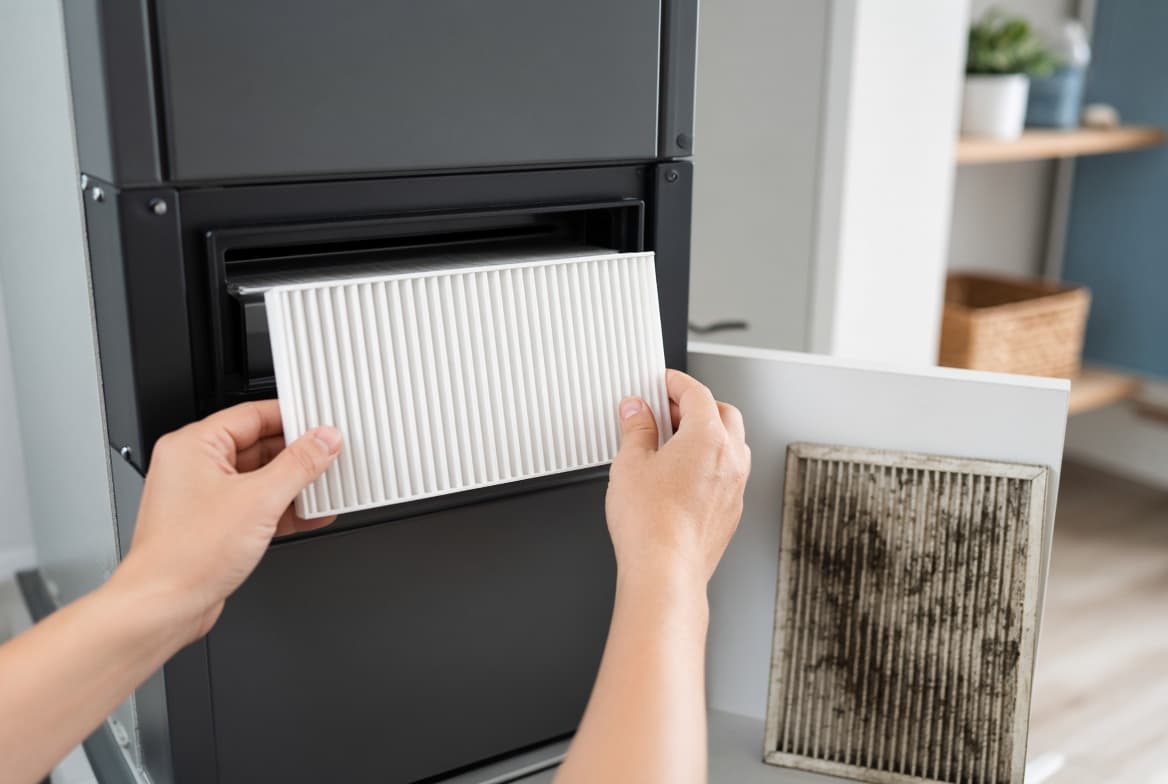
Professional AC maintenance is an annual visit where a technician cleans the parts that lose efficiency, tests the parts that fail, and records readings that show how the system is performing. A real tune-up includes cleaning the outdoor coil, flushing the condensate drain, testing the capacitor and motors, tightening electrical connections and checking the refrigerant charge, and you should get those readings in writing. This guide covers what a proper tune-up includes, how to judge one, and when maintenance stops being worth it. For the jobs you can do yourself between visits, see our DIY AC unit maintenance checklist.
What Does a Professional AC Tune-Up Include?
A full tune-up on a central split system covers both the outdoor condenser and the indoor air handler or furnace. Expect most of these items:
Outdoor unit
- Shut off power at the disconnect, remove the top or panels as needed, and clean the condenser coil with water and, if needed, a coil cleaner. Straighten bent fins.
- Clear debris from the base and check the condenser fan blade and motor.
- Test the run capacitor against its rated value.
- Inspect the contactor for pitted or burnt points.
- Tighten electrical connections and look for heat damage on wires.
- Measure amp draw on the compressor and fan motor and compare it with the nameplate.
Indoor unit
- Replace or check the air filter.
- Inspect the evaporator coil where accessible, and the blower wheel for dust buildup.
- Flush the condensate drain line, check the drain pan, and test the float switch.
- Check blower motor amp draw and, on better visits, measure external static pressure to judge duct and filter restriction.
System performance
- Check the refrigerant charge using superheat or subcooling, not just a quick glance at the gauges.
- Measure the temperature drop between return and supply air. A split of roughly 15 to 20 degrees F is a common rule of thumb, and readings well outside it need an explanation.
- Confirm the thermostat cycles the system correctly.
- Write it all up: readings, findings and recommended repairs, dated and signed.
A typical visit on a single system takes roughly an hour to an hour and a half. A tech who is in and out in 20 minutes didn't do most of the list.
What a Tune-Up Can Find: Findings and Their Causes
The value of a tune-up is in what it catches. These are the findings a good technician reports and what usually causes them.
| Finding at the tune-up | Likely cause | What it means for you |
|---|---|---|
| Capacitor reads below its rated value | Heat and age wearing down the capacitor | Replace now; it's the most common cause of a mid-summer no-cooling call |
| Pitted or burnt contactor points | Normal wear from cycling, insects in the contactor | Replace before it sticks or stops closing |
| High amp draw on the condenser fan motor | Worn bearings, failing motor, weak capacitor | Motor may fail soon; plan the repair |
| Refrigerant charge low | A leak somewhere in the system | Needs leak search and repair, not just a top-off |
| Temperature split too low | Low charge, dirty coil, too much airflow | Further diagnosis needed |
| Temperature split too high, coil very cold | Restricted airflow: dirty filter, dirty coil, closed vents, weak blower | Fix airflow before the coil freezes |
| Slime or standing water in the drain pan | Algae biofilm in the condensate line | Flush now (how to unclog an AC drain line); see AC leaking water inside |
| Rust in the pan or on the coil | Age, constant moisture | Watch closely; pan or coil replacement may be coming |
| Burnt or discolored wire insulation | Loose connection overheating | Repair now; it's a fire and failure risk |
| High static pressure | Undersized ducts or return, restrictive filter, dirty coil | Airflow problem that shortens equipment life |
If a tune-up finds nothing on a system more than a few years old and lists no readings, that's a sign it wasn't thorough.
What You Can Do Between Visits, and What to Leave Alone
Homeowner maintenance is short: replace the filter on schedule, keep about two feet of clearance around the outdoor unit, rinse loose debris off the outside of the condenser coil with a garden hose (power off at the disconnect, no pressure washer), keep supply and return vents open, and flush the condensate line with vinegar early in the season. The DIY AC unit maintenance checklist covers these step by step.
Leave the following to a technician:
- Anything inside the electrical panel. Capacitors can hold a dangerous charge even with the power off, and the contactor carries 240 volts.
- Refrigerant. Checking and adding refrigerant requires gauges, training and EPA Section 608 certification. DIY "recharge kits" sold for cars don't belong on a home system.
- The indoor coil and blower. Pulling sealed panels and cleaning the coil in place can damage fins and disturb the drain pan.
How Much Does AC Maintenance Cost?
A standalone tune-up is one of the cheapest services an HVAC company sells, which is exactly why some companies use it as a loss leader to find repairs. What changes the price:
- System type and count. Two systems, a heat pump, or a multi-zone mini split take longer than a single central AC.
- Scope. A full checklist with charge verification and written readings takes more time than a visual check.
- Condition. A coil that hasn't been cleaned in years, or a badly clogged drain, adds time.
- Access. Attic air handlers in summer and rooftop units cost more to service.
- Maintenance plans. Annual plans bundle visits, sometimes with a repair discount or scheduling priority. They're worth it only if the visits are thorough.
- Add-ons. Refrigerant, capacitors, UV lights and duct cleaning are separate charges.
For typical tune-up prices and what maintenance plans cost, see our AC tune-up cost guide.
AC Maintenance and Your Warranty
Many manufacturer warranties exclude damage caused by lack of maintenance, and some require proof of regular professional service to approve a claim. The longer parts warranty terms often also depend on registering the equipment shortly after installation. Requirements vary by brand and model, so read your own warranty document rather than relying on a general rule.
Keep every dated service report with the readings, plus the original installation paperwork. If the compressor or coil fails under warranty, those records are what the claim rests on. A home warranty HVAC coverage plan is a separate product with its own maintenance exclusions, so check those terms too.
When Maintenance Stops Paying: Repair or Replace?
Annual maintenance makes the most sense on a system in the first two-thirds of its life. Central air conditioners typically last about 12 to 17 years, and some reach 20, as our guide to how long an AC unit lasts explains. As a system ages past that, tune-ups keep finding the same things: a leak that keeps coming back, a corroded coil, a compressor drawing high amps, a pan that's rusting out. At that point, maintenance is just documenting decline.
Start planning replacement when:
- The system is past about 15 years old and the tune-up turns up a major repair.
- It uses R-22 refrigerant (US production ended January 1, 2020) and needs refrigerant.
- A repair would cost more than about half the price of a new system (the 50 percent rule).
- The same leak or failure keeps coming back.
- It no longer keeps the house comfortable on hot days even when it's working correctly.
Our guide to AC installation and replacement explains what to expect. For repairs on a system still worth keeping, see AC repair by symptom.
How to Judge an AC Maintenance Contractor
The biggest difference between a real tune-up and a "filter swap special" is what's on paper at the end. Questions to ask before booking:
- What's on your tune-up checklist? Can I see it?
- Will you clean the outdoor coil and flush the drain line, or only inspect them?
- How do you check the refrigerant charge?
- Will I get a written report with the capacitor reading, amp draws, temperature split and charge readings?
- What does your maintenance plan include, and is anything billed separately?
Red flags:
- A very low-priced "tune-up" that's really a filter change and a sales visit.
- No written checklist or readings.
- Recommending refrigerant on every visit without a leak search.
- Finding a long list of urgent repairs on a system that was working fine, with pressure to approve them before the tech leaves.
- Pushing replacement during a maintenance call on a system with no real problem.
A second opinion is reasonable any time a tune-up turns into a large repair quote. If you have a furnace or heat pump too, whole-system HVAC maintenance covers the heating side.
Frequently Asked Questions
What does a professional AC tune-up include?
A real tune-up includes cleaning the outdoor condenser coil, checking the indoor coil and blower, flushing the condensate drain and testing the float switch, testing the capacitor and measuring motor amp draw, inspecting and tightening electrical connections, checking the refrigerant charge by superheat or subcooling, measuring the temperature drop across the coil, and handing you a written report with the readings.
How often should an AC be professionally serviced?
Once a year for a central air conditioner, ideally in spring before the first heat. Heat pumps run year-round, so many manufacturers and technicians recommend two visits a year, one before cooling season and one before heating season.
Is AC maintenance really worth it?
For most central systems, yes. A tune-up catches weak capacitors, dirty coils, clogged drains and slow refrigerant leaks before they cause a breakdown, and it keeps a record that some manufacturer warranties expect. It stops paying when the system is near the end of its life and needs major repairs every season.
Does an AC tune-up include a refrigerant recharge?
No. A tune-up checks the refrigerant charge but shouldn't need to add any. An AC is a sealed system, so low refrigerant means a leak. Adding refrigerant without finding the leak is a separate repair and should be quoted as one.
Does skipping AC maintenance void the warranty?
It can. Many manufacturer warranties exclude failures caused by lack of maintenance, and some require proof of regular professional service. Read your warranty terms and keep every dated service report in case you need to file a claim.