
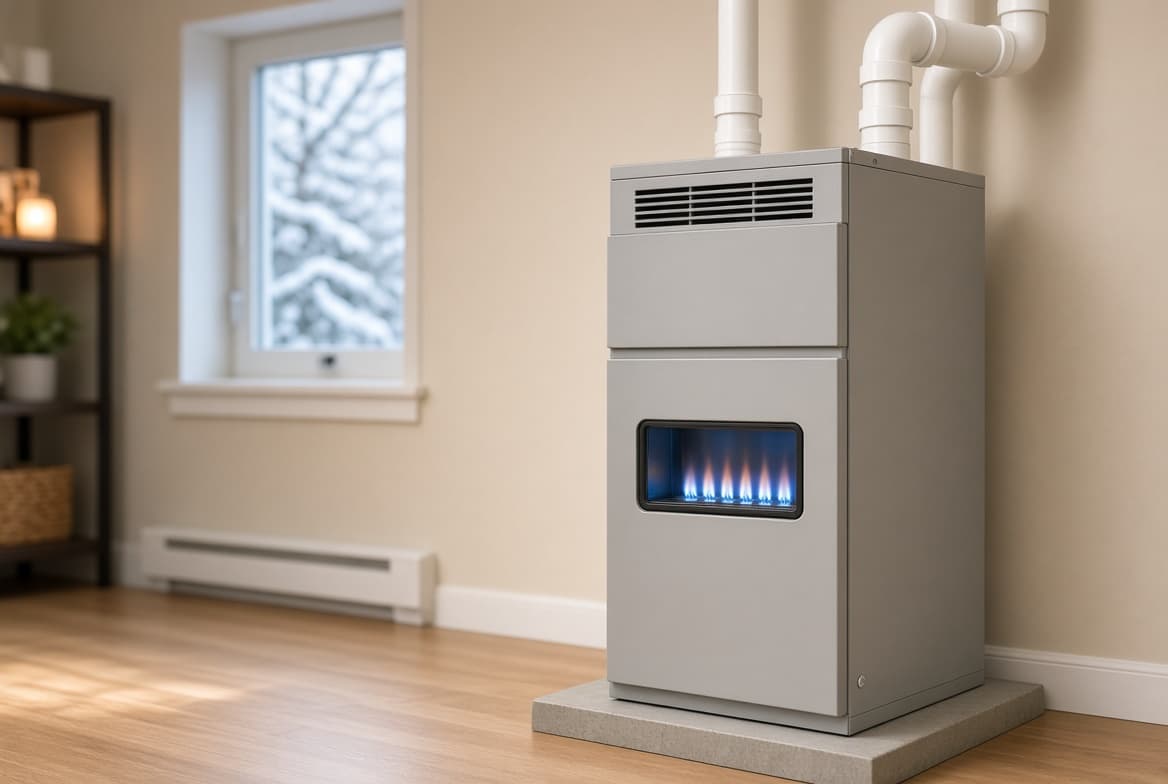
An electric furnace heats your home by running current through resistance heating elements and blowing house air across them into your ducts. Nothing burns, so there is no gas line, no flue and no carbon monoxide at the furnace. It turns essentially all the electricity it uses into heat, yet it usually costs more to run than a gas furnace or a heat pump, because it gets only one unit of heat from each unit of electricity.
That makes it the cheapest forced-air heater to install and, in most markets, one of the most expensive to operate. Below: how it works, the operating cost math with your own rates, gas vs electric, sizing in kilowatts, and when a heat pump is the better spend.
How an Electric Furnace Works
When the thermostat calls for heat, a low-voltage signal starts this sequence:
- Sequencers or relays close. These switch 240-volt power to the elements. A sequencer is a timed switch: a small heater warms a bimetal disc, which closes the contacts after a delay. Elements come on in stages, seconds apart, so the full load never hits your panel at once.
- The elements heat up. Each is a coil of resistance wire, commonly around 5 kW, and furnaces stack several. Output is the sum of the elements that are on.
- The blower moves air from the return ducts, through the filter, across the elements, and out to the supply ducts.
- Safeties watch the temperature. A limit switch opens if the elements run too hot, usually from restricted airflow. Many units add a one-time fusible link as a last line of defense.
- Shutdown is staged too. Elements drop out and the blower runs on briefly to clear residual heat.
Newer furnaces may use a control board and relays instead of bimetal sequencers, but the idea is the same.
When an Electric Furnace Makes Sense
An electric furnace is a reasonable choice when several of these are true:
- No natural gas at the street, or extending a line and adding venting would cost more than the furnace.
- Mild winters. A short heating season means little heat bought each year, so a higher price per unit matters less.
- Low upfront budget. No venting, gas piping or combustion parts keeps installation simple. Most published cost guides put a straightforward installed replacement in roughly the $1,500 to $3,500 range, before any new circuits or panel upgrade.
- Low electricity rates compared with local gas or propane.
- Condos, apartments and manufactured homes, where a flue is impractical.
- Backup heat. In a heat pump system, the same elements serve as backup and emergency heat in an air handler.
It makes the least sense in a cold climate with a long heating season and gas available, where the yearly gap in operating cost adds up fast.
How Much Does an Electric Furnace Cost to Run?
Every kilowatt-hour through an electric furnace becomes 3,412 BTU of heat, 100 percent efficient at the point of use. What matters is what that heat costs next to the alternatives, and your own bills answer it.
Step 1: Find your all-in rates. Divide the total on a winter electric bill (delivery charges included) by the kWh used. Do the same for gas in dollars per therm, or propane in dollars per gallon.
Step 2: Convert each to cost per million BTU of delivered heat.
| Heat source | Cost per million BTU delivered |
|---|---|
| Electric furnace | price per kWh × 293 |
| Heat pump | price per kWh × 293 ÷ COP |
| Gas furnace | price per therm × 10 ÷ AFUE |
| Propane furnace | price per gallon × 10.9 ÷ AFUE |
COP is a heat pump's coefficient of performance, units of heat per unit of electricity: often 3 or more in mild weather, lower in the cold. AFUE is a furnace's efficiency as a decimal, such as 0.95.
Step 3: Compare. Say your bills work out to 15 cents per kWh and $1.50 per therm. These are example numbers, so use your own.
- Electric furnace: 0.15 × 293 = about $44 per million BTU
- 95 percent gas furnace: 1.50 × 10 ÷ 0.95 = about $16 per million BTU
- Heat pump averaging a COP of 2.5: 44 ÷ 2.5 = about $18 per million BTU
In that example, resistance heat costs roughly two and a half to three times as much as gas or the heat pump. Your ratio will differ, but the shortcut is simple: multiply your price per kWh by about 28. If your gas costs more per therm than that, an electric furnace is cheaper to run than a 95 percent gas furnace. With an 80 percent furnace, the multiplier is about 23.
For a cost per hour, multiply the kW that are on by your rate. A 15 kW furnace with every element on uses 15 kWh per hour, plus a little for the blower.
Ducts in an attic or crawl space lose some heat before it reaches a room, which pushes real bills above the math.
Gas Furnace vs Electric Furnace
| Factor | Electric furnace | Gas furnace |
|---|---|---|
| How it heats | Resistance elements | Burns natural gas or propane, heat exchanger |
| Efficiency rating | About 100 percent at the point of use | New units roughly 80 to 98 percent AFUE |
| Cost to run | Usually higher; depends on local rates | Usually lower where gas is available |
| Cost to install | Lower: no flue, gas line or combustion parts | Higher: venting, gas piping, combustion air |
| Supply air feel | Cooler air, longer run cycles | Warmer air, faster recovery |
| Electrical needs | Large 240-volt circuits, can require a panel upgrade | A 120-volt circuit for the blower and controls |
| Combustion safety | No flame, no flue, no carbon monoxide at the unit | Needs correct venting, CO alarms and yearly checks |
| Maintenance | Filter, blower, electrical connections | Adds burner, ignition, flame sensor and vent checks |
| Typical lifespan | Commonly cited at 20 to 30 years | Commonly 15 to 20 years |
| During a power outage | No heat without a very large generator | No heat either, but a small generator can run it |
The outage row is easy to overlook. A gas furnace needs only a few hundred watts for its blower and controls. A 15 kW electric furnace alone needs more than any portable generator delivers and a large share of a whole-house standby unit.
If you are still choosing between forced air and hot water heat, the boiler vs furnace comparison covers that decision.
Sizing an Electric Furnace in kW
One kilowatt of electric heat equals about 3,412 BTU per hour. Size from your home's heat loss at your local winter design temperature, then convert:
| Furnace size | Heat output (BTU/hr) | Element current at 240 volts |
|---|---|---|
| 5 kW | about 17,000 | about 21 amps |
| 10 kW | about 34,000 | about 42 amps |
| 15 kW | about 51,000 | about 63 amps |
| 20 kW | about 68,000 | about 83 amps |
| 25 kW | about 85,000 | about 104 amps |
Add the blower motor on top. Three points catch people out:
- Square footage rules are rough. A heat loss calculation (Manual J) accounts for insulation, windows, air leakage and climate. Oversizing wastes little energy thanks to staging, but it means bigger wire, breakers and panel capacity than you need.
- 208-volt service cuts output. Many apartments and condos get 208 volts. Resistance output falls with the square of voltage, so a 240-volt rating shrinks to about 75 percent on 208.
- Your panel has to carry it. Electric heat counts as a continuous load, so circuits are sized at 125 percent of the heater's current, and the code requires large heaters to be split into smaller protected circuits. On a 100-amp service with an electric range, dryer and water heater, it may not fit without a service upgrade. An electrician's load calculation settles it.
Electric Furnace Installation: What the Job Involves
Electric furnace installation is mostly an electrical job. These are the pieces:
- Circuits. Larger kW furnaces need dedicated 240-volt circuits, often more than one, sized to the heating elements. Check panel capacity before anything else, since an older 100-amp panel may not have room.
- Disconnect and wiring. The unit needs a disconnect, the correct wire size, and the clearances in the installation manual.
- Air side. A filter rack and duct connections. There is no flue or gas line.
- Pairing with AC or a heat pump. The coil has to match, and thermostat staging should be set so the elements run only when needed. The heat pump section below covers that pairing.
- Permit and inspection. Expect both. Installed cost commonly falls in the $1,500 to $3,500 range before new circuits or a panel upgrade.
The furnace installation guide linked near the end of this page covers permits and how to compare bids.
Common Electric Furnace Problems
Most electric furnace failures are electrical, not mechanical.
| Symptom | Likely cause | Who handles it |
|---|---|---|
| Blower runs but air is lukewarm | One or more open elements, a sequencer stage not closing, or one element breaker tripped | Check the furnace breakers once. Element and sequencer testing is a technician job |
| No heat and no blower | Main breaker off, blower door switch not pressed, blown control fuse, failed transformer, thermostat | Breaker, door and thermostat are yours. The rest needs a meter |
| Breaker trips when the heat starts | Shorted element, loose or burned terminal, a worn breaker | Reset once. If it trips again, leave it off and have it inspected |
| Heat shuts off after a few minutes | Limit switch tripping from a dirty filter, closed registers or a weak blower | Change the filter and open registers. A repeat trip needs airflow diagnosis |
| Elements stay on, or the blower never stops | Sequencer or relay stuck closed | Technician. A stuck element relay is a fire risk |
| Burning smell | Dust on the elements at the first run of the season is normal for a few minutes | A smell that persists, or smells like hot plastic, means shut it off at the breaker |
For the broader no-heat checklist, see the furnace not working troubleshooting guide.
What a homeowner should not attempt
An electric furnace carries 240 volts at high current, often on two or three circuits, and the thermostat does not cut that power. Terminals can be live when the house is not calling for heat.
- Do not work inside the cabinet beyond the filter slot. Element and sequencer testing belongs to a technician.
- Do not reset a tripping breaker repeatedly or replace it with a larger one. A breaker that trips is protecting wire from overheating.
- Do not bypass a limit switch or fusible link. They are the only things standing between a blocked filter and an overheated cabinet.
- Know that a PSC blower motor's run capacitor can hold a charge after power is off.
How Long Does an Electric Furnace Last?
Electric furnaces are commonly cited at 20 to 30 years, longer than a typical gas furnace, because there is no heat exchanger exposed to flue gas and condensation. Elements, sequencers, relays, limit switches and the blower motor wear out along the way, and each is replaceable. Whole-unit replacement usually follows repeated repairs or a move to a heat pump.
When a Heat Pump Is the Better Upgrade
A heat pump moves heat instead of making it, delivering two to four units of heat for each unit of electricity in mild weather. The Department of Energy notes that switching from resistance heat to a heat pump can cut heating electricity use by about half. If you already heat with electricity, that is usually the most effective upgrade available.
Signs a heat pump is the better spend:
- Your heating bills are high and you have no gas, or gas is costly where you live.
- Your central AC is near the end of its life. A heat pump replaces it and takes over most of the heating.
- You assumed your winters were too cold. Cold-climate models now hold useful capacity well below freezing.
You may not lose the electric furnace at all. Paired with a heat pump, its elements become backup heat for the coldest hours and for defrost cycles, which is how an air handler with electric heat strips works. Ask for a staged setup or an outdoor temperature lockout so the elements run only when the heat pump cannot keep up. For the basics, see how a heat pump works. If natural gas is also an option at your house, the heat pump vs furnace comparison runs the same cost math against a gas furnace.
An electric furnace by itself still fits when the heating load is tiny, the outdoor unit has nowhere to go, or you expect to move before a heat pump's savings pay back the difference.
What to Ask a Contractor Before Installing One
- What heat loss did you calculate, and at what design temperature?
- What kW size does that support, and is my supply 240 or 208 volts?
- Does my panel have capacity, and what wire, breakers and disconnect does this need?
- Can you quote a heat pump alongside it, with the electric furnace as backup heat?
- What does the manufacturer's warranty cover, and does it require registration?
The furnace installation guide covers permits, the installation process and how to compare bids.
Frequently Asked Questions
Is it expensive to run an electric furnace?
In most of the US it costs more to run than a gas furnace or a heat pump, because one kilowatt-hour buys only 3,412 BTU of resistance heat. For a quick check, multiply your all-in price per kWh by about 28. If your gas costs more per therm than that, the electric furnace is cheaper to run.
What size electric furnace do I need for a 2,000 square foot house?
Often around 15 to 20 kW, about 51,000 to 68,000 BTU per hour, but climate and insulation matter more than floor area. A tight house in a mild climate may need 10 kW, a leaky one in a cold climate 25 kW or more. A heat loss calculation sets the size.
What is the downside of an electric furnace?
Operating cost and electrical demand. Resistance heat gives one unit of heat per unit of electricity, while a heat pump moves two to four in mild weather. An electric furnace also needs large 240-volt circuits, can strain a 100-amp panel, and needs a very large generator during an outage.
How long does an electric furnace last?
Commonly 20 to 30 years, longer than a typical gas furnace, because there is no heat exchanger exposed to combustion gases. Elements, sequencers, relays, and blower motors wear out and get replaced along the way.
Does an electric furnace need a chimney or vent?
No. Nothing burns, so there is no flue gas and no carbon monoxide produced at the furnace. It needs ducts, a filter, a dedicated 240-volt supply, and the clearances in its installation manual, but no chimney or flue pipe.
Is a heat pump better than an electric furnace?
For operating cost, almost always. A heat pump can deliver the same heat for roughly half the electricity or less, and it also cools. An electric furnace still fits where heating loads are tiny, where an outdoor unit has nowhere to go, or as backup heat in a heat pump system.