
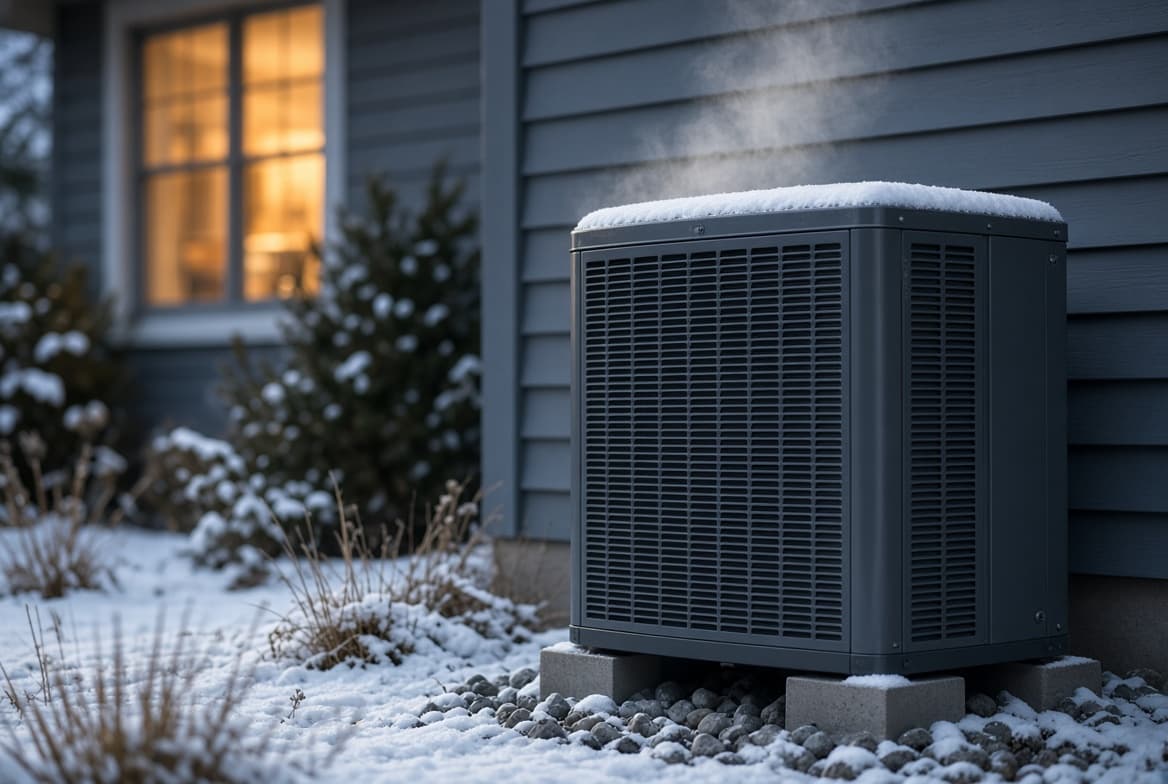
A heat pump moves heat from outdoor air into your home and also cools in summer. A gas furnace burns fuel to make heat and only heats. A heat pump usually costs less to run in mild and mixed climates and against propane, oil or electric resistance. A gas furnace often costs less to run in cold climates with cheap natural gas, and it delivers hotter air on the coldest days. The deciding numbers are your local electricity and gas rates, your winter temperatures, and whether your air conditioner needs replacing too.
Below: how each one heats, a quick break-even check you can run with your own utility bills, a decision table by climate and fuel, and the middle option many cold-climate homes end up with, a heat pump and furnace together.
How Each One Heats
A gas furnace burns natural gas or propane in a burner. The flame heats a metal heat exchanger, a blower pushes house air across it, and combustion gases leave through a flue. Its efficiency is rated in AFUE: an 80 percent furnace turns 80 percent of the fuel's energy into heat in your house, and condensing furnaces reach the mid to high 90s.
A heat pump uses refrigerant and a compressor to collect heat from outdoor air and release it indoors. Because it moves heat instead of making it, it can deliver two to four units of heat for each unit of electricity in mild weather. That ratio is its COP. As the outdoor temperature drops, the COP and the heat output both drop. See what a heat pump is for the full cycle.
Heat Pump vs Furnace at a Glance
| Factor | Air source heat pump | Gas furnace |
|---|---|---|
| Heats | Yes | Yes |
| Cools | Yes, replaces the AC | No, needs a separate AC |
| Energy source | Electricity | Natural gas or propane (oil furnaces also exist) |
| Efficiency | COP of roughly 2 to 4 in mild weather, lower in deep cold | 80 to about 98 percent AFUE |
| Supply air temperature | Often in the 90s F | Often 120 F or more |
| Cold weather | Output falls as it gets colder; cold-climate models hold up much better | Full output regardless of outdoor temperature |
| Combustion safety | No flame, no flue, no carbon monoxide from the unit | Needs venting, yearly checks and CO alarms |
| Typical lifespan | Commonly about 15 years | Commonly about 15 to 20 years |
| Power outage | No heat without a large generator | No heat either, but a small generator can run the blower |
| Outdoor equipment | Outdoor unit runs year-round, needs snow clearance | None for heating, unless you also have AC |
Which Costs Less to Run? The Break-Even COP Check
Generic "heat pumps save X percent" claims don't hold everywhere, because electricity and gas prices vary so much by state and utility. This check uses your own bills.
Step 1: Find your all-in rates. Divide a winter electric bill's total (with delivery charges) by the kWh used. Do the same for gas in dollars per therm, or propane in dollars per gallon.
Step 2: Calculate your break-even COP. This is the COP a heat pump needs to match the furnace's cost per unit of heat.
| Fuel you'd compare against | Break-even COP formula |
|---|---|
| Natural gas furnace | price per kWh × 29.3 × AFUE ÷ price per therm |
| Propane furnace | price per kWh × 26.8 × AFUE ÷ price per gallon |
| Oil furnace | price per kWh × 40.6 × AFUE ÷ price per gallon |
| Electric furnace or baseboard | 1.0, so nearly any working heat pump beats it |
Step 3: Compare with the heat pump's COP. If the heat pump's average COP in your weather is higher than your break-even number, it costs less to run.
Here's how that plays out with example rates. These are illustrations, not current prices, so plug in your own:
- Electricity at 15 cents per kWh, gas at $1.50 per therm, 95 percent furnace: 0.15 × 29.3 × 0.95 ÷ 1.50 = a break-even COP of about 2.8.
- Same electricity, gas at $1.00 per therm: break-even COP of about 4.2. Cheap gas makes the furnace hard to beat.
- Same electricity, propane at $2.50 per gallon, 95 percent furnace: break-even COP of about 1.5. Almost any modern heat pump wins most of the winter.
Where to get a COP number. A rough seasonal average is a heat pump's HSPF2 divided by 3.41. An HSPF2 of 7.5 works out to about 2.2, and 9.0 to about 2.6. HSPF2 reflects a moderate test climate and includes some backup heat, so your real average will be higher in a mild climate and lower in a cold one. For hour-by-hour detail, the manufacturer's extended performance data lists COP at 47, 17 and 5 degrees F.
Because COP falls as it gets colder, a heat pump can beat gas at 45 degrees and lose to it at 15. That's the whole logic behind dual fuel.
Heat Pump vs Furnace by Climate and Fuel
| Your situation | Usually the better fit | Why |
|---|---|---|
| Hot or mixed-humid climate (much of the South) | Heat pump | Short heating season, and you need cooling anyway |
| Mixed climate, AC is due for replacement | Heat pump, or heat pump with furnace backup | A heat pump costs little more than a new AC and takes over most heating |
| Mixed climate, cheap gas, AC and furnace both fine | Keep what you have | No reason to replace working equipment on cost alone |
| Cold climate, cheap natural gas | Furnace, or dual fuel | Gas wins on cost in deep cold; heat pump covers mild days |
| Cold climate, propane or oil | Cold climate heat pump, with or without fuel backup | High break-even COP for the fuel makes the heat pump cheaper most hours |
| Cold climate, no gas, heating with resistance now | Cold climate heat pump | Same heat for far less electricity |
| Very cold climate, no backup wanted | Cold climate heat pump sized to design temperature, or geothermal | Standard heat pumps fall short without backup |
If you're in a cold region, the cold climate heat pump guide explains the ENERGY STAR and NEEP specs and how to size to your design temperature.
Upfront Cost Factors
Installed prices vary too much by region and house to quote one number, but the comparison usually comes down to what you're replacing:
- Replacing only a furnace, AC is fine: a furnace usually costs less than a heat pump.
- Replacing both furnace and AC: a heat pump with an air handler competes with a furnace plus AC, and a dual fuel system (heat pump plus furnace) usually costs the most.
- No gas service: running a new gas line and venting adds cost to the furnace side.
- Cold-climate models cost more than standard heat pumps.
- Electrical work can add cost on the heat pump side if the panel needs capacity for backup heat strips.
- Duct changes matter for both, since heat pumps often need more airflow than a furnace.
For heat pump pricing factors, see heat pump installation cost. For the furnace side, see the furnace installation guide. Federal tax credit rules changed in 2025, so check current federal, state and utility rebates before you count on one.
Comfort Differences
Air temperature. Furnace air comes out hot, often 120 F or more, and warms a room fast. Heat pump air is warm but gentler, often in the 90s, so it runs longer cycles. Some people notice that heat pump air feels cool on the hand even while the house holds temperature.
Evenness. Variable-speed heat pumps run low and steady, which keeps temperatures more even between rooms and cycles. A single-stage furnace heats in bursts.
Humidity and cooling. A furnace adds nothing in summer. A heat pump's cooling is identical to a central air conditioner's, and variable-speed models remove humidity well at low speed.
Setbacks. A furnace recovers quickly from a big overnight setback. With a heat pump, deep setbacks can trigger backup heat on recovery, so smaller setbacks or a thermostat with smart recovery work better.
Safety, Maintenance and Lifespan
A gas furnace needs a sound heat exchanger, correct venting and working carbon monoxide alarms, and it should be checked every year. A heat pump has no combustion risk, but it has refrigerant and high-voltage parts, and its outdoor unit works through snow and summer heat. Both need filter changes and annual service.
Gas furnaces commonly last about 15 to 20 years. Heat pumps commonly last about 15, because they run in both seasons. Coastal salt air shortens outdoor unit life, and skipped maintenance shortens both.
The Middle Option: Keep the Furnace and Add a Heat Pump
You don't have to pick one. A dual fuel heat pump system replaces your air conditioner with a heat pump and keeps the furnace for the coldest weather. The thermostat or control switches to the furnace below a set outdoor temperature, ideally near your break-even point from the check above. It's often the best fit for cold climates with gas service and a furnace that still has years left.
What to Ask a Contractor
- What heat loss did you calculate, and what's this heat pump's capacity at our winter design temperature?
- What COP does it have at 47, 17 and 5 degrees F?
- Would dual fuel make sense here, and what changeover temperature would you set?
- Does our panel have room for a heat pump and backup heat?
- Are our ducts sized for a heat pump's airflow?
- Is the outdoor unit and indoor coil an AHRI matched pair?
For more on air-to-air equipment types and ratings, see the air source heat pump guide.
Frequently Asked Questions
Is it cheaper to run a heat pump or a gas furnace?
It depends on your electricity and gas prices and how efficient the heat pump is in your weather. Multiply your price per kWh by 29.3 and by the furnace AFUE, then divide by your price per therm. If the heat pump's average COP beats that number, it costs less to run. Against propane or oil, the heat pump usually wins.
Should I replace my gas furnace with a heat pump?
It makes the most sense when your air conditioner also needs replacing, when you heat with propane or oil, or when your winters are mild to moderate. If your gas furnace is young, gas is cheap and winters are harsh, keeping the furnace as backup in a dual fuel system is often the better step.
At what temperature is a heat pump less efficient than a furnace?
There is no single temperature. It's the point where the heat pump's COP drops to your break-even COP, which depends on local rates. With cheap gas and pricey electricity that can be around 40 degrees F or higher. With propane or expensive gas, a heat pump can stay cheaper well below freezing.
Does a heat pump last as long as a furnace?
Usually not quite. Gas furnaces commonly last about 15 to 20 years, while heat pumps commonly last about 15, because they run in both heating and cooling seasons. Climate, installation quality and maintenance shift both numbers.
Can I keep my furnace and add a heat pump?
Yes. That setup is called dual fuel or a hybrid system. The heat pump replaces your air conditioner and heats in mild weather, and the furnace takes over below a changeover temperature set on the thermostat or control.
Is a heat pump safer than a gas furnace?
A heat pump burns nothing, so it has no flue, no gas line and produces no carbon monoxide. A properly installed and maintained gas furnace is safe too, but it needs correct venting, yearly checks and working carbon monoxide alarms.