
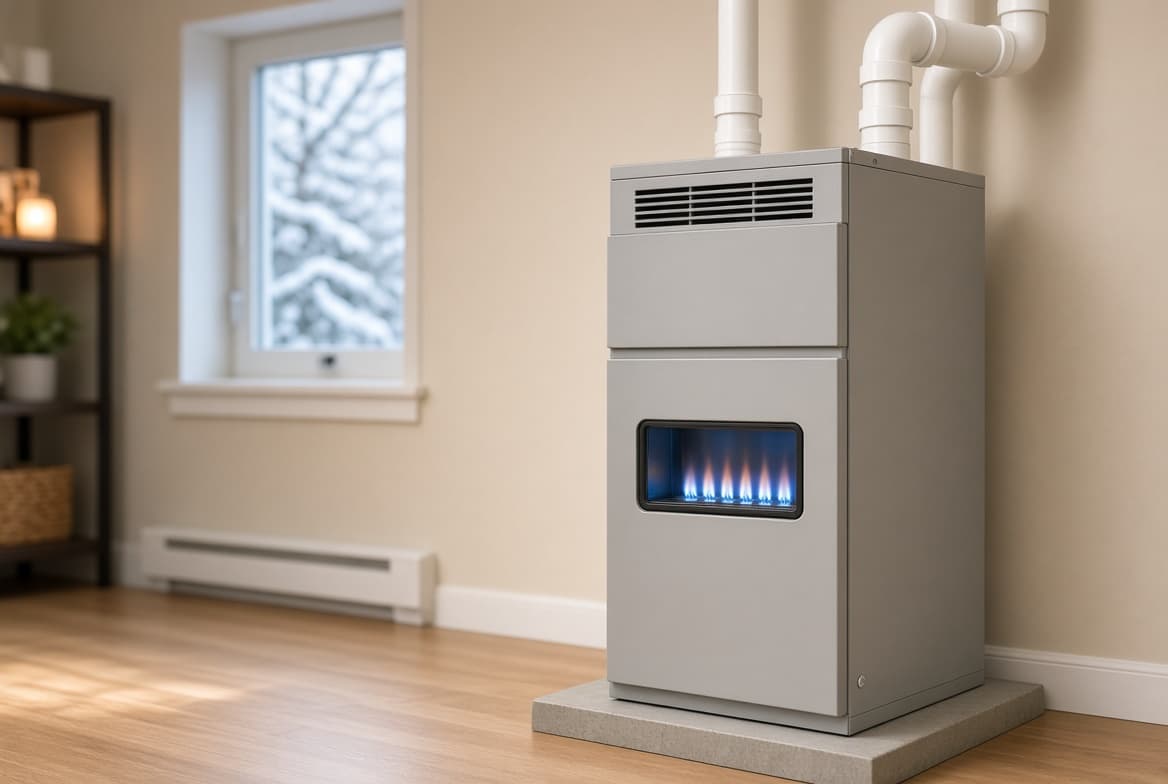
A propane furnace is a standard gas furnace that burns propane (LP gas) from a tank on your property instead of natural gas from a utility main. The burners, heat exchanger and blower are the same hardware. What changes is the gas pressure, the burner orifices, and the fact that you buy fuel by the gallon and store it yourself.
It's the usual choice for rural homes with no gas main. In most places it costs more to run than natural gas and less than electric resistance heat. Below: the running cost math with your own prices, tank sizing, efficiency choices, propane-specific safety, and when a heat pump or dual fuel makes more sense.
How a Propane Furnace Differs From a Natural Gas Furnace
Most gas furnaces leave the factory set for natural gas and are converted with a manufacturer-approved kit. Propane carries more energy per cubic foot and is delivered at higher pressure, so the burners meter much less gas.
| Item | Natural gas | Propane (LP) |
|---|---|---|
| Fuel supply | Utility main and meter | Your own tank, filled by truck |
| Burner orifices | Larger | Smaller, drilled for propane |
| Typical manifold pressure | About 3.5 inches of water column | About 10 inches of water column |
| Gas valve | Natural gas regulator spring | Propane spring or propane-specific valve |
| Low gas pressure switch | Not always fitted | In many kits, shuts the burner down if supply pressure drops |
| Behavior when leaking | Lighter than air, rises | Heavier than air, pools in low spots |
| Heat content | About 100,000 BTU per therm | About 91,500 BTU per gallon |
Exact pressures vary by model and altitude, so the installation manual governs.
Who should do a propane conversion
A conversion means changing every burner orifice, converting the gas valve regulator, fitting any pressure switch in the kit, labeling the furnace, then setting manifold pressure with a manometer and checking combustion. The kit must be the one the manufacturer lists for that model, and some models can't be converted.
This is a job for a qualified gas technician. Natural gas orifices left in place on propane overfire the burners, which can produce carbon monoxide, soot the heat exchanger and crack it. The same care applies if you later get a gas main and convert back.
When a Propane Furnace Makes Sense
- There's no natural gas main at your road, which covers most rural homes.
- You already have propane for a range, water heater or generator, so the tank and supplier are in place.
- Winters are cold and you want hot supply air, or a fuel-burning backup to a heat pump.
- Electric rates are high compared with local propane, which makes resistance heat the expensive option.
It's a weaker choice where natural gas is available (almost always cheaper per unit of heat), or where a modern heat pump can carry your climate alone.
How Much Does a Propane Furnace Cost to Run?
A gallon of propane holds about 91,500 BTU. To compare fuels fairly, convert each to the cost of one million BTU of heat delivered to the house.
Step 1: Find your real prices. Divide a recent propane invoice, fees included, by the gallons delivered. Do the same for electricity per kWh, and for oil or natural gas if you have them.
Step 2: Convert to cost per million BTU delivered.
| Heat source | Cost per million BTU delivered |
|---|---|
| Propane furnace | price per gallon × 10.9 ÷ AFUE |
| Heating oil furnace | price per gallon × 7.2 ÷ AFUE |
| Natural gas furnace | price per therm × 10 ÷ AFUE |
| Electric furnace | price per kWh × 293 |
| Heat pump | price per kWh × 293 ÷ COP |
AFUE is furnace efficiency as a decimal, such as 0.95. COP is a heat pump's heat output per unit of electricity: often 3 or more in mild weather, lower in deep cold. A seasonal average around 2.5 is a reasonable planning figure for a modern unit in a mixed climate.
Step 3: Compare. These are example rates only, so use your own: propane at $2.75 per gallon, heating oil at $3.75 per gallon, electricity at 17 cents per kWh.
- 95 percent propane furnace: 2.75 × 10.9 ÷ 0.95 = about $32 per million BTU
- 80 percent propane furnace: 2.75 × 10.9 ÷ 0.80 = about $37
- 85 percent oil furnace: 3.75 × 7.2 ÷ 0.85 = about $32
- Electric furnace: 0.17 × 293 = about $50
- Heat pump at a seasonal COP of 2.5: 50 ÷ 2.5 = about $20
Two shortcuts against a 95 percent propane furnace:
- Heat pump (COP 2.5): multiply your price per kWh by about 10. If propane costs more per gallon than that, the heat pump is cheaper to run.
- Electric furnace or baseboard: multiply your price per kWh by about 25. If propane costs less per gallon than that, propane is cheaper. The electric furnace running costs guide covers the resistance-heat side.
How much propane a furnace burns per hour
Divide the furnace's input rating by 91,500. A 60,000 BTU input furnace burns about 0.66 gallons per hour of burner run time, an 80,000 BTU unit about 0.87, and a 100,000 BTU unit about 1.1.
Estimate yearly propane use from your old fuel bills
If you're switching fuels, past bills are the best predictor. Convert last year's usage to propane gallons:
- From heating oil: oil gallons × 1.51 × (old AFUE ÷ new AFUE)
- From natural gas: therms × 1.09 × (old AFUE ÷ new AFUE)
- From electric resistance heat: heating kWh × 0.037 ÷ new AFUE
Example: 700 gallons of oil a year in an 80 percent oil furnace becomes roughly 700 × 1.51 × 0.80 ÷ 0.95, about 890 gallons of propane in a 95 percent furnace. Multiply by a quoted propane price for a yearly fuel estimate.
Propane Tank Size: Owning vs Leasing
Tanks are filled to about 80 percent to leave room for the liquid to expand.
| Tank size | Usable propane | Typical use |
|---|---|---|
| 250 gallons | About 200 gallons | Small homes or mild climates; frequent winter fills |
| 500 gallons | About 400 gallons | The common choice for whole-home heating |
| 1,000 gallons | About 800 gallons | Large or cold-climate homes, or furnace plus water heater and generator |
Size the tank so a fill lasts several weeks at peak usage. The supplier sizes the regulator and piping for every propane appliance in the house, and code sets minimum distances from the house, property lines and ignition sources, so the supplier decides where the tank can sit.
Leasing: the supplier owns, installs and maintains the tank. You usually must buy all your propane from that supplier, and there may be a rental fee or minimum yearly usage. Low upfront cost, but no shopping on price.
Owning: you pay for the tank and installation and can buy from any supplier willing to fill it. You're responsible for upkeep.
Either way, ask about automatic delivery, tank monitors, budget plans and pre-buy contracts.
Choosing an Efficiency Level (AFUE)
- 80 to 83 percent AFUE, non-condensing: vents hot flue gas through a metal flue or lined chimney. Lower purchase price.
- 90 to about 98.5 percent AFUE, condensing: a second heat exchanger pulls heat from the flue gas, which vents through PVC pipe, and produces condensate that needs a drain.
Because propane costs more per BTU than natural gas, high efficiency pays back faster. Using example numbers: a home burning 800 gallons a year at 80 percent AFUE would burn about 667 gallons at 96 percent, saving roughly 133 gallons, or about $366 a year at $2.75 a gallon.
The Department of Energy finalized a rule in 2023 that sets a 95 percent AFUE minimum for most new non-weatherized gas furnaces, propane included, starting in late 2028. Rules like this get challenged and revised, so ask your contractor what applies when you buy.
Most published cost guides put a typical installed propane furnace replacement around $3,000 to $8,000, the low end for a like-for-like 80 percent swap and the high end for a condensing, two-stage unit with new venting. A tank, gas piping or conversion work is extra. The furnace installation guide covers sizing, permits and comparing bids.
Propane Safety: What Every Owner Should Know
- It's heavier than air. Leaking propane sinks into basements, crawl spaces and low corners instead of dispersing, where a pilot or motor can ignite it.
- It's odorized. Suppliers add a rotten-egg odorant. The smell can fade in new tanks, rusty tanks or a buried line, and some people smell it poorly.
- Use a propane detector mounted low, near the floor, per the maker's instructions. A detector placed high for natural gas won't protect you well.
- Put carbon monoxide alarms on every level and near bedrooms. Any misadjusted or poorly vented furnace can produce CO.
What to do if you smell gas
- Put out flames and smoking materials. Don't use light switches, appliances, thermostats or phones in the area.
- Get everyone out.
- If it's safe, close the main valve on the propane tank (clockwise).
- From a safe distance, call your propane supplier, or 911 if you can't reach them.
- Stay out until a technician or responder says it's safe, and have the system checked before relighting.
If you run out of propane
An empty tank lets air and moisture into the system, and any valve or pilot left open becomes a leak when gas flows again. Propane codes and many state rules require a leak check after an interruption of service before appliances are relit, and your supplier usually performs it when refilling a tank that ran dry. Don't relight pilots or reset appliances yourself. Keep the tank above roughly 20 to 30 percent in winter and keep the path to it clear of snow.
What a homeowner should not attempt
- Converting a furnace between natural gas and propane, or adjusting gas valve pressure.
- Disconnecting or repiping a propane line or regulator.
- Bypassing a low gas pressure, rollout or limit switch to get the heat back on.
If the furnace stops heating and there's propane in the tank, the furnace not working troubleshooting guide covers the checks that are safe to make.
Propane Furnace vs Heat Pump vs Dual Fuel
| Factor | Propane furnace | Heat pump | Dual fuel |
|---|---|---|---|
| Cost to run | Moderate to high, tracks propane prices | Usually lowest where electricity is moderately priced | Low; each runs when it's cheaper |
| Deep cold | Full output at any temperature | Capacity drops as it gets colder | Furnace covers the coldest hours |
| Cooling | No | Yes | Yes |
| Power outage | A small generator runs it | Needs a large generator | Furnace runs on a small generator |
| Fuel logistics | Tank and deliveries | None | Fewer deliveries |
A heat pump moves heat rather than making it, which is why it usually costs less per unit of heat. See how a heat pump works for the basics.
Dual fuel suits many propane homes. The heat pump does most of the heating and the controls switch to the furnace below a set outdoor temperature. Set that point from your prices: the heat pump stays cheaper while its COP is above your electric cost per million BTU divided by your propane cost per million BTU. With the example prices, $50 ÷ $32 is about 1.6, and many modern heat pumps stay above that well below freezing. If you're replacing both the AC and furnace, get it quoted next to a straight propane furnace. The dual fuel heat pump setup guide covers the controls and changeover settings in more detail.
Coming off oil heat? The oil furnace guide covers leaving oil, including tank removal.
Maintenance and What to Ask a Contractor
Yearly service matches any gas furnace: burner, flame sensor and igniter, heat exchanger, venting, condensate drain and a combustion test. With propane, also ask for inlet and manifold pressure readings. Yellow, lazy flames instead of crisp blue ones need attention.
Before you sign, ask:
- What heat loss did you calculate, and what input size does it support?
- Is the unit factory-set for propane, or will you install the listed kit and set pressure with a manometer?
- Who sizes the regulator and piping for my total propane load?
- Can you quote a heat pump or dual fuel option alongside it?
- Does the new venting orphan a water heater on the old chimney?
- What does the warranty cover, and does it require registration? Check the manufacturer's current warranty terms.
Frequently Asked Questions
Are propane furnaces expensive to run?
Usually more than natural gas and less than electric resistance heat. Multiply your price per gallon by 10.9 and divide by the furnace's AFUE to get your cost per million BTU of delivered heat, then compare it with your other options.
What is the difference between a propane furnace and a natural gas furnace?
The hardware is essentially the same. A propane unit has smaller burner orifices, a gas valve set for propane's higher pressure, and often a low gas pressure switch. Most furnaces ship for natural gas and are converted with the manufacturer's kit.
Can you convert a natural gas furnace to propane?
Many models can, using the kit listed in the installation manual. A qualified technician swaps the orifices, converts the gas valve, sets manifold pressure with a manometer and checks combustion. It is not a homeowner job, and some models cannot be converted.
How long does a 500 gallon propane tank last?
A 500 gallon tank holds about 400 gallons when full. A 100,000 BTU furnace burns about 1.1 gallons per hour of run time, so in a cold climate a full tank may last a few weeks to a few months in winter, depending on the house.
How long does a propane furnace last?
Commonly 15 to 20 years, the same as a natural gas furnace, since the hardware is the same. Annual service and correct gas pressure help it reach the upper end.
Can a propane furnace be paired with a heat pump?
Yes. That setup is called dual fuel. The heat pump heats in mild weather and the propane furnace takes over below a set outdoor temperature, which can cut propane use sharply.