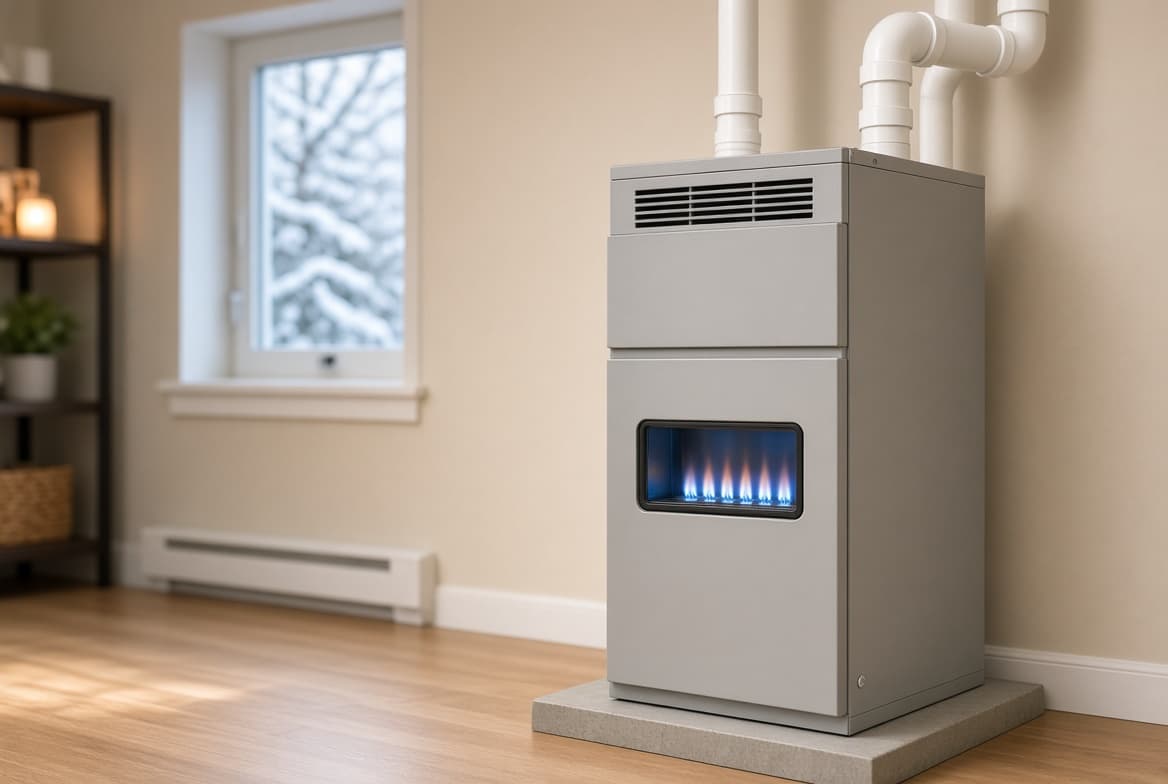
A high efficiency furnace is a gas furnace rated 90 percent AFUE or higher, which means it's a condensing furnace that captures extra heat from its exhaust. Most sold today are rated about 95 to 98 percent, compared with the 80 percent federal minimum for standard indoor gas furnaces. Whether one is worth the extra cost depends mostly on your climate, your gas price and how long you'll stay in the house.
Efficiency isn't the only upgrade on the table. Two-stage and modulating gas valves and variable speed blowers change how the furnace feels to live with, and they're often bundled into the same high efficiency models. This guide sorts out what each feature does, what installation needs to include and how to estimate your payback.
What Makes a Furnace High Efficiency?
AFUE, or annual fuel utilization efficiency, is the share of the fuel's energy that ends up as heat in your home over a typical year. A 95 percent AFUE furnace turns about 95 cents of every gas dollar into heat. An 80 percent furnace sends about 20 cents up the flue.
A standard 80 percent furnace has one heat exchanger and vents hot exhaust through a metal flue or chimney. A high efficiency furnace adds a secondary heat exchanger that cools the exhaust until the water vapor in it condenses. That condensation releases more heat into your home. Because the exhaust comes out cool and wet, the furnace vents through plastic pipe and needs a drain for the acidic condensate.
You won't find gas furnaces rated between about 83 and 89 percent. In that range, exhaust condenses inside a heat exchanger that isn't built for it, which causes corrosion. So the choice is effectively 80 percent or 90-plus.
| Standard (80% AFUE) | High efficiency (90%+ AFUE) | |
|---|---|---|
| Heat exchangers | One | Two (primary and secondary) |
| Venting | Metal flue or chimney | Plastic pipe (PVC, CPVC or ABS) through a wall or roof |
| Condensate drain | Not needed | Required, sometimes with a pump |
| Combustion air | Usually from the room | Often piped in from outside (sealed combustion) |
| Fuel used for the same heat | More | Less |
| Up-front cost | Lower | Higher |
Two-Stage, Modulating and Variable Speed Furnaces
These terms describe how the furnace delivers heat, and they're separate from AFUE, although the features tend to come together in higher-tier models.
| Feature | What it means | What you notice | Trade-off |
|---|---|---|---|
| Single-stage | Gas valve is fully on or off | Short, strong bursts of heat; bigger temperature swings | Cheapest and simplest |
| Two-stage | Low fire for most days, high fire on the coldest | Longer, quieter cycles; more even temperatures | Moderate cost premium |
| Modulating | Flame adjusts in small steps across a wide range | Most steady temperatures; runs long and low | Highest cost, more complex controls |
| PSC blower | Fixed-speed blower motor, older design | Louder start and stop | Uses more electricity |
| Variable speed (ECM) blower | Blower ramps smoothly and adjusts to duct resistance | Quieter, better airflow control, helps AC dehumidify | Costs more to replace if it fails |
Two-stage furnaces
A two-stage furnace usually runs on its low stage, often around 60 to 70 percent of full output, and only switches to high fire when it's very cold or the house needs to recover quickly. Low fire means longer run times at a gentler output, which reduces the blast-then-chill pattern of a single-stage furnace and spreads heat more evenly, especially in two-story homes. To get the full benefit, the thermostat or furnace control needs to be set up to use both stages.
Variable speed furnaces
"Variable speed" refers to the blower. An electronically commutated motor (ECM) can ramp up slowly, run at low speed for long periods and adjust to the resistance of your ducts and filter. That helps comfort and air filtration, and it lets your air conditioner run at the slower airflow that pulls more moisture out of the air in summer. Our guide to furnace blower motors explains how these motors differ and fail.
Modulating furnaces
A modulating furnace adjusts its gas valve in small increments, so it can closely match the heat your house is losing at any moment. These are typically the most efficient models, with ratings up to about 98 percent AFUE, and the most comfortable. They also carry the highest price and the most electronics.
The Federal Furnace Rule: Where It Stands in 2026
Today, new non-weatherized gas furnaces, the kind installed indoors in most homes, must meet at least 80 percent AFUE. In December 2023, DOE finalized a rule raising that minimum to 95 percent AFUE for furnaces manufactured from December 18, 2028. The rule has been challenged in court, and in 2026 gas industry groups petitioned DOE to push the date back. Its future timing is uncertain, so don't let it rush your decision either way. An 80 percent furnace can still be installed today, and a condensing furnace is a sound choice regardless of what happens to the rule.
Do the Math: Payback on a High Efficiency Furnace
To estimate how much less gas a more efficient furnace burns:
Fuel savings = 1 minus (old AFUE divided by new AFUE)
Going from 80 percent to 95 percent: 1 minus 0.80/0.95 is about 0.158, or roughly 16 percent less gas for the same heat. An older furnace may be performing below its original rating, which makes the gap bigger.
Here's an illustrative example with assumed numbers. If your heating gas cost is $1,200 a year with an 80 percent furnace, a 95 percent furnace would cut that by about 16 percent, or roughly $190 a year. If the high efficiency option costs $2,000 more installed, simple payback is a little over 10 years. With a $2,400 heating bill, it's closer to 5. Use the heating portion of your own gas bills, not the total, since cooking and water heating are included in the total.
ENERGY STAR estimates that a certified furnace pays back its extra cost over a standard new furnace in about 5 years in the North and about 11 years in the South. That gap is the whole story: the colder your winters, the faster efficiency pays.
Which furnace makes sense for you?
| Your situation | Good fit | Why |
|---|---|---|
| Cold climate, long heating season | 95%+ AFUE, two-stage or modulating, variable speed blower | Fast payback and the biggest comfort gains |
| Mild climate, short heating season | 80% AFUE may be reasonable | Low gas use means slow payback on the premium |
| Moving within a few years | Usually standard efficiency | Not enough years to recover the cost |
| Hot and cold rooms, two-story home | Two-stage or modulating with variable speed | Longer, gentler cycles even out temperatures |
| Humid summers with central AC | Variable speed blower | Better moisture removal during cooling |
| No practical route for plastic vent pipe or drain | Get a site assessment first | Venting and drain cost can change the math |
For typical installed price ranges by efficiency, see our guide to furnace replacement cost. A high efficiency furnace usually costs more in both equipment and installation, because of the venting and drain work.
What a High Efficiency Furnace Installation Needs
Most problems with condensing furnaces trace back to installation. Make sure your quote covers:
- Plastic venting of the type and size the manufacturer specifies, sloped back toward the furnace so condensate drains, with intake and exhaust terminals placed according to the installation manual and clear of snow.
- A condensate drain to a floor drain or a condensate pump, with a trap. Some areas require a neutralizer for the acidic condensate.
- Freeze protection in attics, crawlspaces and garages. A frozen trap or drain line can shut the furnace down, and a burst line can leak into the space below.
- The orphaned water heater. If an old 80 percent furnace shared a chimney with a gas water heater, removing the furnace leaves the water heater alone in a flue that may be too big. That can cause poor draft and backdrafting, a carbon monoxide risk. The installer should test it and reline the chimney or recommend a different water heater if needed.
- Correct sizing from a heat load calculation, not the old furnace's label.
- Duct and static pressure check, since a variable speed blower can only do so much with undersized ducts.
- Combustion analysis and gas pressure set at startup, written on the paperwork.
Gas, venting and combustion work isn't a DIY job. A venting mistake can put carbon monoxide in the house. Our guide to the furnace installation process walks through what installation day should look like.
Questions to Ask a Furnace Contractor
- What's the AFUE, and is the furnace single-stage, two-stage or modulating?
- Does it have a variable speed blower, and will the thermostat use all the stages?
- How did you size it?
- Where will the vent pipes and condensate drain go, and what freeze protection is included?
- What happens to my water heater's venting?
- What heat exchanger and parts warranty comes with it, and does it require registration?
- Will you do a combustion analysis and give me the readings?
Brand matters less than installation quality, but if you're comparing makers, see our furnace brands compared guide. Federal tax credit rules changed in 2025, so check current federal, state and utility rebates before you count on one.
How Long Do High Efficiency Furnaces Last?
Condensing furnaces are commonly expected to last about as long as standard ones, roughly 15 to 20 years, provided the condensate trap, drain and vent pipes get checked at each annual service. See how long furnaces last for what shortens that. If you're replacing the AC too, its efficiency scale is covered in SEER ratings for air conditioners.
Frequently Asked Questions
What AFUE counts as a high efficiency furnace?
Generally 90 percent AFUE or higher, which means a condensing furnace. ENERGY STAR's current criteria for gas furnaces are at least 97 percent AFUE in the northern U.S. and 95 percent in the southern U.S. The federal minimum for most indoor gas furnaces is 80 percent AFUE.
Is a two-stage furnace worth it?
For many homes, yes. A two-stage furnace runs on low fire most of the time, which gives longer, quieter cycles and more even temperatures than a single-stage unit. It costs more up front, so it pays off most in colder climates and in homes where comfort complaints, like hot and cold rooms, are a problem.
What's the difference between a two-stage and a variable speed furnace?
Two-stage refers to the gas valve, which has a low and a high fire setting. Variable speed refers to the blower motor, which can ramp its speed up and down. Many furnaces combine both. A modulating furnace goes further, adjusting its flame in small steps across a wide range.
Will 80% furnaces be banned?
DOE finalized a rule in 2023 that would require 95 percent AFUE for most new non-weatherized gas furnaces made from December 18, 2028. The rule has faced legal challenges and a petition to delay it, so its timing could change. For now, 80 percent furnaces can still be made and installed.
Do high efficiency furnaces need a chimney?
No. A condensing furnace vents through plastic pipe, usually PVC, out a sidewall or the roof. That frees up the chimney, but if a gas water heater shared it, the water heater's venting needs to be checked and often relined.