
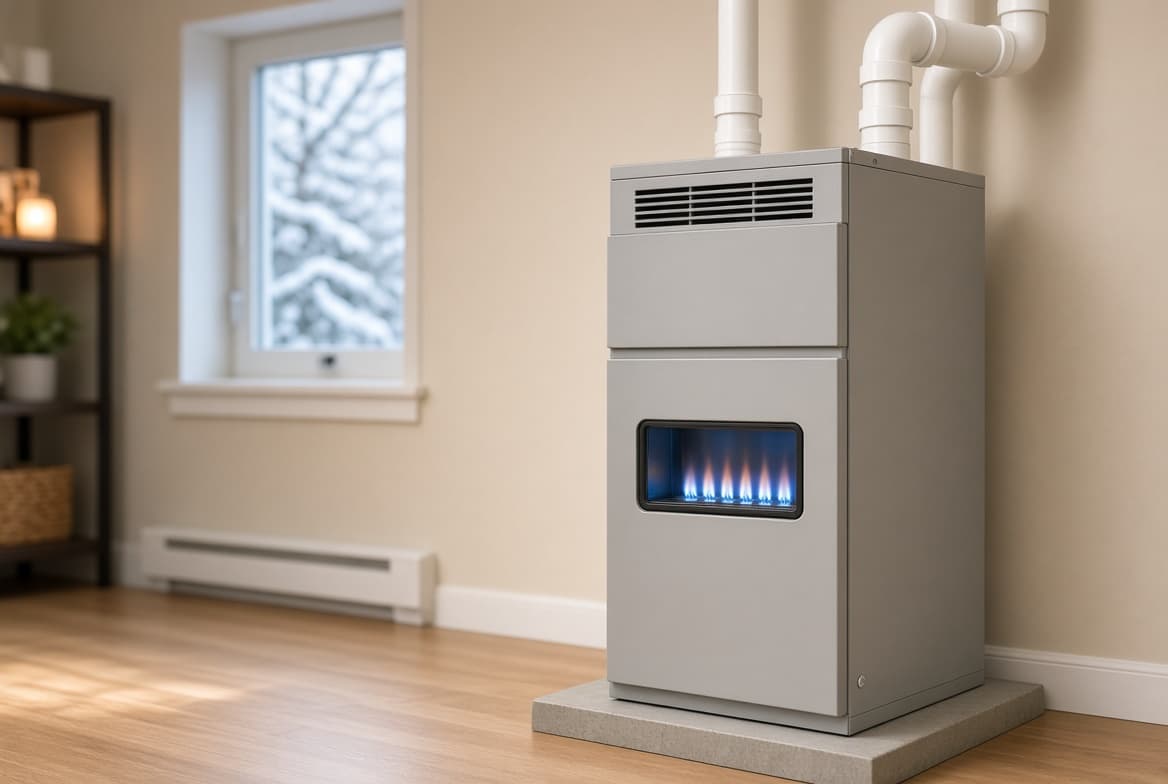
An oil furnace heats your home by spraying a fine mist of heating oil into a combustion chamber, igniting it, and blowing house air across a heat exchanger into your ducts. The oil comes from a tank in the basement, garage or yard, and the exhaust leaves through a chimney or side-wall vent. Oil heat is most common in the Northeast and in older homes built before gas mains reached them.
It's durable and puts out strong heat, but it needs yearly service, usually costs more to run than natural gas, and the tank brings its own risks. Below: how it works, service, common problems, running cost math, tank concerns, and converting to gas.
How an Oil Furnace Works
When the thermostat calls for heat:
- The primary control starts the burner. This control, usually mounted on the burner, runs the firing sequence and holds the red reset button.
- The fuel pump pulls oil from the tank through a filter, then pushes it to the nozzle at high pressure, commonly 100 to 150 psi depending on the burner.
- The nozzle atomizes the oil into a cone of fine droplets at a rated flow in gallons per hour.
- The igniter sparks across two electrodes in front of the nozzle, lighting the mist. The burner fan supplies combustion air.
- The CAD cell confirms the flame. It's a light sensor that watches the fire. If it doesn't see flame within the control's safety time, typically 15 to 45 seconds, the control shuts off the oil and locks out.
- The heat exchanger warms up, and the blower pushes house air across it and into the ducts. Combustion gases stay inside the exchanger.
- Flue gases exit through the flue pipe to the chimney. A barometric damper on the flue pipe steadies the draft.
Some homes with oil heat have a boiler instead, which heats water for radiators. The boiler vs furnace comparison explains the difference.
Your nozzle tells you the firing rate
The nozzle is stamped with its flow in gallons per hour (gph) at 100 psi. Multiply by 138,500 to get the input in BTU per hour: a 0.75 gph nozzle is about 104,000 BTU per hour. Many modern burners run above 100 psi, which raises the actual flow, so ask the technician for the actual firing rate. It's also your fuel use per hour of burner run time.
Oil Furnace Maintenance: What Annual Service Includes
Oil burns dirtier than gas, so yearly service matters more. A proper tune-up includes:
| Task | Why it matters |
|---|---|
| Replace the nozzle | A worn or partly clogged nozzle sprays poorly, causing soot, smoke and lockouts |
| Replace the oil filter and pump strainer | Sludge and debris from the tank clog the line and starve the burner |
| Clean the combustion chamber and heat exchanger | Soot insulates the exchanger, so more heat goes up the chimney |
| Check electrodes, igniter and CAD cell | Weak spark or a dirty CAD cell causes failed starts |
| Combustion test with an analyzer | Smoke, CO2 or O2, draft and stack temperature show how cleanly and efficiently it burns |
| Inspect the flue pipe, damper and chimney base | Blockages or leaks push exhaust back into the house |
| Check the tank, lines and fittings | Catches weeping seams, rust and leaks early |
Ask for the combustion test printout. Adjusting by eye can't show how efficiently it burns. The annual furnace maintenance guide covers the filter and blower checks that apply to every furnace.
Common Oil Furnace Problems
| Symptom | Likely cause | What to do |
|---|---|---|
| No heat, red reset button tripped | Burner failed to prove flame: low oil, clogged nozzle or filter, dirty CAD cell, weak ignition | Check the tank gauge and thermostat, then press reset once |
| No heat after running low or out of oil | Air in the pump and lines, sludge drawn into the filter | Fill the tank; a technician bleeds the pump and changes the filter |
| Burner starts, runs briefly, then locks out | Dirty or failing CAD cell, flame problem | Technician |
| Black soot around the burner or registers | Poor combustion, clogged nozzle, draft problem | Shut it off and schedule service |
| Strong oil or exhaust smell | Leak at the pump or line, or exhaust spilling from the flue | Shut it off; check for leaks; get it inspected |
| Rumbling or booming at startup | Delayed ignition, oil building up before it lights | Shut it off; this is how puff-backs start |
For thermostat, breaker and filter checks, see the furnace not working troubleshooting guide.
Why you press the reset button only once
Each time the burner fails to light, some unburned oil can be left in the combustion chamber. Pressing reset again pumps in more. When it finally lights, the pooled oil can ignite all at once in a small explosion called a puff-back, which can blow open the burner, crack the chamber and spread soot through the house and ducts.
So check that the thermostat is calling for heat and the tank has oil, then press reset once. If the burner locks out again, leave it and call a technician. Many modern controls go into a restricted lockout after a few failed tries that only a technician can clear. Never press reset if you smell oil or see smoke.
Running out of oil and sludge
When a tank runs dry, the pump draws air and loses its prime, and refilling alone often won't restart it. A technician bleeds the air from the pump and usually changes the filter. Running very low also pulls sludge from the tank bottom (water from condensation, rust and microbial growth) into the line. Keep the tank above about a quarter full in winter, or use automatic delivery.
Oil Furnace Safety
- Carbon monoxide. A poorly tuned burner, blocked chimney or cracked heat exchanger can put CO into your home. Keep CO alarms on every level and near bedrooms.
- Puff-backs. Prevented by yearly service, a correct nozzle, a tight oil line, and not pressing reset repeatedly.
- Oil leaks. Wipe up small drips and watch for wet spots, but have a technician fix the source.
What a homeowner should not attempt: pressing reset more than once, lighting oil by hand, opening the burner while it's firing, bypassing a limit switch or the primary control, or adjusting pump pressure or the air band.
How Much Does an Oil Furnace Cost to Run?
Heating oil holds about 138,500 BTU per gallon. Convert each option to cost per million BTU delivered:
| Heat source | Cost per million BTU delivered |
|---|---|
| Oil furnace | price per gallon × 7.2 ÷ AFUE |
| Natural gas furnace | price per therm × 10 ÷ AFUE |
| Propane furnace | price per gallon × 10.9 ÷ AFUE |
| Heat pump | price per kWh × 293 ÷ COP |
Use your own invoice prices with fees included. As an example only, with oil at $3.75 a gallon, natural gas at $1.50 a therm and electricity at 17 cents per kWh:
- 85 percent oil furnace: 3.75 × 7.2 ÷ 0.85 = about $32 per million BTU
- 95 percent gas furnace: 1.50 × 10 ÷ 0.95 = about $16
- Heat pump at a seasonal COP of 2.5: 0.17 × 293 ÷ 2.5 = about $20
Two shortcuts, against an 85 percent oil furnace:
- Natural gas (95 percent furnace): gas is cheaper to run if your price per therm is below about 0.8 times your oil price per gallon.
- Heat pump (COP 2.5): the heat pump is cheaper if oil costs more per gallon than about 14 times your price per kWh.
Oil prices swing, so use a year of invoices rather than one delivery.
Oil Tank Concerns
Most indoor tanks are 275 gallon steel tanks. They corrode from the inside out, where water and sludge sit on the bottom, so a tank can look fine and still be close to failing. State environmental guidance commonly puts indoor tank life at around 20 to 25 years, often less, and outdoor and buried tanks fail sooner.
Warning signs: wet spots or weeping on the bottom or seams, rust scale, an oil smell, stains on the floor, unstable legs, a damaged fill or vent pipe, or a vent whistle that has stopped sounding during delivery.
- Insurance. Many homeowners policies limit or exclude oil spill cleanup, and some insurers ask about tank age or require replacement or an inspection past a certain age. Ask your insurer in writing.
- Replacement. Modern double-wall tanks reduce leak risk and are worth considering if you're staying with oil.
- Buried tanks. Common on older properties and a frequent snag in home sales. Buyers often ask for a tank sweep or soil test.
- Removal or abandonment. A licensed tank contractor pumps out the oil, cleans the tank, and removes it, or, for a buried tank where local rules allow, fills it in place. Keep the permit and closure paperwork.
Replacing an Oil Furnace: What a New Installation Involves
Oil furnace replacement makes sense when the heat exchanger is cracked, repair bills keep rising, or efficiency is low, as covered in the lifespan answer below. A new installation involves more than swapping the box:
- Sizing. The new furnace should be sized by a heat loss calculation, not by copying the old furnace's nozzle or firing rate. Many older oil furnaces were oversized, as the nozzle section above explains.
- Configuration and efficiency. Match upflow, lowboy or another configuration to the space. New oil furnaces are commonly rated around 83 to 87 percent AFUE.
- Venting. The chimney condition and liner should be checked. A sidewall power vent is an option on some models. If a water heater is left alone on the chimney after the swap, it needs attention too.
- Fuel side. The installer should inspect the tank and oil line, fit a new oil filter, and set up the burner with a combustion test at startup.
- Permits and matching. Permits are usually required, and an existing AC coil has to match the new furnace.
If you are replacing anyway, this is the moment to compare staying on oil with the conversion and heat pump options in the sections that follow.
Oil to Gas Conversion: What's Involved
Switching from oil to natural gas usually means a new gas furnace, not a modified oil furnace.
- Confirm gas service. Ask the utility whether a main runs on your street, what the service line and meter cost, and whether it offers conversion programs. A main extension is the most expensive variable.
- Choose the equipment. A new gas furnace is the standard route and lets you correct the size. Gas conversion burners that fit an existing oil appliance exist, mostly for boilers, but on a furnace they keep an aging heat exchanger at lower efficiency, and many contractors won't recommend them.
- Sort out venting. Gas flue gas is cooler and wetter than oil exhaust and damages an unlined masonry chimney. An 80 percent gas furnace needs a liner sized for gas. A 90 percent or higher condensing furnace vents through PVC out a side wall, avoiding the chimney, but a water heater left alone on the old chimney may then need a liner of its own.
- Run gas piping inside, sized for every gas appliance, and have it pressure tested.
- Deal with the tank. Remove it, or abandon a buried tank in place where allowed. Ask the oil supplier about any prepaid balance.
- Pull permits. Expect a mechanical or gas permit, a tank removal permit or fire department sign-off, and a utility inspection before the meter goes live.
Conversion cost factors
Published conversion totals vary too widely to quote a single range. These factors decide where yours lands:
| Factor | Lower cost | Higher cost |
|---|---|---|
| Gas service | Main and service line already at the house | Main extension or long service line |
| Furnace | 80 percent single-stage | Condensing, two-stage or modulating |
| Venting | Condensing furnace vents out a side wall | Chimney liner for the furnace or orphaned water heater |
| Oil tank | Indoor tank, easy access | Buried tank, soil testing or cleanup |
| Extras | Ducts in good shape | Duct changes, new water heater, adding AC |
Estimate your gas bill before you convert
Translate last year's oil use into therms: oil gallons × 1.385 × (oil furnace AFUE ÷ new gas furnace AFUE). Example: 700 gallons in an 80 percent oil furnace becomes about 700 × 1.385 × 0.80 ÷ 0.95, or roughly 820 therms in a 95 percent gas furnace. Multiply by your utility's all-in price per therm and compare it with last year's oil spend to see your yearly savings and payback.
Alternatives to an Oil Furnace
- Heat pump. Cold-climate heat pumps now carry many northern homes, often on the existing ducts. An add-on heat pump can also pair with your oil furnace, leaving oil as backup for the coldest days. See how a heat pump works.
- Propane. Without a gas main, a propane furnace avoids oil sludge and nozzle service, and its cost per unit of heat often lands in a similar range to oil. The propane furnace guide covers tanks and costs.
- New oil furnace. If oil prices are workable and the tank is sound, a modern unit with a flame-retention burner is a straightforward swap.
What to Ask a Contractor
- What heat loss did you calculate, and what firing rate does that support?
- If I stay with oil, is my tank sound, and what would a double-wall replacement involve?
- If I convert, who handles the gas service, chimney liner, tank removal and permits?
- Can you quote a cold-climate heat pump or hybrid setup alongside?
- What does the manufacturer's warranty cover? Check the manufacturer's current warranty terms.
The furnace installation guide covers sizing, permits and comparing bids for any fuel.
Frequently Asked Questions
How long does an oil furnace last?
Commonly 15 to 25 years with yearly service. A sooted or neglected heat exchanger shortens that. Age alone is not a reason to replace one, but a cracked heat exchanger, rising repair bills or low efficiency usually is.
Why does my oil furnace keep locking out?
The primary control shuts the burner down when the CAD cell does not see a flame within its safety time. Common causes are low or no oil, a clogged nozzle or filter, sludge in the line, a dirty CAD cell, weak ignition or a failing pump. Press reset once. If it locks out again, call a technician.
Is it worth converting from oil to gas?
Often, where a gas main already runs down your street, because natural gas is usually much cheaper per unit of heat and needs less service. It is a harder case if the utility must extend the main, the chimney needs a liner, or a heat pump would cut costs as much without a new fuel line.
Do they still make oil furnaces?
Yes. Several major brands still sell oil furnaces, commonly rated around 83 to 87 percent AFUE, in upflow, lowboy and other configurations for homes without gas service.
How often should an oil furnace be serviced?
Once a year, ideally before the heating season. Service includes a new nozzle and oil filter, cleaning the combustion chamber and heat exchanger, checking the ignition and CAD cell, and a combustion test.
Is oil heat more expensive than gas?
In most of the US, yes. Multiply your oil price per gallon by 7.2 and divide by the furnace's AFUE to get cost per million BTU, then compare it with natural gas at price per therm times 10 divided by AFUE.