
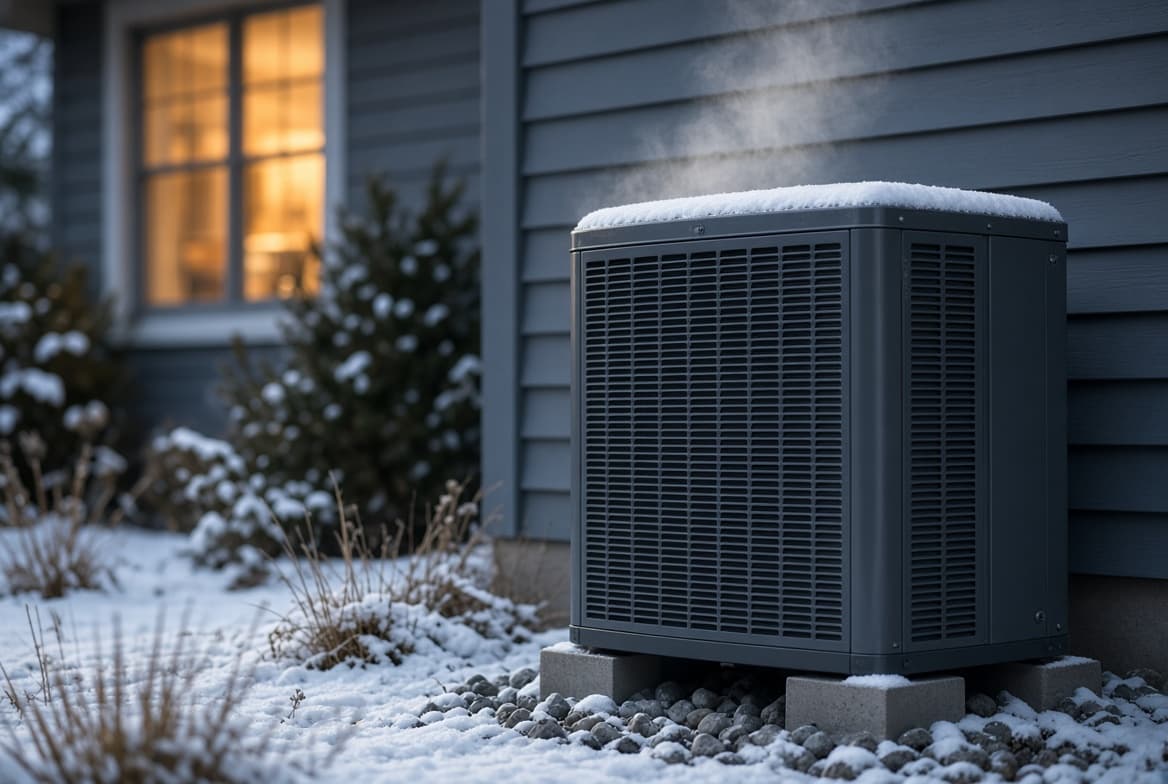
An air source heat pump heats and cools your home by moving heat between the outdoor air and the indoor air with refrigerant. In winter it pulls heat out of outside air, even below freezing, and releases it indoors. In summer it runs in reverse and works exactly like a central air conditioner. Because it moves heat instead of making it, it can deliver two to four units of heat for each unit of electricity in mild weather.
It's the most common type of heat pump in the US, and it's the one most people mean when they say "heat pump." This guide covers how it works, the main types, how to read the ratings on a spec sheet, and how to tell whether one fits your house. If you want the broader background first, start with what a heat pump is.
How an Air Source Heat Pump Works
The system is a sealed refrigerant loop with four main parts: an outdoor coil, a compressor, an indoor coil and a metering device. A fifth part, the reversing valve, decides which direction the heat flows.
In heating mode:
- Cold, low-pressure liquid refrigerant flows through the outdoor coil. It's colder than the outside air, so it absorbs heat and boils into a vapor. This works even at 10 or 20 degrees F, because the refrigerant can be well below that temperature.
- The compressor squeezes the vapor, which raises its pressure and temperature.
- The hot vapor flows to the indoor coil, where your blower or indoor head pushes air across it. The refrigerant gives up its heat to that air and condenses back to a liquid.
- The liquid passes through the metering device, its pressure drops, it gets cold again, and the loop repeats.
In cooling mode, the reversing valve swaps the job of each coil. The indoor coil absorbs heat from your house and the outdoor coil dumps it outside.
Defrost. When the outdoor coil runs below freezing in damp air, frost builds on it. The control periodically switches the system into cooling for a few minutes to melt it. You'll see the outdoor fan stop and steam rise from the unit. That's normal. Backup heat usually comes on during defrost so you don't get cold air from the vents.
Backup heat. Most ducted systems have electric heat strips in the air handler, or a gas furnace in a dual fuel setup, to help on the coldest days. How that backup is controlled has a big effect on your bill, which is why emergency heat and aux heat on the thermostat are worth understanding.
Types of Air Source Heat Pumps
"Air source" describes where the heat comes from. What it delivers heat into, and how, splits the category further.
| Type | How it delivers heat | Best fit | Watch for |
|---|---|---|---|
| Ducted split system | Outdoor unit plus an indoor air handler or furnace coil feeding existing ducts | Homes with ductwork in good shape | Leaky or undersized ducts cut delivered capacity |
| Ductless mini split | Outdoor unit plus one or more wall, floor or ceiling heads, no ducts | Additions, older homes without ducts, room-by-room zoning | Each head needs a spot on an exterior-facing wall or a line set route |
| Ducted mini split (compact ducted) | Small concealed air handler with short duct runs | A few rooms or one floor without full ductwork | Limited duct length and static pressure |
| Packaged heat pump | All components in one outdoor cabinet, ducted into the house | Homes with no indoor space for an air handler, common on slabs and in the South | Cabinet sits outside, so ducts run through a wall or roof |
| Air-to-water heat pump | Heats water for radiators, radiant floors or fan coils | Homes with hydronic heat, more common in Europe than the US | Lower water temperatures than a boiler, so emitters may need upgrading |
Most American installs are air-to-air: the ducted split, the ductless mini split systems, and packaged units. Air-to-water units exist in the US but have a smaller installer base, and they make sense mostly where a boiler and radiators or radiant floors already exist.
How to Read an Air Source Heat Pump Spec Sheet
Two heat pumps with the same tonnage can perform very differently in your climate. These ratings tell you how.
| Rating | What it measures | What to look for |
|---|---|---|
| SEER2 | Seasonal cooling efficiency | Federal minimum for split heat pumps is 14.3. ENERGY STAR requires at least 15.2 |
| EER2 | Cooling efficiency at a hot 95 degree F condition | Matters most in hot climates. ENERGY STAR requires at least 11.0 for split systems |
| HSPF2 | Seasonal heating efficiency | Federal minimum for split heat pumps is 7.5. ENERGY STAR requires at least 7.8, and its cold climate tier at least 8.1 ducted or 8.5 ductless |
| Capacity at 47, 17 and 5 degrees F | Heat output in BTU per hour at each outdoor temperature | Compare the number at or near your winter design temperature with your heat loss |
| COP at 5 degrees F | Heat delivered per unit of electricity in deep cold | ENERGY STAR cold climate and the NEEP cold climate specification both set a floor of 1.75 |
| Compressor type | Single-stage, two-stage or variable speed | Variable speed holds capacity better in the cold and runs longer, quieter cycles |
Two practical notes. First, HSPF2 and SEER2 are tested ratings for a specific outdoor unit paired with a specific indoor coil or air handler. A mismatched pair doesn't carry the rating, and some rebate programs check the AHRI certificate number for the exact combination. Second, nominal tonnage tells you little about winter output. A "3 ton" heat pump might deliver 36,000 BTU per hour at 47 degrees and far less at 17, or close to full output at 5 degrees if it's a cold-climate model. The extended performance tables in the manufacturer's data, or the NEEP cold climate product list, give the real numbers. Our best heat pump brands guide compares makers on matched-system ratings, cold-weather performance and warranty terms.
New residential heat pumps have also moved away from R-410A refrigerant. Under EPA rules that took effect in 2025, newly made split systems use lower global warming potential refrigerants such as R-454B or R-32. That matters if you're replacing only half of an older system, because a new outdoor unit generally needs a matched indoor coil.
Does an Air Source Heat Pump Work in Cold Weather?
Yes, but output falls as the temperature falls, and the house needs more heat at exactly the same time. The outdoor temperature where the two lines cross is the balance point. Below it, backup heat makes up the difference.
Where that balance point lands depends on the equipment:
- Single-stage standard models often hit their balance point somewhere in the 20s or 30s F in an average house, so they rely on strips more in a cold climate.
- Variable-speed models ramp the compressor up in cold weather and hold capacity lower.
- Cold-climate models meet the ENERGY STAR cold climate criteria (at least 70 percent of rated 47 degree capacity at 5 degrees F, with a COP of at least 1.75) or appear on the NEEP cold climate list. Sized to your heat loss, many can carry a house in climate zones 5 and 6 with little or no backup.
For sizing a heat pump to a cold design temperature and reading low-ambient data, see the cold climate heat pump guide.
Pros and Cons
Advantages
- One system heats and cools, so it replaces a furnace and an air conditioner.
- Much less electricity than resistance heat (baseboard, electric furnace or space heaters) for the same warmth.
- No combustion at the unit: no flue, no gas line and no carbon monoxide from the equipment.
- Variable-speed models run long, steady cycles that even out temperatures and handle humidity well in cooling.
Drawbacks
- Capacity and efficiency drop in deep cold, so sizing and backup heat matter.
- Supply air in heating mode is often in the 90s F, which feels cooler on your hand than furnace air in the 120s or higher.
- The outdoor unit needs clearance, a stable pad or bracket, drainage for defrost water and snow protection in snowy areas.
- Operating cost tracks your electricity rate, so the math differs a lot from state to state.
- A ducted system is only as good as the ducts. Leaky ducts in an attic waste a larger share of a heat pump's gentler heat.
Is an Air Source Heat Pump Right for Your Home?
Use this as a quick screen before you talk to installers.
| Your situation | Air source heat pump fit | Why |
|---|---|---|
| Mild or mixed climate, AC needs replacing | Strong | Costs little more than an AC swap and takes over most or all heating |
| Heating with electric resistance now | Strong | Same heat for roughly half the electricity or less |
| Heating with propane or oil | Strong to moderate | Often cheaper per unit of heat, depending on your rates |
| Cold climate, natural gas furnace with years left | Moderate | Consider a heat pump with the furnace as backup |
| Very cold climate, no backup planned | Depends on equipment | Needs a cold-climate model sized to your design temperature |
| Older house with no ducts | Strong for ductless | Mini split heads avoid tearing open walls for ducts |
| 100-amp electrical panel with electric range, dryer and water heater | Check first | Backup heat strips can push the panel over capacity |
If you're weighing it against gas heat specifically, the heat pump vs furnace comparison walks through the cost math with your own utility rates.
What Installation Involves
A good air source heat pump install starts with a room-by-room heat loss and heat gain calculation (ACCA Manual J), then equipment selection (Manual S) using capacity at your design temperature. The installer should also check duct size and leakage, since a heat pump moves more air per BTU than a furnace.
On install day the crew sets the outdoor unit on a raised pad or wall bracket, runs and brazes the line set, pressure tests it with nitrogen, pulls a deep vacuum and charges by weight or by subcooling. Electrical work usually means a 240-volt circuit for the outdoor unit and separate circuits for backup heat strips. Most jurisdictions require a permit.
Installed price depends on capacity, efficiency tier, ducted or ductless, cold-climate rating, duct repairs and electrical upgrades. See heat pump pricing for what moves the number. Federal tax credit rules changed in 2025, so check current federal, state and utility rebates before you count on one.
Keeping It Running
An air source heat pump works two seasons a year, so it gets dirty and wears faster than an air conditioner. Change or clean the filter on schedule, keep the outdoor coil clear of leaves, grass clippings and snow, and keep the unit level so defrost water drains. Annual professional service, ideally before heating season, catches weak capacitors, low charge and defrost faults early. The heat pump maintenance checklist breaks down what you can do and what the technician should check.
What to Ask an Installer
- What heat loss did you calculate, and at what winter design temperature?
- What is this unit's capacity at that temperature, not just at 47 degrees?
- Is the outdoor unit and indoor coil combination AHRI matched, and what is the certificate number?
- How will backup heat be controlled, and at what outdoor temperature will it lock out?
- Did you check my ducts for size and leakage?
- Does my electrical panel have capacity for the heat pump and backup heat?
Frequently Asked Questions
How does an air source heat pump work in winter?
Refrigerant in the outdoor coil is colder than the outside air, so it absorbs heat even when the air is below freezing. The compressor raises that heat to a useful temperature and the indoor coil releases it into your ducts or room. Every so often the unit runs a short defrost cycle to clear frost from the outdoor coil.
What is the downside of an air source heat pump?
Heating capacity and efficiency fall as the outdoor temperature drops, so a standard unit may lean on backup heat in cold snaps. Supply air feels cooler than furnace air, the outdoor unit makes some noise and needs clearance, and operating cost depends heavily on your electricity rate.
How long do air source heat pumps last?
Commonly about 15 years, with a range of roughly 10 to 20 depending on climate, salt air exposure, installation quality and maintenance. Because a heat pump runs in both heating and cooling seasons, it logs more hours per year than an air conditioner.
Do air source heat pumps work below freezing?
Yes. They keep producing heat below 32 degrees F, though capacity drops as it gets colder. Cold-climate models built to the ENERGY STAR cold climate criteria must hold at least 70 percent of their 47 degree capacity at 5 degrees F with a COP of at least 1.75.
Is an air-to-air heat pump the same as a mini split?
A ductless mini split is one kind of air-to-air heat pump. The term also covers ducted split systems that look like a central air conditioner and packaged units that sit outside in one cabinet. All of them heat or cool air directly rather than water.
Can an air source heat pump replace a furnace?
In most US climates, yes, as long as it is sized to your heating load at your winter design temperature. In very cold regions many homes pair the heat pump with a furnace in a dual fuel setup, or choose a cold-climate model and keep electric backup heat for the coldest hours.