
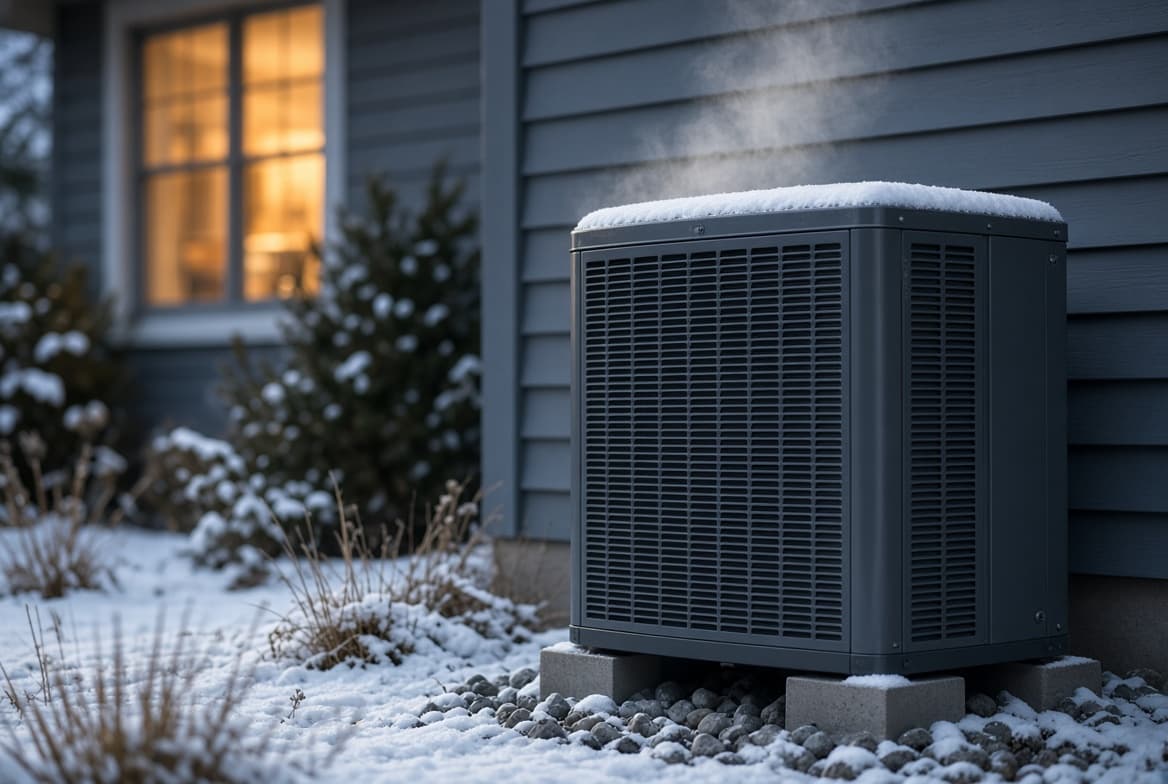
A dual fuel heat pump system pairs an electric heat pump with a gas, propane or oil furnace in the same ducted system. The heat pump cools in summer and heats in mild winter weather, when it's cheapest to run. Below a changeover temperature you choose, the control shuts the heat pump off and lets the furnace take over. You get the heat pump's efficiency most of the year and the furnace's hot, full-capacity heat on the coldest days.
It's also called a hybrid heat pump system. Where you set that changeover temperature decides how much money it saves, so most of this guide is about picking it with your own utility rates.
How a Dual Fuel System Works
A typical setup looks like a furnace with central air, with one difference: the outdoor unit is a heat pump, and the coil on top of the furnace is rated for heat pump use.
- Summer. The heat pump cools exactly like an air conditioner. The furnace blower moves the air.
- Mild winter weather. The heat pump runs in heating mode. The furnace burner stays off and only its blower runs.
- Below the changeover temperature. The control locks out the heat pump and fires the furnace.
- Defrost. When the heat pump defrosts its outdoor coil, it briefly runs in cooling mode. Most dual fuel controls fire the furnace during defrost so the house doesn't get cold air.
Why the two don't heat at the same time. The heat pump's indoor coil sits on top of the furnace, in the furnace's hot discharge air. If the furnace and the heat pump both heated at once, the furnace would push hot air across a coil that's trying to release heat, which drives refrigerant pressure up and can trip the heat pump's safeties. So dual fuel controls run one or the other for heating, with defrost the usual exception. That's different from a heat pump with electric strips, where strips and compressor often run together.
Dual Fuel vs Heat Pump With Electric Strips vs Furnace Plus AC
| Dual fuel (heat pump + furnace) | Heat pump + electric strips | Furnace + central AC | |
|---|---|---|---|
| Cooling | Heat pump | Heat pump | AC |
| Mild weather heat | Heat pump | Heat pump | Furnace |
| Coldest weather heat | Furnace | Heat pump plus strips | Furnace |
| Backup cost per unit of heat | Gas or propane price | Electric resistance, usually the most expensive | Not applicable |
| Fuel line and flue needed | Yes | No | Yes |
| Electrical load | Moderate | High (strips are often 10 kW or more) | Moderate |
| Heat during an outage with a small generator | Furnace can run | No | Furnace can run |
| Best fit | Cold climates with gas or propane and a sound furnace | All-electric homes, milder climates, or cold-climate heat pumps | Cheap gas, mainly heating needs |
If you're still deciding between systems, the heat pump vs furnace comparison covers the full trade-off.
Thermal vs Economic Balance Point
Two temperatures matter when you set up a dual fuel system.
The thermal balance point is the outdoor temperature where the heat pump's output equals your home's heat loss. Below it, the heat pump can't keep the house warm alone. Your installer finds it by plotting the home's heat loss (from a Manual J calculation) against the heat pump's capacity at different outdoor temperatures. A standard single-stage heat pump in an average house often reaches it somewhere in the 20s or 30s F. A cold climate heat pump can push it far lower.
The economic balance point is the outdoor temperature where the furnace becomes cheaper per unit of heat than the heat pump. It depends on your electricity price, your fuel price, the furnace's AFUE and the heat pump's COP at each temperature. With cheap gas and expensive electricity, it can be well above freezing. With propane, it's usually much lower.
Wisconsin's Focus on Energy program gives rough typical values in its heat pump buying guide: economic balance points of about 40 to 50 degrees F when natural gas is the backup, and about 15 to 20 degrees F when propane is. Treat those as a sense of scale, not a setting. Your rates decide it.
How to Find Your Changeover Temperature
Step 1: Calculate your break-even COP. Use your all-in winter rates from your bills.
| Backup fuel | Break-even COP |
|---|---|
| Natural gas | price per kWh × 29.3 × AFUE ÷ price per therm |
| Propane | price per kWh × 26.8 × AFUE ÷ price per gallon |
| Heating oil | price per kWh × 40.6 × AFUE ÷ price per gallon |
Example with made-up round numbers: electricity at 15 cents per kWh, natural gas at $1.50 per therm and a 95 percent furnace gives a break-even COP of about 2.8. The same electricity with propane at $2.50 per gallon gives about 1.5.
Step 2: Find where the heat pump's COP falls to that number. The manufacturer's extended performance data, or the NEEP cold climate product list for cold-climate models, lists COP at several outdoor temperatures such as 47, 17 and 5 degrees F. Find the temperature where COP crosses your break-even number. That's roughly your economic balance point.
Step 3: Pick the higher of the two balance points. If the economic point is 38 degrees and the thermal point is 25, set the changeover near 38: below that, the furnace is cheaper anyway. If the economic point is 15 and the thermal point is 25, set it near 25, because below that the heat pump can't hold temperature on its own.
Step 4: Revisit it. Utility rates change. Recheck the setting when rates move, and ask about it at annual service. Focus on Energy makes the same recommendation.
Some people choose a lower changeover than the pure cost math suggests, to cut fuel burning for its own sake or because propane deliveries are a hassle. That's a reasonable choice as long as the heat pump can still keep up.
Control Options
- Outdoor temperature lockout. The simplest approach: an outdoor sensor locks out the heat pump below a fixed temperature and enables the furnace. Most dual fuel thermostats and control kits work this way.
- Smart thermostat with dual fuel support. Uses a wired outdoor sensor or internet weather data, and some let you enter utility rates so they shift the changeover automatically.
- Communicating systems. Some manufacturers' matched heat pump, furnace and thermostat systems handle changeover in the equipment controls and can use the outdoor unit's own temperature reading.
- Droop or setpoint-based staging. The furnace comes on only if the house falls a few degrees below setpoint while the heat pump runs. This keeps the heat pump on longer but needs careful setup to avoid the coil issue described above.
Wiring matters here. A dual fuel thermostat uses O/B for the reversing valve, Y for the compressor and W for the furnace, and settings like "fossil fuel" or "dual fuel" have to be turned on during setup. See heat pump thermostat wiring for the terminals.
Can You Add a Heat Pump to Your Existing Furnace?
Often, yes, and it's the most common way people end up with dual fuel. It usually happens when the air conditioner fails and the furnace still has years left. Things to check:
- Furnace condition and age. Pairing a new heat pump with a furnace near the end of its life means replacing the furnace soon anyway.
- Coil. The indoor coil has to be rated for heat pump use and matched to the outdoor unit.
- Blower. A variable-speed or multi-speed blower can supply the airflow a heat pump wants in both heating and cooling.
- Controls. You'll need a dual fuel thermostat or a control kit, plus an outdoor temperature source.
- Ducts. Heat pumps usually need somewhat more airflow per ton than a furnace delivers at its heating speed.
If you're replacing the furnace too, the furnace installation guide covers sizing and efficiency choices.
When Dual Fuel Makes Sense
Good candidates:
- Cold climates with natural gas, where a furnace has several years left and the AC needs replacing.
- Propane homes. The high cost of propane per unit of heat means the heat pump carries most of the winter. See propane furnace running costs for that math.
- Homes that want heat during outages from a small generator, since a gas furnace's blower and controls need little power.
- Homes where the electrical panel can't handle 10 to 15 kW of backup strips without an expensive service upgrade.
Weaker candidates:
- Mild climates where the heat pump rarely needs backup.
- Homes without gas or propane, where adding fuel service just for backup costs more than strips.
- Very efficient homes where a cold-climate heat pump alone covers the design load.
Installed cost depends on whether you keep your furnace, the heat pump's size and efficiency, controls, coil and duct work. Federal tax credit rules changed in 2025, so check current federal, state and utility rebates before you count on one.
Common Dual Fuel Problems
| Symptom | Likely cause |
|---|---|
| Furnace runs in mild weather, heat pump rarely heats | Changeover set too high, outdoor sensor failed or misreading, dual fuel setting off |
| Heat pump runs in deep cold and the house won't hold temperature | Changeover set too low for the heat pump's capacity |
| Heat pump trips on high pressure in heating | Furnace and heat pump heating together because of a control setup error |
| Cold air during defrost | Control not set to fire the furnace during defrost |
| Thermostat shows "emergency heat" and only the furnace runs | Emergency heat selected by mistake. See the emergency heat setting guide |
What to Ask an Installer
- What thermal balance point did you calculate for our house and this heat pump?
- What changeover temperature do you recommend with our current rates, and how did you get there?
- Will the furnace fire during defrost?
- Is our furnace compatible with the dual fuel control, and is the coil matched to the heat pump?
- How do we change the changeover setting later if rates change?
Frequently Asked Questions
What is a dual fuel heat pump system?
It's a heat pump paired with a gas, propane or oil furnace in one ducted system. The heat pump handles cooling and heats in mild weather. When the outdoor temperature drops below a set changeover point, the control shuts the heat pump off and runs the furnace instead.
What temperature should a dual fuel system switch to the furnace?
Somewhere between your economic balance point, where the furnace becomes cheaper per unit of heat, and your thermal balance point, where the heat pump can no longer keep up. Wisconsin's Focus on Energy program cites typical economic balance points of about 40 to 50 degrees F with natural gas backup and about 15 to 20 degrees F with propane. Your own rates set the real number.
Is a dual fuel system worth it?
It's usually worth it in cold climates when you have a furnace with years of life left, or when you heat with propane and want to burn much less of it. It's less compelling where winters are mild, where gas is very cheap and electricity expensive, or where a cold-climate heat pump alone can carry the house.
Can I add a heat pump to my existing furnace?
Often, yes. The heat pump replaces your air conditioner's outdoor unit, a heat-pump-rated indoor coil goes on the furnace, and a dual fuel thermostat or control kit coordinates them. The furnace needs to be compatible with the control setup and in good condition, and the ducts need to handle the heat pump's airflow.
Does a dual fuel system need a special thermostat?
It needs a thermostat or control that supports dual fuel, meaning it can lock out the heat pump below a set outdoor temperature and run the furnace instead. That requires an outdoor temperature reading from a wired sensor, the outdoor unit or an internet weather feed. Some communicating systems handle this in the equipment controls.
Is a hybrid heat pump the same as dual fuel?
In US HVAC usage, yes. Hybrid heat and dual fuel both describe a heat pump with a fuel-burning furnace as backup. Some manufacturers use their own brand names for the same idea, and the term hybrid is also used for heat pump water heaters, which are a different product.