
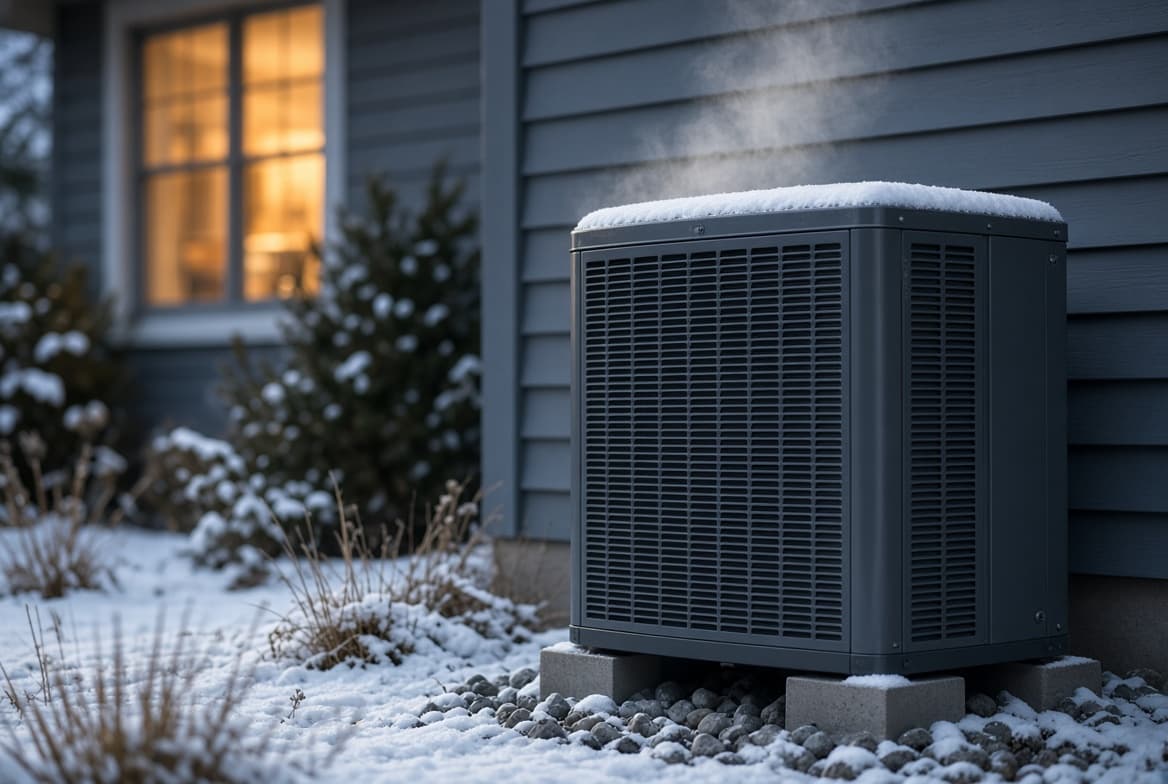
A cold climate heat pump is an air source heat pump built to keep delivering most of its heating capacity at temperatures far below freezing. It uses a variable-speed (inverter) compressor and refrigerant circuit designs that hold output at 5 degrees F and below, where a standard heat pump would lean heavily on backup heat. The two common benchmarks are ENERGY STAR's cold climate criteria and the NEEP cold climate specification. Both require a COP of at least 1.75 at 5 degrees F.
Matching the label is only half the job. A cold climate heat pump works well in a cold climate when it's sized to your home's heat loss at your local winter design temperature, and when the installer plans for snow, defrost and backup. This guide covers all three.
What Makes a Heat Pump "Cold Climate"
Every air source heat pump loses capacity as the outdoor temperature drops, because there's less heat in the air to collect and the compressor has to work across a bigger pressure difference. Cold-climate models fight that loss in a few ways:
- Variable-speed compressors that can run faster than their nominal speed in cold weather, so a unit's maximum output at 5 degrees F can stay close to its rated output at 47.
- Enhanced vapor injection or similar designs in some models, which inject refrigerant partway through compression to raise capacity and efficiency in the cold.
- Larger coils and refined defrost controls that frost up less often and defrost only when needed.
- Base pan heaters in many models to keep defrost water from freezing inside the unit.
ENERGY STAR Cold Climate vs NEEP: What the Specs Require
These are the two lists you'll see on rebate forms and spec sheets. They overlap but aren't identical.
| Requirement | ENERGY STAR cold climate (central heat pumps) | NEEP ccASHP specification, version 4.0 |
|---|---|---|
| Who runs it | U.S. EPA | Northeast Energy Efficiency Partnerships, a regional nonprofit |
| COP at 5 degrees F | At least 1.75 | At least 1.75, at maximum capacity |
| Capacity at 5 degrees F | At least 70 percent of capacity at 47 degrees F | No ratio required, but 5 degree capacity must be reported |
| Compressor | Not listed as a separate requirement in the key criteria | Must be variable capacity (three or more speeds, or continuously variable) |
| HSPF2 | At least 8.1 ducted, 8.5 ductless | At least 7.7 ducted, 8.5 ductless |
| SEER2 | At least 15.2 | At least 14.3 ducted, 15 ductless |
| Verification | Cold climate performance confirmed by a controls verification procedure | Manufacturer-reported lab or engineering data |
| Where to look it up | ENERGY STAR product finder | NEEP ccASHP product list |
The NEEP list is the more useful of the two for sizing, because it publishes minimum, rated and maximum capacity and COP at 47, 17 and 5 degrees F, and often at the model's lowest catalogued outdoor temperature. NEEP itself warns that meeting the spec doesn't make a unit right for every house. You still have to compare its output with your heat loss.
Both specs get revised. NEEP has a version 5.0 in development. Check the current version when you shop. For how the major makers' cold-climate lines compare, see top heat pump makers.
How Cold Can a Cold Climate Heat Pump Go?
Two different numbers get confused here:
- Minimum operating temperature is how cold it gets before the unit shuts itself off. For many cold-climate models this falls somewhere around negative 13 to negative 22 degrees F in the published specs.
- Capacity at temperature is how much heat it delivers when it's that cold. A unit can be "running" at negative 10 while producing only half the heat your house needs.
The second number is the one that decides whether you'll be comfortable. On the coldest nights, a well-chosen cold climate heat pump still delivers more heat per unit of electricity than resistance heat, since its COP stays above 1 down to its cutoff in most cases.
How to Size a Cold Climate Heat Pump
Traditional practice sized heat pumps for cooling and let electric strips cover the winter gap. In a cold climate that can mean strips run for weeks. The better approach sizes to heating.
Step 1: Get a real heat loss number. A Manual J calculation gives your home's heat loss in BTU per hour at your local 99 percent winter design temperature, the temperature your area stays above for 99 percent of the hours in a typical year. Your installer can look up the design temperature for your county.
Step 2: Find the unit's capacity at that temperature. Use the maximum capacity column at 5 degrees F (or the closest catalogued temperature) from the manufacturer's extended performance data or the NEEP list.
Step 3: Compare. Here's a worked example with made-up round numbers to show the method:
| Item | Example value |
|---|---|
| Heat loss at a 0 degree F design temperature | 36,000 BTU per hour |
| Unit A max capacity at 5 degrees F | 30,000 BTU per hour |
| Unit B max capacity at 5 degrees F | 38,000 BTU per hour |
Unit A covers most hours of the winter but needs backup heat on the coldest days. Unit B can carry the house down to design temperature on its own. Unit B probably costs more and is larger in cooling, but a variable-speed compressor can throttle down in summer, so oversizing for cooling matters less than it would with a single-stage unit.
Step 4: Check the low end. Compare the unit's minimum capacity at 47 degrees F with your heat loss on a mild day. If the minimum output is far above it, the unit will cycle on and off in spring and fall, which costs comfort and efficiency.
Step 5: Check the ducts. A ducted heat pump moves more air per BTU than a furnace, and its supply air is cooler. Undersized or leaky ducts, especially in an attic or crawl space, cut delivered heat.
Backup Heat in a Cold Climate
Even a heat pump sized to design temperature usually gets some backup. The question is what kind and how it's controlled.
| Backup option | How it works | Fits when | Watch for |
|---|---|---|---|
| Electric heat strips in the air handler | Resistance elements add heat when the heat pump can't keep up and during defrost | No gas service, all-electric home | Large electrical load, expensive per hour if they run often |
| Existing gas or propane furnace (dual fuel) | Furnace takes over below a set outdoor temperature | You already have a furnace with years left | Changeover setting decides how much the heat pump actually runs |
| Boiler or existing hydronic heat | Heat pump handles shoulder seasons, boiler covers the coldest weather | Homes adding ductless heads to a hot water system | Two separate control systems to coordinate |
| Wood or pellet stove, or none | Occupant-controlled backup | Very efficient homes, or homes with a reliable stove | No automatic coverage if the heat pump fails |
If you keep a furnace, see the dual fuel heat pump systems guide for how changeover temperatures work. With electric strips, ask for staging and an outdoor temperature lockout so the strips can't run on mild days, and learn the aux heat and emergency heat settings on your thermostat.
Check your electrical panel early. A heat pump plus 10 to 15 kW of strip heat is a big load for a 100-amp service that also feeds an electric range, dryer and water heater.
Installing a Heat Pump Where It Snows
Cold climates add outdoor details that warm-weather installs never deal with:
- Raise the outdoor unit on a stand or wall bracket above typical snow depth. A unit buried in drift can't breathe.
- Stay out of drip lines. Water dripping from a roof edge freezes into a cap that defrost can't melt. A small overhang above the unit can help, as long as it doesn't block the discharge.
- Plan defrost drainage. Each defrost cycle releases water. Make sure it drains away and won't freeze on a walkway or driveway.
- Mind prevailing wind. Wind blowing straight into the coil can make defrost less effective.
- Keep clearance for airflow and service on all sides, following the installation manual.
Is a Cold Climate Heat Pump Worth It?
It depends mostly on what you heat with now and what your energy costs.
| Current heat | Likely case for a cold climate heat pump |
|---|---|
| Electric baseboard or electric furnace | Strong. Same heat for much less electricity |
| Propane or heating oil | Often strong, depending on your fuel and electric prices |
| Natural gas, furnace near end of life | Compare with a new furnace plus AC, or go dual fuel |
| Natural gas, furnace in good shape | A heat pump with the furnace as backup can still cut gas use while adding efficient cooling |
The heat pump vs furnace by climate comparison shows how to run the cost per unit of heat with your own rates. For pricing factors, see heat pump installation cost. Federal tax credit rules changed in 2025, so check current federal, state and utility rebates before you count on one. Many state and utility programs in cold regions tie their rebates to the NEEP list or ENERGY STAR cold climate certification, so confirm which one your program uses before you pick a model.
What to Ask an Installer
- What heat loss did you calculate, and at what design temperature?
- What is this model's maximum capacity at 5 degrees F and at our design temperature?
- Is it on the NEEP list or ENERGY STAR cold climate certified, and does our rebate program require one of them?
- What backup heat will we have, and at what outdoor temperature does it lock in and out?
- How high will the outdoor unit sit, and where will defrost water go?
- Will our panel and ducts handle this system?
Frequently Asked Questions
How cold is too cold for a heat pump?
It depends on the model. Standard single-stage heat pumps often need backup heat once it drops into the 20s or 30s F in a typical house. Many cold-climate models keep running well below 0 degrees F, and their published minimum operating temperatures are often somewhere around negative 13 to negative 22 degrees F. Check the specific model and its capacity at your design temperature.
What makes a heat pump a cold climate heat pump?
There is no single legal definition, but two specs are widely used. ENERGY STAR's cold climate criteria require a COP of at least 1.75 at 5 degrees F, at least 70 percent of the 47 degree capacity at 5 degrees F, and higher HSPF2 than standard models. NEEP's specification requires a variable-capacity compressor and a COP of at least 1.75 at 5 degrees F at maximum capacity.
Do cold climate heat pumps need backup heat?
Not always. Sized to your heat loss at your winter design temperature, many can carry the whole load. Most installers still include some backup, either electric strips or an existing furnace, for temperatures below design, during defrost, and in case the outdoor unit fails.
Are cold climate heat pumps worth it?
They usually are when you heat with electric resistance, propane or oil, or when you need new air conditioning anyway. They cost more than standard heat pumps, and the payback depends on your electricity rate, your current fuel cost and how much of the winter they can run without backup.
Can a cold climate heat pump heat a whole house?
Yes, if the house's heat loss at design temperature is within the unit's capacity at that temperature and the ducts or indoor heads can deliver heat to every room. A ductless system with one head may heat an open main floor well and leave closed bedrooms cooler.
Where should a cold climate heat pump be installed outside?
On a stand or wall bracket high enough to stay above typical snow depth, away from roof drip lines, with clearance on all sides and a path for defrost water to drain away. Avoid spots where drifting snow piles up or where defrost runoff will freeze on a walkway.