
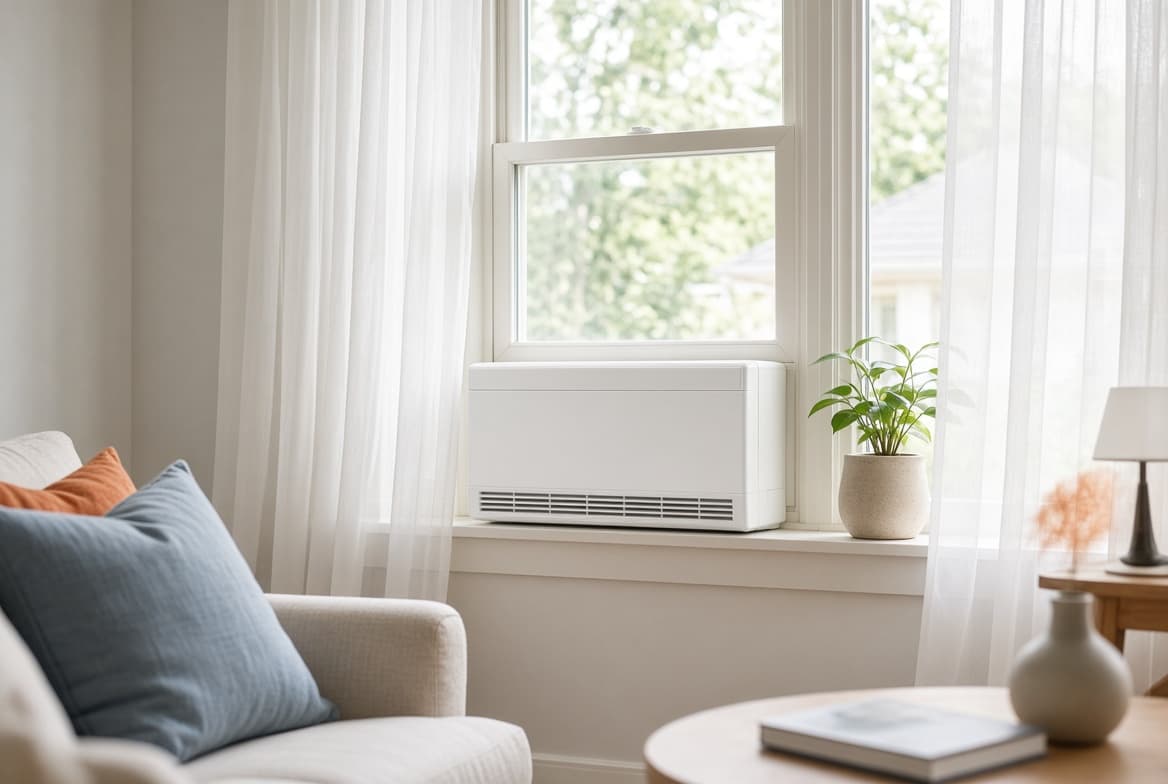
A window AC with heat is a window unit that also warms the room, either with an electric resistance heater (a heat strip) or by running its refrigerant cycle in reverse as a heat pump. Strip-heat models work at any outdoor temperature but cost the most per hour to run. Heat pump models make more heat per kilowatt-hour in mild weather, but many stop heating or fall back to a strip once it gets near 40 degrees F outside, so the spec sheet's minimum heating temperature matters more than the brochure.
Most of these units are one-room or supplemental heat. For the cooling side, fit and noise, see the best window air conditioner buyer's guide.
Electric Heat Strips vs Heat Pump Window Units
| Electric heat strip | Heat pump window unit | |
|---|---|---|
| How it heats | A resistance element in the indoor airstream | Reverses the refrigerant cycle to pull heat from outdoor air |
| Efficiency | Each watt makes about 3.412 BTU per hour of heat | More heat than the electricity it uses in mild weather |
| Cold weather | Works at any outdoor temperature | Output falls as it gets colder; many stop near 40 degrees F or switch to a backup strip |
| Typical voltage | 115 V for small heaters; 230/208 V for 3 kW and up | 115 V or 230/208 V |
| Running cost | Highest per hour of heat | Lower until the cutoff or backup point |
| Best fit | Short shoulder-season use, cold snaps | Regular heating in mild climates |
A heat pump moves heat instead of making it, which is why it gets more heat from each watt. For the full mechanism, see how a heat pump works.
How cold is too cold for a heat pump window unit?
There's no industry-wide number, so read the spec sheet. Two documented examples show the range:
- Friedrich Kühl: Friedrich's spec sheets say its 115 V heat pump models won't provide heat below 40 degrees F. Its 230 V heat pump models carry backup electric heat that takes over when it's too cold for the heat pump.
- Cold-climate window heat pumps: a newer category built for winter. Midea has said the window heat pump it developed for New York City public housing heats down to minus 13 degrees F, and Gradient's All-Weather 120 is a saddle-style heat pump that plugs into a standard 120 volt outlet.
Look for a line labeled minimum heating temperature, heat pump operating range or auxiliary heat. Below about 40 degrees F the outdoor coil also frosts, so the unit pauses heating to defrost, and the meltwater can drip and freeze on the sill below.
Sizing: Cooling and Heating Are Separate Numbers
Size cooling first, at about 20 BTU per square foot of floor area, then adjust for sun, kitchens and ceiling height with the room air conditioner sizing chart. Then check heat on its own line, because heat output is often well below cooling output. Retail listings for several 8,000 BTU, 115 V models show about 4,000 BTU of heat. LG's LW1216HR, a 230 V model, lists 11,200 BTU of heat at 230 V and 9,200 at 208 V.
A common rule of thumb for electric heat is about 10 watts per square foot for an insulated room in a moderate climate:
| Room size | Approximate heat needed |
|---|---|
| 150 sq ft | 1,500 W (about 5,100 BTU) |
| 250 sq ft | 2,500 W (about 8,500 BTU) |
| 350 sq ft | 3,500 W (about 11,900 BTU) |
| 450 sq ft | 4,500 W (about 15,400 BTU) |
Cold climates, older windows and exterior walls on several sides push those numbers up. A 4,000 BTU heater takes the chill off a small room but won't hold a 350 square foot room comfortable in real cold. Remember that 208 V lowers strip-heat output by roughly 18 percent compared with 230 V, which is why spec sheets list both.
Electrical Needs: 115 V vs 230 V, Circuits and Plugs
| Plug (NEMA) | Voltage | Typical use |
|---|---|---|
| 5-15P (standard household) | 115 V | Small units with modest heaters |
| 5-20P (one blade turned sideways) | 115 V | Some larger 115 V units; needs a 20 amp receptacle |
| 6-15P, 6-20P | 230/208 V | Mid-size units with roughly 3 kW and larger heaters |
| 6-30P | 230/208 V | Large units with the biggest heaters |
Heat mode often draws more current than cooling on strip-heat models, so check the nameplate's heating amps, not just cooling amps. The electrical code limits a cord-connected room air conditioner to 80 percent of the circuit's rating, and to 50 percent if the same circuit also feeds lights or other outlets. That's why manufacturers recommend a dedicated circuit for the bigger units.
The large plug with test and reset buttons on the cord is a leakage current detection device (LCDI), a type of cord protection the electrical code requires on room air conditioners. Don't cut it off or replace it. Adding a 230 V circuit is electrician work.
Window Types and Saddle-Style (U-Shaped) Units
- Double-hung and single-hung: fit the widest range, including saddle-style units.
- Sliding windows: need a slider-specific unit, and few of those heat.
- Casement windows: can't hold a window unit. A through the wall air conditioner and PTAC unit guide covers the wall-mounted alternatives, many of which also heat.
A saddle-style unit straddles the sill in a U shape, with the compressor outside and the controls inside, and the sash closes down into the channel. That puts the noisy parts outside and seals better than accordion panels, which matters more for a unit that stays in all winter. Check the sill depth, window height and required bracket before ordering.
What to Compare Before You Buy
- Heat output: BTU at 230 V and 208 V, or at 115 V.
- Heat type: strip, heat pump, or heat pump with strip backup.
- Minimum heating temperature: the single most important heat pump spec.
- CEER: the cooling efficiency rating. It says nothing about heating, so a high CEER doesn't make a model cheaper to heat with.
- Noise: published sound levels where listed; inverter and saddle models usually run quieter.
- Controls: a thermostat that reads room temperature accurately (some remotes sense at your seat), auto heat/cool changeover, scheduling, and automatic restart after a power outage.
- Electrical fit: voltage, amps and plug against the receptacle you have.
How Running Costs Compare
The math is simple: watts divided by 1,000, times hours of use, times your electric rate. At an example rate of 16 cents per kWh (use the rate on your bill), a 3,500 watt heat strip running 8 hours uses 28 kWh, or about $4.48 a day. A heat pump unit delivering the same heat in mild weather uses a fraction of that. Below its cutoff it either stops or runs its backup strip at strip-heat cost.
Strip heat in a window unit costs exactly what an electric baseboard heater costs for the same output. Neither is cheap as primary heat where gas is available or winters are long.
When a Mini Split Is the Better Answer
A ductless mini split is the stronger buy when:
- you need primary heat in a cold climate, since cold-climate mini splits keep heating well below freezing;
- you want to heat or cool more than one room;
- you want the window back, or quieter operation, with the compressor outside;
- the unit will run many hours a year, where lower running cost repays the higher installed price.
A window unit with heat wins on upfront cost, renter-friendliness and no permanent holes.
Safety: Cords, Clearances and Winter Use
- Plug straight into a properly rated wall receptacle. No extension cords, power strips or plug adapters.
- A warm or discolored plug or receptacle means a bad connection. Stop using it until it's fixed.
- Keep curtains, bedding and furniture out of the front grille's airflow, at the clearances the manual lists.
- Use the manufacturer's support bracket, and secure the sash so the unit can't fall.
- Keep snow and ice off the outdoor section and watch for icicles from defrost water.
- Don't open the case. Capacitors inside hold a charge after the unit is unplugged, and refrigerant work requires EPA Section 608 certification.
Frequently Asked Questions
Are window air conditioners with heat worth it?
They are worth it for one room that needs cooling in summer and some heat in spring, fall or mild winters, such as a bedroom over a garage, an addition or a sunroom. They're poor value as the only heat in a cold climate, because strip heat is expensive to run and many heat pump models stop heating near 40 degrees F.
Can a window AC with heat heat a whole house?
No. A window unit heats the room it sits in, and its heat output is usually smaller than its cooling output. A 115 volt model typically makes only a few thousand BTU of heat. Treat it as heat for one room or as a supplement to a central system.
Do window AC units with heat work in cold weather?
Electric strip heat works at any outdoor temperature, since it makes heat from electricity rather than outdoor air. Heat pump models are different: many stop heating, or hand off to a backup heater, somewhere around 40 degrees F. Newer cold-climate window heat pumps are rated much lower, so check the minimum heating temperature on the spec sheet.
Do window air conditioners with heat use a lot of electricity?
In heat mode with electric strips, yes. A 3,500 watt heater uses 3.5 kWh every hour it runs, the same as a 3,500 watt baseboard heater. A heat pump model uses noticeably less for the same heat in mild weather. Cooling use is the same as any window AC of similar size and CEER.
Do I need a 220V outlet for a window AC with heat?
Only for the larger models. Small units with modest heaters run on a standard 115 volt outlet, while models with heaters of roughly 3 kW and up usually need a 230/208 volt circuit and a matching NEMA 6-series receptacle. The nameplate and plug tell you which one you have. Never use an adapter.
Can you leave a window AC with heat in the window all winter?
Yes, that's what it's built for, but seal it well. Insulate the side panels, weatherstrip the gap between the sashes, and keep snow and ice clear of the outdoor section. A saddle-style unit seals better in winter because the window closes down into its channel.