
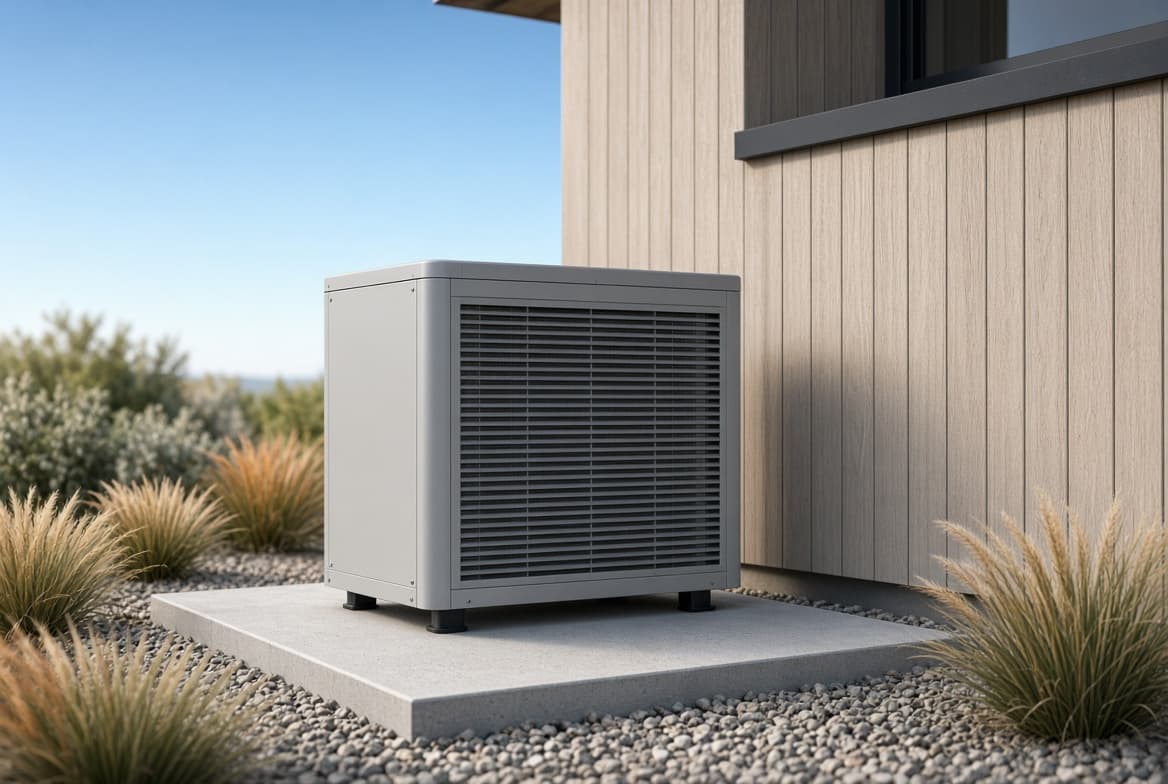
A SEER rating tells you how efficiently an air conditioner or heat pump cools over a typical season: the higher the number, the less electricity it uses for the same cooling. Since January 1, 2023, new equipment is rated with SEER2, an updated test that produces slightly lower numbers than the old SEER for the same unit. Federal minimums now start at 13.4 SEER2 for central air conditioners in the North and 14.3 SEER2 in the South for most home-sized units.
This guide explains what the number measures, how SEER2 and EER fit in, what the law requires where you live and how to work out what a higher rating would actually save you.
What Is SEER? The Seasonal Energy Efficiency Ratio
SEER stands for seasonal energy efficiency ratio. It's the total cooling a system delivers over a cooling season, in BTUs, divided by the total electricity it uses over that season, in watt-hours.
A 16 SEER system delivers 16 BTUs of cooling for every watt-hour of electricity. A 10 SEER system delivers 10. The rating comes from a standardized lab test at several outdoor temperatures and part-load conditions, weighted to represent an average U.S. cooling season. It's a comparison tool, like a car's fuel economy rating, rather than a promise about your own electric bill.
Two things about SEER that often get missed:
- It's a rating for a combination, not just the outdoor unit. The SEER or SEER2 on a split system belongs to a specific outdoor unit paired with a specific indoor coil, and sometimes a specific furnace or air handler. The same condenser can carry different ratings with different coils.
- Your real efficiency depends on installation. Leaky or undersized ducts, a wrong refrigerant charge and poor airflow can keep any system from reaching its rating.
SEER vs. SEER2: What Changed in 2023
The Department of Energy updated its test procedure for central air conditioners and heat pumps, and the new metrics, SEER2, EER2 and HSPF2, took effect for equipment manufactured from January 1, 2023.
The biggest change is airflow resistance. The old test assumed very little resistance from ductwork, around 0.1 inches of water column of external static pressure. The new test, known as Appendix M1, uses 0.5 inches, which is much closer to what real homes with filters and ducts impose. More resistance means the blower works harder and the system delivers a little less, so the same equipment earns a lower number.
| Equipment | Approximate SEER2 from SEER | Approximate HSPF2 from HSPF |
|---|---|---|
| Ducted split system | SEER x 0.95 | HSPF x 0.85 |
| Ducted packaged unit | SEER x 0.95 | HSPF x 0.84 |
| Ductless mini-split | About the same (x 1.00) | HSPF x 0.90 |
These conversion factors are approximations used by the energy rating industry, so treat them as a way to compare an old system's label with a new one, not as exact values. A 16 SEER ducted system from 2020 is roughly a 15.2 SEER2 system in today's terms.
When you compare quotes, make sure every number is on the same scale. A contractor quoting SEER2 for one system and another quoting SEER for a different one makes the higher number look better than it is.
Federal Minimum SEER2 Requirements by Region
DOE efficiency standards for central air conditioners differ by region. Heat pumps have one national standard.
| Equipment (made from Jan. 1, 2023) | North | Southeast | Southwest |
|---|---|---|---|
| Split AC under 45,000 Btu/h (under about 3.75 tons) | 13.4 SEER2 | 14.3 SEER2 | 14.3 SEER2 and 11.7 EER2 (9.8 EER2 if 15.2 SEER2 or higher) |
| Split AC 45,000 Btu/h and up | 13.4 SEER2 | 13.8 SEER2 | 13.8 SEER2 and 11.2 EER2 (9.8 EER2 if 15.2 SEER2 or higher) |
| Packaged AC | 13.4 SEER2 | 13.4 SEER2 | 13.4 SEER2 and 10.6 EER2 |
| Split heat pump | 14.3 SEER2, 7.5 HSPF2 | Same | Same |
| Packaged heat pump | 13.4 SEER2, 6.7 HSPF2 | Same | Same |
For reference, 13.4 SEER2 corresponds to the old 14 SEER and 14.3 SEER2 to the old 15 SEER. Before 2023, the minimum for a split AC was 13 SEER in the North and 14 SEER in the South.
Which region are you in?
- Southeast: Alabama, Arkansas, Delaware, Florida, Georgia, Hawaii, Kentucky, Louisiana, Maryland, Mississippi, North Carolina, Oklahoma, South Carolina, Tennessee, Texas, Virginia, the District of Columbia and the U.S. territories.
- Southwest: Arizona, California, Nevada and New Mexico.
- North: every other state.
The installation-date rule in the South
In the North, the standard applies by manufacture date, so older compliant inventory can still be installed. In the Southeast (for split air conditioners) and the Southwest, the standard is enforced by installation date. A split AC that doesn't meet the regional minimum can't legally be installed there, no matter when it was built. DOE also requires that, in those regions, the outdoor unit have a compliant rating with a coil, not just with a particular furnace or air handler. If a quote offers a bargain on an older-stock unit, ask the contractor to confirm it meets your region's rule.
EER vs. SEER: Peak Heat vs. Seasonal Average
EER, the energy efficiency ratio, measures efficiency at one hot, steady condition: 95 degrees outdoors, with indoor air at 80 degrees and moderate humidity. EER2 is the same idea on the newer test.
SEER averages performance across a range of milder temperatures, which is where an air conditioner spends most of its hours. That means a variable-speed system that's very efficient at low speed can earn a high SEER while its EER, at full output on a scorching afternoon, is closer to a simpler unit's.
| Rating | What it measures | When it matters most |
|---|---|---|
| SEER / SEER2 | Seasonal average cooling efficiency | Comparing cooling costs over a typical year |
| EER / EER2 | Cooling efficiency at 95 degrees outdoors | Very hot climates and peak-demand days |
| HSPF / HSPF2 | Seasonal heating efficiency of a heat pump | Heat pump heating costs |
| COP | Instantaneous heating efficiency at a given temperature | Cold-climate heat pump performance |
That's why the Southwest, where long stretches above 95 degrees are common, has an EER2 minimum in addition to SEER2. If you live somewhere similar, ask for both numbers when you compare equipment.
What Is a Good SEER Rating?
New central systems today range from the regional minimum up to the mid-20s SEER2 for top-tier variable-speed models. A good rating for you depends on climate, electricity cost and how long you plan to stay. If you're comparing makers at the top of that range, our best AC brands guide lines up their efficiency tiers and warranty terms, and Trane vs Carrier compares two of the most common premium lines.
| Your situation | Sensible range | Why |
|---|---|---|
| Mild summers, low electric rates | Minimum to about 15 SEER2 | Not enough cooling hours to pay back a premium |
| Moderate summers | About 15 to 17 SEER2 | Two-stage systems often hit a good balance |
| Long, hot cooling season | About 16 SEER2 and up | More hours means faster payback |
| Humidity is a problem | Two-stage or variable-speed | Longer low-speed runs pull more moisture |
| Replacing a heat pump | Look at HSPF2 too | Heating efficiency may matter more than cooling |
Higher-rated systems usually get there with two-stage or variable-speed compressors and variable-speed blowers, which also run quieter and hold temperature more evenly. Those comfort gains are worth weighing alongside the energy savings.
How to Estimate Savings Between Two SEER Ratings
The math is simple once both ratings are on the same scale:
Cooling energy savings = 1 minus (old rating divided by new rating)
Going from 10 SEER to 16 SEER: 1 minus 10/16 = 0.375, or about 37.5 percent less electricity for the same cooling. Going from 14 SEER2 to 16 SEER2: 1 minus 14/16 = 0.125, or 12.5 percent. Each step up saves less than the one before, which is why the jump from an old, inefficient unit is where the big savings live.
To turn that into dollars, estimate your annual cooling cost first:
Annual cooling kWh = (system size in BTU per hour x cooling hours per year) / (SEER x 1,000)
Here's an illustrative example with assumed numbers: a 3-ton system (36,000 BTU per hour) running 1,500 hours a year. At 10 SEER, that's 36,000 x 1,500 / 10,000 = 5,400 kWh. At 16 SEER, it's 3,375 kWh. The difference is 2,025 kWh a year. Multiply by your electric rate from your utility bill to see the dollar figure for your home. Your own cooling hours depend on climate, thermostat settings and the house, so treat this as a rough estimate.
Then compare that yearly saving with the extra cost of the higher-rated system. Our AC replacement cost guide covers what drives the price difference between efficiency tiers.
SEER, HSPF and Heat Pumps
Heat pumps carry two ratings: SEER2 for cooling and HSPF2 for heating. HSPF2 is the seasonal heating output divided by the electricity used, including backup electric resistance heat. In colder regions, the heating rating usually matters more for your bills than the cooling one.
ENERGY STAR now certifies heat pumps but no longer certifies central air conditioners; that program ended in 2026. For a standard split heat pump, the current ENERGY STAR criteria are at least 15.2 SEER2, 11.0 EER2 and 7.8 HSPF2. Cold climate heat pumps have tighter criteria, including a coefficient of performance of at least 1.75 at 5 degrees and heating capacity at 5 degrees of at least 70 percent of what the unit delivers at 47 degrees. If you're deciding between systems, see our heat pump vs air conditioner comparison.
Furnaces use a different scale. Their efficiency is rated by AFUE, the share of fuel that becomes heat in your home. Our guide to AFUE ratings for furnaces covers that side of the system.
How to Find Your System's SEER Rating
- Check the yellow EnergyGuide label on the outdoor unit, if it's still there.
- Read the model numbers from the data plates on the outdoor unit and the indoor coil or air handler.
- Look up the combination in the AHRI Directory of Certified Product Performance. It lists the certified rating for that exact pairing.
- Ask for the AHRI certificate when you buy a new system. It's proof that the combination in your quote has the rating you're paying for.
If your system is old enough that the label is gone and the model isn't listed, its age is a clue. Before 2006 the federal minimum for central air was 10 SEER, so many systems from that era are rated around 10 to 12 SEER. Our guide to how long an AC unit lasts helps you judge whether a system that old is due for replacement.
Getting the Rated Efficiency in Real Life
A high SEER2 rating is only the starting point. To get close to it:
- Size the system correctly. An oversized system short-cycles and never settles into efficient operation. Ask for a Manual J load calculation; our guide on how to size an AC unit explains it.
- Fix the ducts. Leaky ducts in an attic or crawlspace can waste a large share of the cooling you pay for.
- Get the charge right. The installer should set refrigerant charge by superheat or subcooling against the manufacturer's targets.
- Check airflow and static pressure. A restrictive filter or undersized return starves the coil.
- Keep it maintained. Clean coils and filters keep a system near its rated efficiency.
Frequently Asked Questions
What is a good SEER rating?
For most homes, a good SEER2 rating sits a few points above the federal minimum for your region, roughly 15 to 17 SEER2. Hot climates with long cooling seasons get more payback from higher ratings. Mild climates often don't run the AC enough to justify the top tiers.
What is the difference between SEER and SEER2?
SEER2 uses an updated federal test procedure that took effect on January 1, 2023. It tests equipment at a higher external static pressure that better reflects real ductwork, so the same unit scores lower on SEER2. For ducted systems, SEER2 is roughly 0.95 times the old SEER number.
What is the minimum SEER rating in 2026?
Under the DOE standards in effect since January 1, 2023, new split-system central air conditioners must meet 13.4 SEER2 in the North and 14.3 SEER2 in the Southeast and Southwest for units under 45,000 Btu/h (13.8 SEER2 for larger units). Split heat pumps must meet 14.3 SEER2 nationwide.
Is a higher SEER rating always worth it?
No. A higher SEER2 rating lowers cooling energy use, but it costs more up front, and the payback depends on your climate, electricity price and how long you'll keep the system. Proper sizing and installation can matter as much as a few points of SEER2.
What is the difference between EER and SEER?
SEER averages efficiency over a range of outdoor temperatures across a cooling season. EER measures efficiency at one hot condition, 95 degrees outdoors. EER is a better guide to how a system performs on the hottest days, which is why the Southwest has EER2 minimums as well as SEER2.
How do I find my AC's SEER rating?
Look for the yellow EnergyGuide label on the outdoor unit or in the paperwork. If it's gone, the model numbers of the outdoor unit and the indoor coil can be looked up in the AHRI directory, which lists the certified rating for that exact combination.