
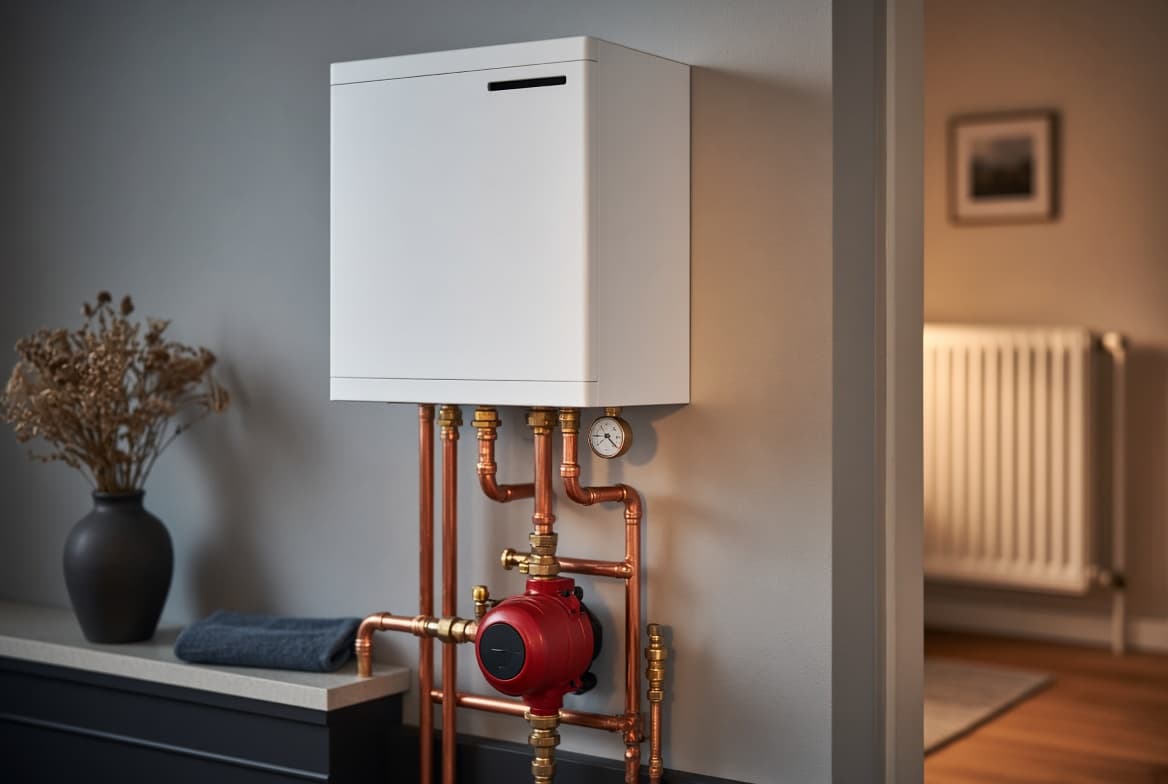
A baseboard heater is a long, low heater mounted along the bottom of a wall, usually under a window, that warms the room by natural convection. Most are electric: current runs through a resistance element, fins pass the heat to the air, and the warm air rises while cooler air is drawn in at the floor. Hydronic baseboard looks similar but carries hot water from a boiler.
Electric baseboard is cheap to install and gives room-by-room control, but it is one of the most expensive ways to heat with electricity. Below: types, sizing, the cost math with your own rates, safety, problems, and when a ductless heat pump pays.
How an Electric Baseboard Heater Works
There is no fan and nothing moves. A resistance element runs through aluminum fins. When the thermostat closes the circuit, cool air enters at the bottom and warm air leaves through the top louvers. Under a window, that loop counters cold air falling off the glass.
A high-limit switch, often a sensing tube running the full length of the heater, cuts power if any section overheats, usually because something is blocking airflow. Most reset on their own once the heater cools.
Standard residential units are commonly rated around 250 watts per foot, so a 4-foot heater is about 1,000 watts and a 6-foot heater about 1,500. Check the label on yours.
120 volts vs 240 volts
- 240 volts is the norm for hardwired heaters, since lower current means more heaters per circuit.
- 120 volts suits a small room with only a 120-volt circuit nearby, and all plug-in models.
- Never install a 120-volt heater on a 240-volt circuit. Doubling the voltage roughly quadruples the output, which can burn out the element and start a fire.
- A 240-volt heater on 120 volts runs safely but makes only about a quarter of its rated heat.
- Many apartments and condos have 208-volt service, where a 240-volt heater makes about 75 percent of its rating.
Built-in vs wall-mounted line-voltage thermostats
Baseboards are switched by a line-voltage thermostat that carries the full 120 or 240 volts. The 24-volt thermostats used with furnaces cannot run them without a relay.
- Built-in thermostats sit on the end of the heater. They are cheap but read air near the floor beside the heat, so rooms swing warm and cold.
- Wall-mounted thermostats sense room air on an interior wall about 5 feet up and can run several heaters. Electronic and programmable models hold temperature tighter and handle setbacks automatically. Line-voltage smart models add remote control and runtime history.
- Check the rating. The thermostat must be rated for line voltage and for the total watts on its circuit.
On 240-volt circuits, prefer double-pole thermostats. A single-pole model breaks only one leg, so the heater still has voltage on it at "off." Shut the breaker before any work either way.
Hydronic vs Electric Baseboard Heat
Hydronic baseboard runs hot water from a boiler through copper pipe with aluminum fins. It heats by the same convection loop, but the energy comes from the boiler's fuel.
| Factor | Electric baseboard | Hydronic baseboard (boiler) |
|---|---|---|
| Heat source | Resistance element in each heater | Hot water from a gas, oil, propane or electric boiler |
| Running cost | One unit of heat per unit of electricity | Depends on fuel and boiler efficiency, often lower |
| Install cost | Low: heater, thermostat, circuit | High without an existing boiler: boiler, piping, pump, venting |
| Heat feel | Heats and cools quickly | Gentle and even, slower to recover |
| Zoning | Every room is its own zone | Zones need extra valves or circulators |
| Maintenance | Vacuum fins, check thermostats | Boiler service, bleeding air, leak checks |
Liquid-filled electric baseboards, which heat sealed fluid with an element, are often marketed as more efficient. They give steadier heat, but each kilowatt-hour still makes 3,412 BTU. Buy one for comfort, not a lower bill.
Hydronic output depends on water temperature. Manufacturer ratings for typical residential fin-tube are roughly 500 to 600 BTU per hour per foot at 180°F water, and much less at the lower temperatures a condensing boiler or heat pump prefers. Converting to a low-temperature heat source can mean adding baseboard length or switching rooms to radiant floor heating. For hot water vs forced air at the system level, see the boiler vs furnace comparison.
What Size Baseboard Heater Do I Need?
The common rule of thumb is about 10 watts per square foot of floor area, for 8-foot ceilings and average insulation. Treat it as a starting point.
| Room condition | Watts per sq ft (rule of thumb) | 12 by 12 room (144 sq ft) |
|---|---|---|
| New, well insulated, tight | about 7.5 to 8 | about 1,100 W |
| Average insulation, 8-foot ceiling | about 10 | about 1,450 W |
| Older, drafty, single-pane windows | about 12.5 to 15 | about 1,800 to 2,150 W |
Then adjust:
- Ceiling height. Scale roughly with height: a 10-foot ceiling needs about 25 percent more than 8 feet.
- Climate. The rule assumes a moderate heating climate. Go up in cold regions, down in mild ones.
- Exposure. Corner rooms, big windows, rooms over a garage and basements with bare walls need more.
- Placement. Two shorter heaters under two windows heat more evenly than one long one.
Undersizing is the worse mistake: the room never reaches setpoint on cold nights. Oversizing wastes little energy but adds wire and panel load. For a whole-house job, ask for a room-by-room heat loss calculation (Manual J).
Electric Baseboard Heat Cost: How to Work It Out
Electric baseboard is 100 percent efficient at the heater, which only means each kilowatt-hour becomes 3,412 BTU. Your bill depends on how many kilowatt-hours you buy.
The formula: watts × hours of actual running time ÷ 1,000 = kWh, then kWh × your price per kWh = cost.
Example (example numbers, use your own): a 1,500-watt heater running 8 hours a day after thermostat cycling, for 30 days, at an example all-in rate of 15 cents per kWh.
- 1,500 × 8 ÷ 1,000 = 12 kWh per day
- 12 × 30 = 360 kWh per month
- 360 × $0.15 = about $54 per month, or about 22 cents for each hour fully on
Your all-in rate is a winter bill's total, delivery charges included, divided by the kWh used.
Running hours are the hard part, since thermostats cycle. Three ways to get a real number:
- Compare bills. Subtract a mild month's kWh (no heating or cooling) from a winter month's. The difference is roughly your heating use.
- Check your utility's interval data. Many utilities with smart meters show hourly use online, and baseboard heat stands out on cold nights.
- Use a smart line-voltage thermostat that reports runtime per room.
Why resistance heat costs more per BTU than a heat pump
A baseboard heater converts electricity to heat one to one. A heat pump moves heat from outdoors, delivering two to four units per unit of electricity in mild weather. The Department of Energy notes that switching from resistance heat to a heat pump can cut heating electricity use by about half. Using the method from the electric furnace guide:
| Heat source | Cost per million BTU | At an example 15 cents per kWh |
|---|---|---|
| Electric baseboard | price per kWh × 293 | about $44 |
| Ductless heat pump, seasonal COP 2.5 | price per kWh × 293 ÷ 2.5 | about $18 |
| Ductless heat pump, seasonal COP 3 | price per kWh × 293 ÷ 3 | about $15 |
COP is heat delivered per unit of electricity; seasonal averages vary with climate and model.
Ways to lower the bill
- Use setbacks. The claim that leaving heaters on all the time is cheaper does not hold for resistance heat: a warmer house loses heat faster, and baseboards recover quickly.
- Replace built-in dials with programmable wall thermostats.
- Heat only rooms in use, keep fins clean, and seal air leaks.
Baseboard Heater Safety
Most baseboard fires start with something combustible touching the heater.
- Clearances. Follow your model's manual. Manufacturers commonly ask for at least 6 inches between the heater's front and furniture, and many safety guides recommend 12. Drapes must never touch or hang over the heater.
- Don't block airflow. No furniture against the louvers, no clothes drying on top, no deep carpet pinching the bottom inlet.
- Never mount one under a wall outlet. Manuals prohibit it because cords draped over the heater can melt.
- Children and pets. Covers get hot. Keep toys and paper out of the fins, and consider a cooler-surface model or a guard in a child's room.
Circuit and breaker sizing
The electrical code treats fixed electric space heating as a continuous load, so the circuit is sized at 125 percent of the heater current. In practice a circuit carries no more than 80 percent of its breaker rating:
| Circuit | Max heater load | Typical copper wire |
|---|---|---|
| 15 A at 240 V | about 2,880 W | 14 AWG |
| 20 A at 240 V | about 3,840 W | 12 AWG |
| 20 A at 120 V | about 1,920 W | 12 AWG |
A 1,500-watt, 120-volt heater draws 12.5 amps, about 15.6 amps at 125 percent, so it needs a 20-amp circuit. Code editions and local amendments vary; the electrician's load calculation decides.
What a homeowner should not attempt
- Opening the wiring compartment with the breaker on. A thermostat at "off" may leave a leg live.
- Adding a heater to a circuit without checking the total load.
- Bypassing a limit switch or upsizing a breaker that keeps tripping.
- New 240-volt circuits or panel work. That belongs to a licensed electrician, usually under a permit.
Common Baseboard Heater Problems
| Symptom | Likely cause | What to do |
|---|---|---|
| No heat | Tripped breaker, setpoint too low, failed thermostat, loose wire | Check breaker and setpoint; wiring and thermostat tests need a meter |
| Heater won't shut off | Thermostat contacts stuck, or built-in sensor reading the wrong air | Replace the thermostat or move to a wall-mounted one |
| Heats, then shuts off | High-limit tripping from blocked airflow or heavy dust | Clear and vacuum the fins; repeat trips need a technician |
| Burning dust smell | Dust burning off at the season's first run | Normal for a few minutes; vacuum the fins first |
| Hot plastic or electrical smell | Something touching the heater, or an overheated connection | Shut it off at the breaker and inspect |
| Ticking as it heats | Element and housing expanding | Usually harmless; check it is level and secure |
On an older heater, a failed element often means replacing the whole unit, which may cost little more than the part. For other systems in the house, see the heating repair guide.
When to Replace Baseboard Heat With a Ductless Mini Split
A ductless mini split is a heat pump with wall-mounted indoor heads and no ducts, so it fits the same houses baseboard heat does. The ductless mini split guide explains how they work. The switch makes sense when:
- Winter bills are high and most of the house runs on baseboards.
- You want cooling too. One system replaces both the baseboards and the window units.
- Heaters or thermostats are failing and you are rewiring anyway.
- The layout is open, so one or two heads can cover several baseboard rooms.
Many owners keep a few baseboards as backup. For one room, a window AC with heat is a smaller step, but only heat pump models beat resistance heat on cost.
Baseboard Heater Installation Cost Factors
Most published cost guides put a standard hardwired electric baseboard heater at roughly $400 to $1,000 installed. The heater alone commonly runs about $50 to $300 in common residential sizes. What raises the price:
- New circuits. Swapping a heater on an existing, correctly sized circuit is quick. A new 240-volt run through finished walls adds most of the cost.
- Panel capacity. An older 100-amp service may need a load calculation, and sometimes an upgrade, before several heaters fit.
- Thermostats. Programmable and smart line-voltage models add parts and labor.
- Permit and inspection, usually required for new circuits.
- Hydronic work, which means boiler capacity, piping and a heating contractor.
What to ask an electrician or contractor
- What wattage does each room need, and how did you size it?
- Is my supply 240 or 208 volts, and are these heaters rated for it?
- How many heaters per circuit, and what breaker and wire size?
- Does my panel have capacity?
- Will you install double-pole wall thermostats?
- Is the permit included?
Frequently Asked Questions
Are baseboard heaters expensive to run?
Electric ones usually are, because each kilowatt-hour makes only 3,412 BTU of heat. A 1,500-watt heater on full output uses 1.5 kWh per hour, so multiply 1.5 by your price per kWh. Hydronic baseboard costs whatever the boiler's fuel costs, which is often less.
How much does it cost to run a baseboard heater per month?
Multiply watts by the hours it actually runs, divide by 1,000, and multiply by your rate. A 1,500-watt heater running 8 hours a day for 30 days uses 360 kWh, about $54 at an example rate of 15 cents per kWh.
Is it cheaper to leave baseboard heaters on all the time?
No. A house loses heat faster the warmer it is inside, so holding a lower temperature while you sleep or are away uses less electricity. Electric baseboards recover quickly, so setbacks work well with them.
Can baseboard heaters cause a fire?
Yes, if something combustible touches or covers them, usually drapes, bedding, furniture or papers. Keep the clearances in the installation manual, never mount one under an outlet, and never bypass the high-limit switch.
How long do baseboard heaters last?
Electric baseboard heaters have no moving parts and commonly last 20 years or more. Thermostats and limit switches usually fail first and are replaceable. Hydronic baseboard lasts as long as the piping stays free of leaks and corrosion.
Is a mini split cheaper to run than baseboard heat?
Almost always. A ductless heat pump delivers two to four units of heat per unit of electricity in mild weather, and more than one in most cold weather, while a baseboard heater makes exactly one.