
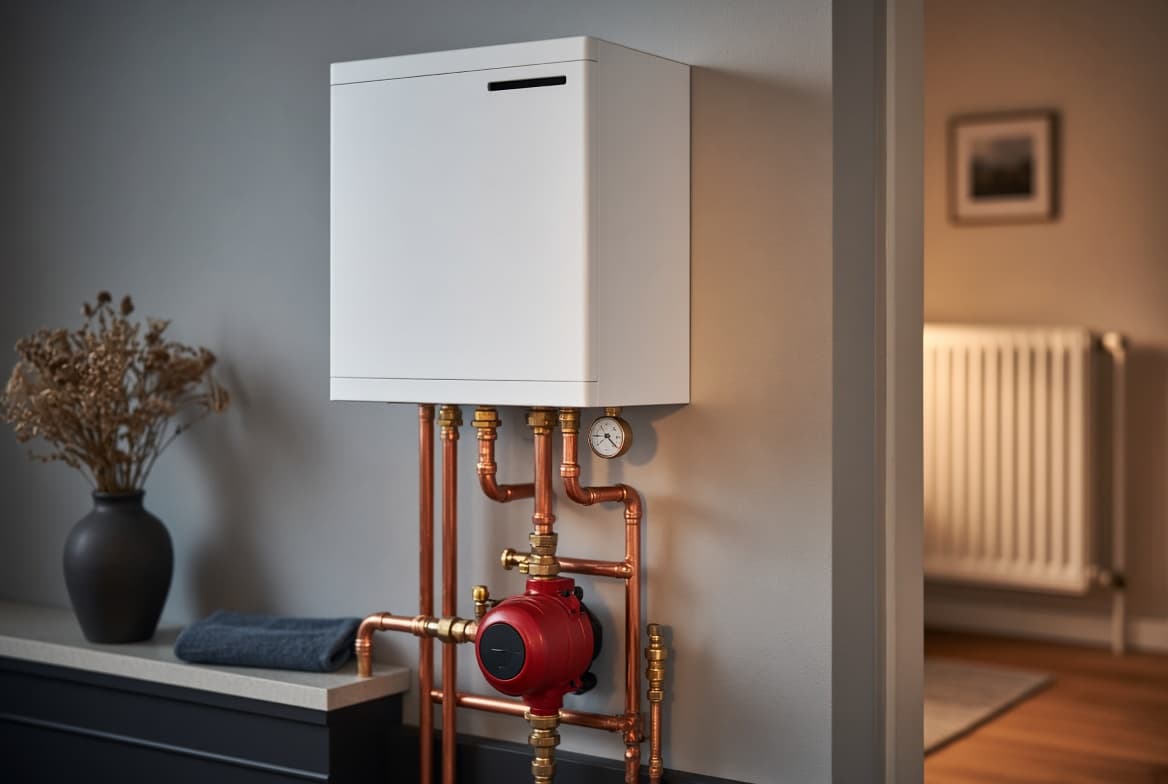
A combi boiler is a single wall-hung, gas-fired condensing appliance that heats your home through a hydronic system and also makes domestic hot water on demand, with no storage tank. It replaces a boiler and a water heater with one box about the size of a kitchen cabinet. It works best in smaller homes with hot water heat and modest hot water use, and it falls short where several showers regularly run at once.
What Is a Combi Boiler?
"Combi" is short for combination. Inside the cabinet are the parts of any modern condensing boiler plus the hardware for hot water:
- Modulating burner. Fires at a variable rate. Most US combis run on natural gas, and many convert to propane with a kit.
- Primary heat exchanger. Usually stainless steel; it heats the water that circulates to your radiators, baseboard or floor tubing.
- Circulator and expansion tank. Built into the cabinet on many models.
- Diverter valve and plate heat exchanger. The valve sends boiler water either to the heating loop or to a compact brazed-plate exchanger, where it heats your tap water without the two ever mixing.
- Flow sensor. Detects when a faucet or shower opens.
Because it recovers heat by condensing water vapor out of the flue gas, a combi vents through plastic pipe and produces acidic condensate that has to be drained.
A combi needs hydronic distribution to heat the house. In a home with ducts and registers it would need a hydronic air handler (fan coil) added, a design question covered in the boiler vs furnace comparison.
How a Combi Boiler Prioritizes Hot Water
A combi can't make heat and hot water at full output at the same time, so it takes turns, and hot water wins.
- The thermostat calls and the boiler heats the house, modulating to match the load.
- A tap opens and the flow sensor sees water moving.
- The diverter valve swings boiler water to the plate heat exchanger and the burner ramps toward full fire.
- The tap closes and space heating resumes.
During a 10-minute shower your radiators get no new heat. That's rarely noticeable, because the water and emitters hold heat, but back-to-back showers on the coldest morning are a different story. Hot water also takes a few seconds longer to arrive than from a tank; some models offer a preheat setting or small internal buffer to shorten the lag.
How to Size a Combi Boiler
A combi has two jobs with very different appetites, and sizing means satisfying both.
Step 1: The heating load in BTU per hour
The heating side should come from a room-by-room heat loss calculation (ACCA Manual J or an equivalent hydronic method), not from the old boiler's nameplate, since older boilers were routinely oversized. A small, reasonably tight house may need well under 40,000 BTU per hour on the coldest design day.
Step 2: The hot water flow in gallons per minute
Heating water takes about 500 BTU per hour for each gallon per minute and each degree of rise (8.33 pounds per gallon times 60 minutes):
Required output (BTU/hr) = flow (GPM) x 500 x temperature rise (degrees F)
Temperature rise is the gap between incoming cold water and the temperature you want out. Incoming water tracks groundwater: in northern states it can drop into the 40s in winter, and along the Gulf Coast it can stay near 70.
Here's what one hypothetical combi delivering 140,000 BTU per hour to the hot water side can supply at a 120 degree setpoint:
| Incoming water temperature | Temperature rise | Approximate flow at 120 degrees |
|---|---|---|
| 40 degrees (northern winter) | 80 degrees | 3.5 GPM |
| 50 degrees | 70 degrees | 4.0 GPM |
| 60 degrees | 60 degrees | 4.7 GPM |
| 70 degrees (Gulf Coast) | 50 degrees | 5.6 GPM |
Same box, same gas, and usable flow drops by more than a third between a Gulf Coast summer and a northern winter. Showers mix in cold water, so flow at the showerhead runs somewhat higher, but the seasonal ratio holds. Many current showerheads are rated around 2.0 GPM and older ones 2.5 GPM or more, so two showers plus a kitchen faucet add up fast.
Add up the fixtures that realistically run at the same time in your house, then check that total against the manufacturer's flow table at your winter rise, not the brochure's headline number.
Step 3: Check the turndown
This is the step most comparisons skip. Hot water pushes you toward a big burner, often 120,000 to 199,000 BTU per hour, while your heating load may be a quarter of that, and a small fraction of it on a mild day. If the burner can't throttle down far enough, the boiler short cycles: it fires, overshoots, shuts off and repeats, which wastes fuel and wears out ignition parts and controls.
Look at the minimum firing rate, often expressed as a turndown ratio. A 150,000 BTU per hour combi with 10:1 turndown fires as low as 15,000; at 5:1 it bottoms out at 30,000. If that minimum sits well above your typical winter heating load, ask about deeper turndown, a buffer tank, or a heat-only boiler with an indirect tank.
When a Combi Boiler Fits, and When It Doesn't
| Your home | Combi fit | Why |
|---|---|---|
| One or two bathrooms, one shower at a time | Strong | Demand stays inside a combi's range year-round |
| Existing hydronic heat (baseboard, radiators, radiant floors) | Strong | The distribution is already in the walls |
| Tight mechanical space or a condo | Strong | Wall-hung, no tank |
| Replacing an old boiler and water heater together | Strong | One appliance, one vent, one service visit |
| Two or more showers often running together | Weak | Flow drops or temperature swings when draws overlap |
| Large home with several baths and a big heating load | Weak | Burner sizing and simultaneous demand both work against it |
| Ducted forced-air house with no hydronic loop | Poor | Can't heat the house without a fan coil or new emitters |
| Very hard water with no plan to treat it | Risky | Scale builds fast in the plate heat exchanger |
Combi Boiler vs Tankless Water Heater Plus Separate Heating
This is the comparison many searchers are really making, since both share the on-demand idea. The difference is scope: a tankless water heater only makes hot water, so it always pairs with some other heating system.
| Factor | Combi boiler | Tankless water heater plus separate heating |
|---|---|---|
| Appliances | One | Two |
| Space heating method | Hydronic only, unless a fan coil is added | Anything: forced air, hydronic, heat pump |
| Heat during a hot water draw | Pauses | Both run independently |
| Hot water flow | One burner shared with heating | Set by the water heater alone; can be upsized for high demand |
| If one part fails | Heat and hot water can go down together | You usually keep one of the two |
| Venting and gas | One vent, one large gas load | Two vents unless heating is electric; combined gas load sets pipe size |
| Service | One annual visit; installer needs heating and plumbing skills | Two appliances, sometimes two trades |
| Best fit | Small hydronic homes, tight spaces | Forced-air homes or high hot water demand |
Combi vs System Boiler With an Indirect Tank
The other common choice in a hydronic home is a heat-only boiler (often called a system boiler) that also heats a separate indirect storage tank through its own zone. The tank has no burner; a coil carrying boiler water warms the stored water.
| Factor | Combi boiler | Boiler plus indirect tank |
|---|---|---|
| Hot water delivery | On demand, limited by burner output | Stored volume covers a burst, then recovers |
| Simultaneous showers | Limited | Strong, within the tank's capacity |
| Boiler sizing | Driven by hot water, often far above the heating load | Sized to the heating load |
| Short cycling risk | Higher when the heating load is small | Lower |
| Space | Minimal | Needs floor space for the tank |
| Upfront cost | Usually lower | Usually higher (tank, extra zone, piping) |
An indirect tank suits larger households, heavy or irregular hot water use, and homes where the heating load is small next to the hot water demand. A combi wins when space is tight and demand is predictable.
Venting, Condensate and Gas Supply
Venting. Combis are direct-vent appliances, usually with two pipes or a concentric kit through a sidewall or the roof, in PVC, CPVC or polypropylene as the manufacturer approves. The terminal needs clearances from windows, doors, air intakes, gas meters and the snow line. An old masonry chimney can't be reused as-is.
Condensate. The acidic condensate drains through a trap to a floor drain or condensate pump, and many jurisdictions and manufacturers call for a neutralizer cartridge first. A frozen or blocked line shuts the boiler down.
Gas supply. A combi's maximum input often exceeds the old boiler's and water heater's combined. The installer must confirm the meter and piping can deliver it; undersized gas pipe is a common cause of ignition lockouts and lukewarm hot water on new installs.
These are code and manufacturer-instruction items, not DIY work. Don't alter gas piping or vent runs yourself, keep a working carbon monoxide alarm on each level, and if you smell gas or a CO alarm sounds, leave the house and call the gas utility from outside.
Combi Boiler Maintenance and Lifespan
Plan on one professional service a year, ideally before heating season: combustion analysis with a CO reading, heat exchanger and burner cleaning as the manufacturer specifies, condensate trap and neutralizer check, system pressure and expansion tank charge, the cold water inlet screen, and the vent terminal.
Descaling in hard water. Scale on the plate heat exchanger shows up as shrinking hot water flow, temperature that hunts up and down, or overheat codes during draws. A technician flushes the exchanger with descaling solution through isolation valves on the hot and cold connections, so ask for those valves at installation. Many manufacturers set a maximum water hardness and require a softener or scale-inhibiting filter above it.
Between visits, compare the pressure gauge with the cold-fill figure on the label, keep the outdoor terminal clear of snow and leaves, and note any error codes. The boiler repair guide covers common faults, and the yearly visit fits alongside the rest of your annual HVAC system maintenance.
A wall-hung condensing combi commonly lasts somewhere in the 10 to 20 year range, similar to other condensing boilers and shorter than cast iron. Annual service, treated water and correct sizing push it toward the long end. Check the manufacturer's current warranty terms, especially on the heat exchanger and whether registration or proof of annual service is required.
What Drives Combi Boiler Cost
Published installed prices for combis vary too widely by region, model and job scope to quote one range with confidence. The scope of the job moves the price more than the box does. From least to most involved:
- Combi replacing a combi. Piping, venting and gas are already sized.
- Combi replacing a boiler and a separate water heater. New vent route, gas check, condensate drain and removal of two appliances.
- Converting from a cast iron boiler on a chimney. Adds sidewall venting, likely gas pipe upsizing, and possibly a buffer or low-loss header for large old piping.
- Adding hydronic heat to a house without it. New emitters, such as baseboard heaters, panel radiators or radiant floor heating, plus piping throughout. The distribution can cost more than the boiler.
Unit size, built-in recirculation, a water softener, permits and access also matter. Check current federal, state and utility rebates, since programs change.
What to Ask a Combi Boiler Installer
- What heating load did you calculate, and how?
- What incoming water temperature did you use, and what flow will this unit deliver at it?
- What's the minimum firing rate compared with my heating load on a mild day?
- Will you verify gas meter and pipe sizing for the full input?
- Where will the vent and condensate go, and is a neutralizer included?
- Will you install isolation valves for descaling, and do I need water treatment?
A contractor who quotes a size without asking about your bathrooms and your water, or simply matches the old boiler's nameplate, hasn't sized the job.
Frequently Asked Questions
Can a combi boiler run two showers at once?
A larger combi can, within limits. Output depends on burner size and how cold your incoming water is, so a unit that handles two showers in summer may struggle in January. If two or more showers regularly overlap, a boiler with an indirect tank is usually the better fit.
Is a combi boiler better than a tankless water heater?
They solve different problems. A tankless water heater only makes hot water, so the house still needs a separate heating system. A combi does both, but only in a home with hydronic heat. In a forced-air house, a tankless heater alongside the existing furnace is usually simpler.
What are the disadvantages of a combi boiler?
Limited hot water flow, space heating that pauses during hot water draws, and one failure that takes out both heat and hot water. Sizing is a compromise between a big hot water load and a small heating load, and hard water scales the hot water heat exchanger.
How long does a combi boiler last?
With annual service, a wall-hung condensing combi commonly lasts somewhere in the 10 to 20 year range. Untreated hard water, skipped maintenance and short cycling from oversizing pull it toward the low end.
Do combi boilers need a water tank?
No storage tank is needed for hot water, which is why combis save space. The heating loop still needs a small expansion tank, often built into the cabinet, and some models include a small internal buffer to steady the temperature at the tap.
What size combi boiler do I need?
Size it on two numbers: the heating load in BTU per hour from a room-by-room load calculation, and the hot water flow in gallons per minute you need at your coldest groundwater temperature. Hot water usually sets the burner size, so also check that the unit turns down low enough for mild days.