
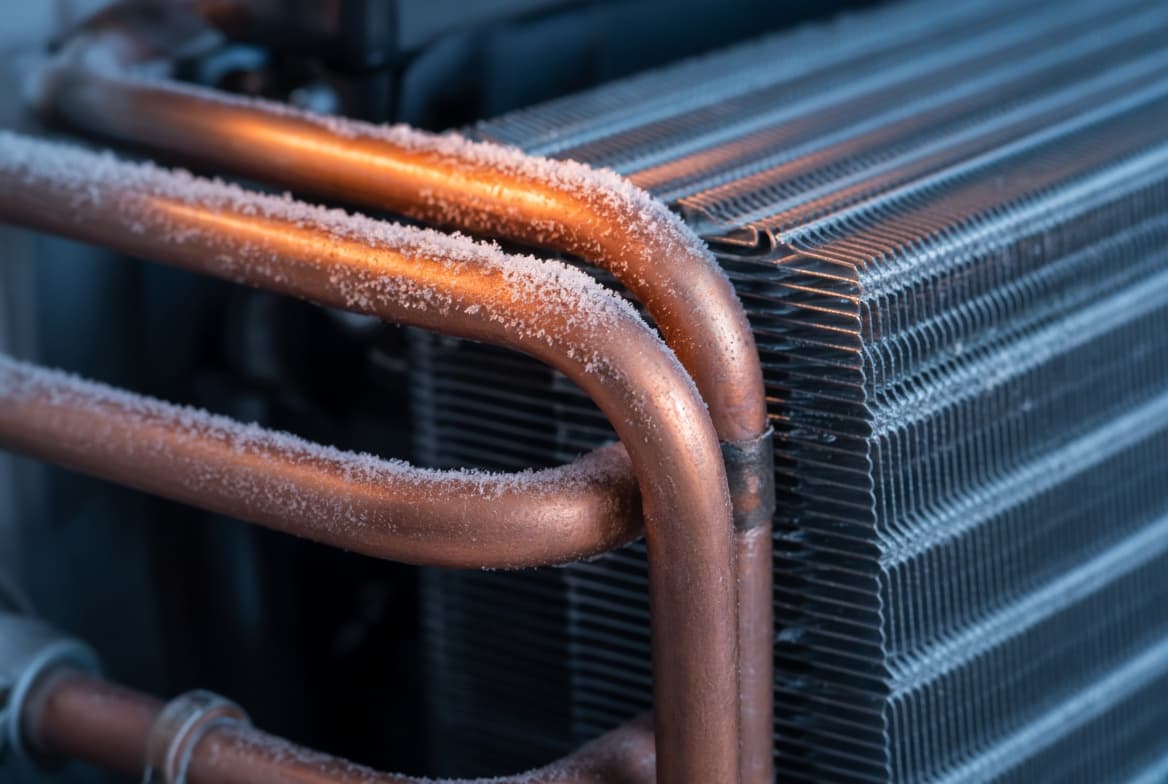
Freon is a brand name for refrigerant, the fluid your air conditioner pumps between the indoor and outdoor coils to move heat out of your house. When most homeowners say "Freon," they mean R-22, the refrigerant used in home central air systems for decades. R-22 is no longer made or imported in the US, so a system built in the last 15 years almost certainly runs on something else: R-410A in most systems built from 2010 through 2024, and R-454B or R-32 in new systems made since 2025.
Your AC does not burn through refrigerant like a car burns gas. If it needs more, it has a leak. That's the single most useful fact on this page.
What Is Freon?
Freon started as a DuPont trademark and now belongs to Chemours, the company DuPont spun off its chemicals business into. The name has been used on several refrigerants over the years, including R-22 and R-410A. Because the brand was so common, "Freon" became the everyday word for any AC refrigerant, the same way people say Kleenex for any tissue.
So "freon AC" is a loose term. A technician will ask which refrigerant you have, because the answer changes what parts fit, what a repair costs and whether a repair makes sense at all.
What refrigerant actually does
Refrigerant boils at a very low temperature. At the indoor evaporator coil, it boils into a vapor and absorbs heat from the air your blower pushes across the coil. The compressor in the outdoor unit squeezes that vapor into a hot, high-pressure gas, and the outdoor coil releases the heat outside, turning the refrigerant back into a liquid. Then the loop repeats. For the full cycle, see how air conditioning works.
The refrigerant also carries compressor oil around the loop. That's why a leak often leaves an oily stain on a coil or fitting.
AC Refrigerant Types Compared
These are the refrigerants you're most likely to find in a US home air conditioner or heat pump. GWP is global warming potential: how much heat a pound of the gas traps compared with a pound of carbon dioxide over 100 years. The figures below are the commonly cited values used in EPA rules and manufacturer literature.
| Refrigerant | What it is | GWP (approx.) | Status in new US home systems | What it means for you |
|---|---|---|---|---|
| R-22 (HCFC-22) | The original "Freon" for home AC; depletes ozone | About 1,810 | No new R-22 systems since 2010; production and import ended January 1, 2020 | You can keep using it, but repairs rely on reclaimed supply and cost more |
| R-410A | HFC blend, sometimes sold as Puron or Freon 410A | About 2,088 | New systems can no longer be manufactured or imported as of January 1, 2025 | Fine to run and repair; supply is being phased down, so refrigerant costs may rise |
| R-454B | Blend of R-32 and an HFO; mildly flammable (A2L) | About 466 | One of the two main replacements in new ducted systems | Common in new Carrier, Trane, Lennox and Rheem central systems |
| R-32 | Single-component HFC; mildly flammable (A2L) | About 675 | The other main replacement; long used in mini-splits | Common in Daikin and Goodman central systems and many ductless units |
| R-407C, R-422D, R-438A and similar | HFC blends sold for converting R-22 systems | Varies | Service and retrofit use only | A possible way to keep an R-22 system going, with trade-offs |
None of these refrigerants mix. You can't add R-410A to an R-22 system, and you can't top off an R-410A system with R-454B or R-32. Each one runs at different pressures and uses specific oils and parts. That's why an aging R-22 system with a leak is often a replacement decision rather than a repair, and new AC pricing breaks down what a new system runs.
For the details on each, see R-22 refrigerant and the phase out, R-410A refrigerant and R-32 vs R-454B.
Does My AC Use Freon? How to Check in Two Minutes
- Find the data plate on the outdoor unit. It's a metal or foil label on the side or back of the cabinet, usually near the electrical panel.
- Look for "Refrigerant" or "Charge." It names the refrigerant and gives the factory charge in pounds and ounces, such as "R-410A, 7 lb 4 oz." Some plates say "HCFC-22" instead of R-22.
- Check the manufacture date. It's often coded into the serial number. A unit built before 2010 very likely uses R-22. A unit built from 2010 through 2024 very likely uses R-410A.
- Check your paperwork. Install invoices and warranty registrations usually list the model number, and the model number tells a technician the refrigerant.
One catch: an R-22 system that was converted to a replacement blend should carry a new label showing the refrigerant and oil now in it. If the label still says R-22 but a past invoice mentions a conversion, ask the next technician to confirm what's in the system before adding anything.
Is Freon Banned? What Changed and When
Nothing forces you to replace a working system because of its refrigerant. The rules limit what can be made, imported and sold, and how refrigerant is handled. Here's the sequence, based on EPA rules as of October 2026.
| Year | What happened | Effect on homeowners |
|---|---|---|
| 2010 | New R-22 could only be used in equipment made before January 1, 2010, so manufacturers moved new home systems to R-410A | Systems from about 2010 on generally use R-410A |
| 2018 | EPA's refrigerant sales restriction expanded to cover HFCs such as R-410A | Only certified technicians can buy refrigerant for home systems |
| 2020 | US production and import of R-22 ended on January 1 | R-22 repairs depend on recovered, reclaimed and stockpiled refrigerant |
| 2024 | The AIM Act phasedown cut allowed HFC production and import to 60 percent of the baseline | Less new R-410A comes to market each year |
| 2025 | New home AC and heat pump systems using refrigerants with a GWP of 700 or more can no longer be manufactured or imported | New systems use R-454B or R-32 instead of R-410A |
| 2026 | An EPA rule finalized in May 2026 removed the deadline for installing R-410A systems whose components were all made or imported before 2025 | Leftover R-410A equipment can still be installed while it lasts |
| 2029 | The next phasedown step cuts HFC allowances to 30 percent of the baseline | Expect R-410A to get scarcer and pricier over time |
The HFC phasedown continues in steps after that, down to 15 percent of the baseline from 2036. Some states have their own refrigerant rules, and EPA has revised parts of this program more than once, so treat the dates above as a snapshot and ask your contractor what applies where you live.
Your AC Doesn't Use Up Freon
A sealed system holds the same charge for its whole life unless something breaks the seal. When a technician says your system is "low on Freon," the real finding is "your system has a leak." Common leak points are the indoor coil, brazed joints on the outdoor coil, Schrader valve cores at the service ports, and copper lines that rub against something.
Low refrigerant usually shows up as:
- Air from the vents that feels cool but not cold
- Long run times and rising electric bills
- Ice on the indoor coil or on the larger copper line at the outdoor unit
- A hissing or bubbling sound near the indoor or outdoor unit
- Oily residue on a coil, valve or fitting
A dirty filter or a dirty outdoor coil can cause several of the same symptoms, so rule those out first with AC not cooling. If the signs point to refrigerant, our guide to AC refrigerant leak signs and recharge cost covers how leaks are found and what a fix involves.
Is Freon Dangerous?
The refrigerants in home systems are low in toxicity, but they're not harmless:
- Oxygen displacement. Fluorocarbon refrigerants are heavier than air. A large release in a small, closed space such as a basement mechanical room or closet can push out breathable air.
- Frostbite. Liquid refrigerant escaping from a line boils at well below freezing and can freeze skin and eyes on contact.
- Toxic byproducts in a flame. Refrigerant drawn into a gas flame, such as a furnace burner or water heater, can break down into irritating and toxic gases.
- Mild flammability. R-454B and R-32 are rated A2L, meaning low toxicity and lower flammability. They're hard to ignite, but new equipment built for them includes safety measures, and technicians use tools rated for them.
If you hear a loud hiss or smell a sharp chemical odor indoors, turn the system off at the thermostat, open windows, keep flames and sparks away from the area, and leave the space if anyone feels dizzy or short of breath. Then have the system checked.
Deliberately inhaling refrigerant to get high can kill, even on the first try. Keep service ports capped; locking caps are inexpensive and stop tampering.
What Homeowners Should Not Do
- Don't buy or add refrigerant yourself. EPA rules restrict the sale of refrigerant for home air conditioners and heat pumps to technicians certified under Section 608 of the Clean Air Act and to businesses that employ them. Handling it on a home system is certified technician work.
- Don't use car AC recharge cans on a home system. Those small cans are exempt from the sales restriction only because they're meant for vehicles. They hold the wrong refrigerant for a home system, and connecting one can contaminate the whole charge.
- Don't use anything sold as "R-22a" or a propane-based R-22 substitute. EPA has warned that these hydrocarbon products are flammable and not approved for existing home air conditioners, and that charging a system with them creates a fire and explosion risk.
- Don't pour in a leak sealer. Many equipment manufacturers discourage sealant additives because they can clog metering devices and complicate warranty claims.
- Don't vent refrigerant or open the lines. Releasing refrigerant during service or disposal is prohibited under the Clean Air Act.
What you can do: change the filter, keep the outdoor coil clear of grass and debris, read the data plate, and write down the symptoms and when they started. That saves diagnostic time when someone comes out.
What Your Refrigerant Means for Repair or Replace
The refrigerant on your data plate is a big input in any repair-or-replace decision.
- R-22 system with a leak: The system is at least 15 years old, and reclaimed R-22 is expensive. Most of the time, a significant leak repair on an R-22 system is money better spent on a new system. Small, accessible fixes like a valve core can still make sense.
- R-410A system with a leak: Repair is often reasonable if the system is under about 10 to 12 years old and the leak is repairable. Repair parts and refrigerant remain available for existing systems, though refrigerant costs may climb as supply shrinks.
- New R-454B or R-32 system: Leaks in the first years are often covered by the manufacturer's parts warranty, though labor and refrigerant usually aren't. Register new equipment so you get the longest coverage.
When you talk to a contractor, ask what refrigerant is in your system, how many pounds it holds, how they'll find the leak, and what the repair costs compared with replacement.
Frequently Asked Questions
Do air conditioners still use Freon?
New central air conditioners do not use R-22, the refrigerant most people mean by Freon. Systems built since 2010 use R-410A, and new systems made since 2025 use lower-impact refrigerants such as R-454B or R-32. Older R-22 systems can still be used and serviced with reclaimed or stockpiled refrigerant.
Is Freon banned in the US?
Using it is not banned. US production and import of R-22 ended on January 1, 2020, and new equipment stopped being built for it years earlier. You can keep running an R-22 system, and a certified technician can service it with recovered, reclaimed or previously produced R-22.
How do I know what refrigerant my AC uses?
Read the data plate on the outdoor unit. It lists the refrigerant type, such as R-22, R-410A, R-454B or R-32, along with the factory charge in pounds and ounces. If the label is gone, the model number and the installer's paperwork will tell you.
Does an air conditioner need Freon added every year?
No. Refrigerant circulates in a sealed loop and does not get used up. If your system needs more refrigerant, it has a leak, and adding refrigerant without finding and fixing the leak only buys time.
Can I buy Freon for my home AC?
Not legally without certification. Under EPA rules, refrigerant for home air conditioners and heat pumps can only be sold to technicians certified under Section 608 of the Clean Air Act, or to businesses that employ them. The small cans sold at auto parts stores are for car air conditioning only.
Is Freon dangerous to breathe?
Fluorocarbon refrigerants are heavier than air and can displace oxygen in a closed space, liquid refrigerant can cause frostbite, and refrigerant exposed to a flame can break down into toxic gases. If you smell a strong chemical odor or hear a loud hiss indoors, turn the system off, ventilate the room and have a technician check it.