
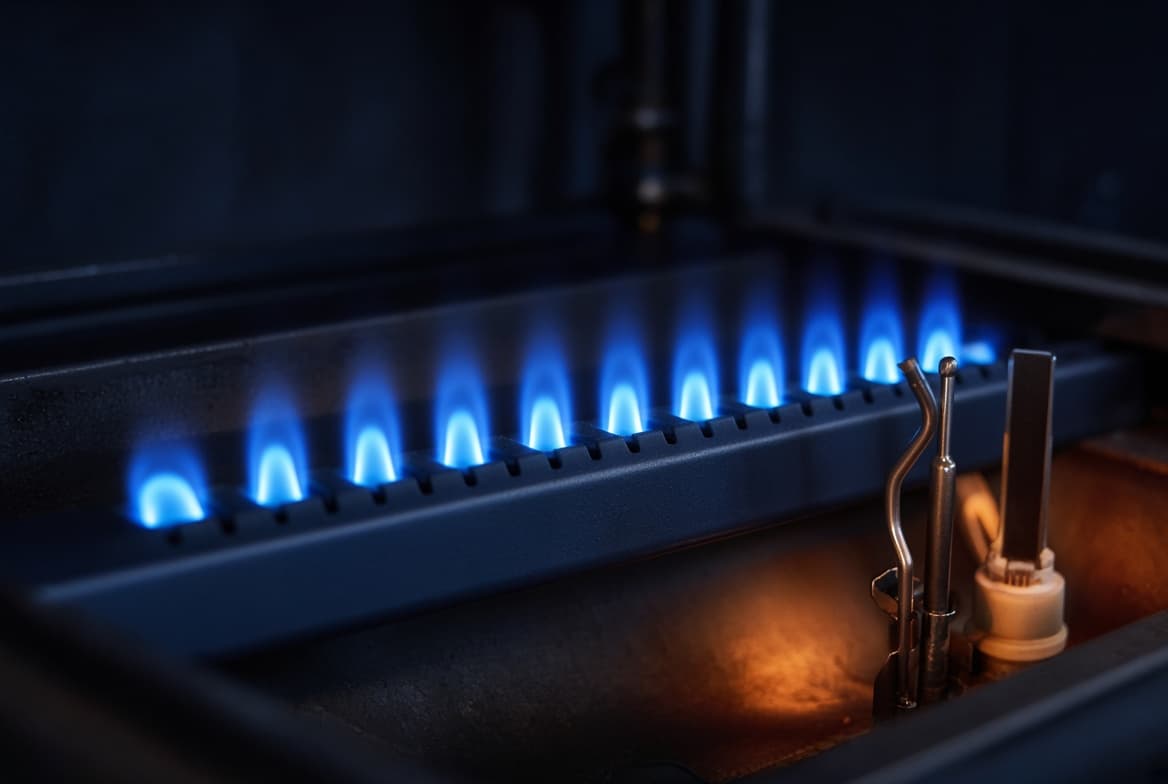
A furnace ignitor is the part that lights the gas burners at the start of every heating cycle. Most gas furnaces built in the last few decades use a hot surface ignitor, a ceramic element that glows bright orange and lights the gas when the valve opens. When it cracks or burns out, the furnace goes through its startup, never lights, and locks out with no heat. It's one of the most common furnace failures, and the fix is usually a single replacement part, but it's worth confirming the ignitor is actually the fault before buying one.
How a Furnace Ignitor Works
A modern gas furnace lights in a fixed order, and the ignitor has to wait its turn:
- The thermostat calls for heat.
- The inducer fan starts to clear the combustion chamber.
- The pressure switch closes, proving the vent is drawing.
- The control board powers the ignitor, which heats until it glows.
- The gas valve opens and the glowing element lights the burners.
- The furnace flame sensor proves the flame, and the ignitor shuts off.
- After a short delay, the blower starts.
The ignitor only runs for a short time each cycle, but it heats from room temperature to well over a thousand degrees every time. That thermal shock, repeated thousands of times, is what eventually cracks it.
Types of furnace ignitors
| Type | How to recognize it | Notes |
|---|---|---|
| Silicon carbide hot surface | Flat, gray-black zigzag element, often on a ceramic block | Common on older furnaces. Fragile and slower to heat |
| Silicon nitride hot surface | Small, smooth, often round or pencil-shaped dark element | Used in many newer furnaces. Tougher and heats faster |
| Direct spark ignition | Electrode that clicks and sparks at the burner | No glow. Fails as weak or missing spark |
| Intermittent pilot | Spark lights a small pilot flame each cycle, which lights the burners | Pilot only burns during a call for heat |
| Standing pilot | Flame burns all the time, with an OFF/PILOT/ON knob | Older furnaces. See the furnace pilot light guide |
Most of this guide covers hot surface ignitors, since they're what most homeowners have.
Bad Furnace Ignitor Symptoms and Common Ignitor Problems
- No glow. You hear the inducer, maybe a click from the board, but the sight window never lights up orange. Then the furnace shuts down and tries again.
- Ignition lockout. After several failed tries, often three, the board stops trying and blinks a code for ignition failure. Many boards retry automatically after about an hour.
- A visible crack or white spot. With the power off, look at the element with a flashlight. Hairline cracks, a white blistered spot or a broken leg mean it's done.
- Weak or uneven glow. An ignitor that glows dimly or only in one section may not get hot enough to light the gas reliably, causing intermittent no-heat calls.
- Cold air from the vents on some furnaces where the blower runs after a failed ignition. See furnace blowing cold air for other causes.
Ignitor or Something Else? Find Where the Sequence Stops
The best way to diagnose a no-heat furnace is to watch where the startup sequence stops. Several parts can stop it, and only one of them is the ignitor.
| Where it stops | Likely cause | Ignitor at fault? |
|---|---|---|
| Nothing happens, no inducer | Thermostat, power switch, breaker, blown board fuse | No |
| Inducer runs, ignitor never glows, code for pressure switch | Blocked vent or intake, clogged condensate drain, failed pressure switch or inducer | No, the board never powered the ignitor |
| Inducer runs, pressure switch closes, ignitor never glows | Cracked or burned-out ignitor, loose plug, board not sending power | Likely |
| Ignitor glows brightly, no flame | Gas shutoff closed, no gas supply, failed gas valve | No |
| Ignitor glows, burners light, flame drops out in seconds | Dirty flame sensor, poor ground | No |
| Ignitor glows dimly, burners light only sometimes | Weak ignitor or low supply voltage | Likely |
The second and third rows are the trap. A furnace with a pressure switch problem never sends power to the ignitor, so the ignitor looks dead even though it's fine. The blink code tells you which one you have. Check the sticker inside the panel door before buying parts.
How Technicians Test a Hot Surface Ignitor
Visual check. The first step is looking at the element for cracks, white spots and broken sections.
Resistance check. With the power off and the ignitor unplugged, a technician measures its resistance in ohms and compares it with the manufacturer's range for that part. An open circuit (no reading) means it's broken inside even if it looks fine. As an example of how specific these figures are, Carrier lists one of its silicon nitride ignitors at 40 to 70 ohms when new at room temperature, and other ignitors have different ranges.
Voltage check. During a trial for ignition, the technician measures voltage at the ignitor plug. Voltage present with no glow means a failed ignitor. No voltage means the board or wiring is the problem.
The voltage check happens inside a live furnace cabinet, so it's not a homeowner test.
Why Furnace Ignitors Fail
- Normal wear. Every heat-up cycle stresses the element. Furnaces that run many short cycles wear ignitors faster.
- Short cycling. A furnace that cycles on and off frequently, from an oversized unit, a dirty filter tripping the limit or a dirty flame sensor, multiplies ignition attempts. Fixing the cause protects the new ignitor.
- Handling. Touching the element leaves skin oils that create hot spots, and even a light bump can crack silicon carbide.
- High supply voltage. Line voltage above the ignitor's rating shortens its life.
- Dust and debris. Construction dust or debris in the burner area can coat or damage it.
- The wrong replacement. An ignitor rated for a different voltage than the furnace supplies will fail early or never get hot enough.
Furnace Ignitor Replacement
On many furnaces the ignitor is held by one or two screws on a bracket next to the burners and connects with a plug. The work itself is short. What matters is matching the part and handling it correctly.
Matching the part. Use the furnace's model number, found on the rating plate inside the door, to find the specified ignitor. Material, shape, bracket, plug and voltage all have to match. Some furnaces run their ignitor at reduced voltage, and a standard-voltage ignitor in one of those won't get hot enough. Universal ignitor kits exist, but only use one if the kit lists your furnace or the original part number.
What the technician does:
- Turns off power and gas, and lets the burner area cool.
- Removes the old ignitor by its base, without touching the new element.
- Mounts the new ignitor in the same position relative to the burner.
- Reconnects the plug, restores power and gas, and watches several full ignition cycles.
- Checks why the old one failed: supply voltage, short cycling, the flame sensor and the burner flame.
Cost. Carrier's homeowner page puts the ignitor part at about $20 to $150 and a professional replacement at about $150 to $450 in total. The service call fee, the specific part and timing (nights and weekends) drive where your bill lands. Our gas furnace repair guide covers how this compares with other common furnace repairs.
Should you replace it yourself? It's one of the simpler furnace parts mechanically, and many homeowners do it. The case for a technician: the element is easy to break during installation, the job is next to gas and line-voltage parts, a wrong diagnosis means you bought a part you didn't need, and manufacturers recommend qualified service, which can matter if the furnace is under warranty. If you can read a blink code, confirm the pressure switch closes, and match the exact part, it's within reach. If any of that is uncertain, it isn't.
What Not to Attempt Yourself
- Don't touch the glowing or new element with bare fingers.
- Don't test voltage inside a powered furnace cabinet unless you're trained to work on live circuits.
- Don't try to light the burners by hand with a lighter on a furnace designed for electronic ignition. Gas can build up in the combustion chamber before it lights.
- Don't jumper the pressure switch or any safety to get the ignitor to fire. If the board isn't powering the ignitor because a safety is open, that safety is telling you something.
- Stop if you smell gas. Leave, and call the gas utility or 911 from outside.
If the ignitor checks out and the furnace still won't light, the furnace not working troubleshooting guide covers the remaining causes in order.
Frequently Asked Questions
How do I know if my furnace ignitor is bad?
Watch a startup through the sight window. If the inducer runs but the ignitor never glows, and the furnace locks out with an ignition code, the ignitor is the first suspect. A visible crack, a white spot or a burned-through section confirms it. If the ignitor glows brightly but the burners never light, the ignitor is fine and the problem is gas supply or the gas valve.
How long does a furnace ignitor last?
There's no universal lifespan, and manufacturers don't publish a fixed replacement interval. Life depends on the ignitor material, how many cycles the furnace runs, supply voltage and whether it's been handled. Older silicon carbide ignitors are generally more fragile and tend to fail sooner than the silicon nitride type used in many newer furnaces.
Can I replace a furnace ignitor myself?
It's mechanically simple, often one screw and a plug, but the element is brittle, skin oils can shorten its life, and the job sits next to gas and line-voltage components. Manufacturers recommend a qualified technician. If you aren't sure which part matches your furnace or how to confirm the ignitor is the actual fault, leave it to a pro.
Are hot surface ignitors universal?
No. Ignitors differ in material, shape, mounting bracket, plug and operating voltage. Some furnaces run their ignitor below standard household voltage, and an ignitor rated for a different voltage will either fail to get hot enough or burn out fast. Use the part listed for your furnace model, or a universal kit the maker specifically lists as compatible.
What's the difference between a furnace ignitor and a flame sensor?
The ignitor lights the gas. The flame sensor confirms the gas is burning. A bad ignitor means no flame at all. A dirty flame sensor means the burners light and then shut off a few seconds later. The ignitor usually has two wires and a ceramic element, while the flame sensor is a single metal rod with one wire.
What resistance should a furnace ignitor read?
It depends on the part, so compare the reading with that ignitor's published range. As an example, Carrier lists one silicon nitride ignitor at 40 to 70 ohms new at room temperature, and other ignitors differ. An open reading means it is broken inside. A reading in range does not prove it is good, since a hairline crack can open only when hot. The test is done with the power off and the ignitor unplugged.
Can a furnace ignitor be repaired?
No. A cracked or burned-out hot surface ignitor is replaced, not repaired. Fixing an ignitor problem often means fixing what stopped it: a loose plug, wiring, a control board not sending power, low or high supply voltage, or short cycling that wears ignitors out. Carrier's homeowner page puts a professional replacement at about $150 to $450 in total.