
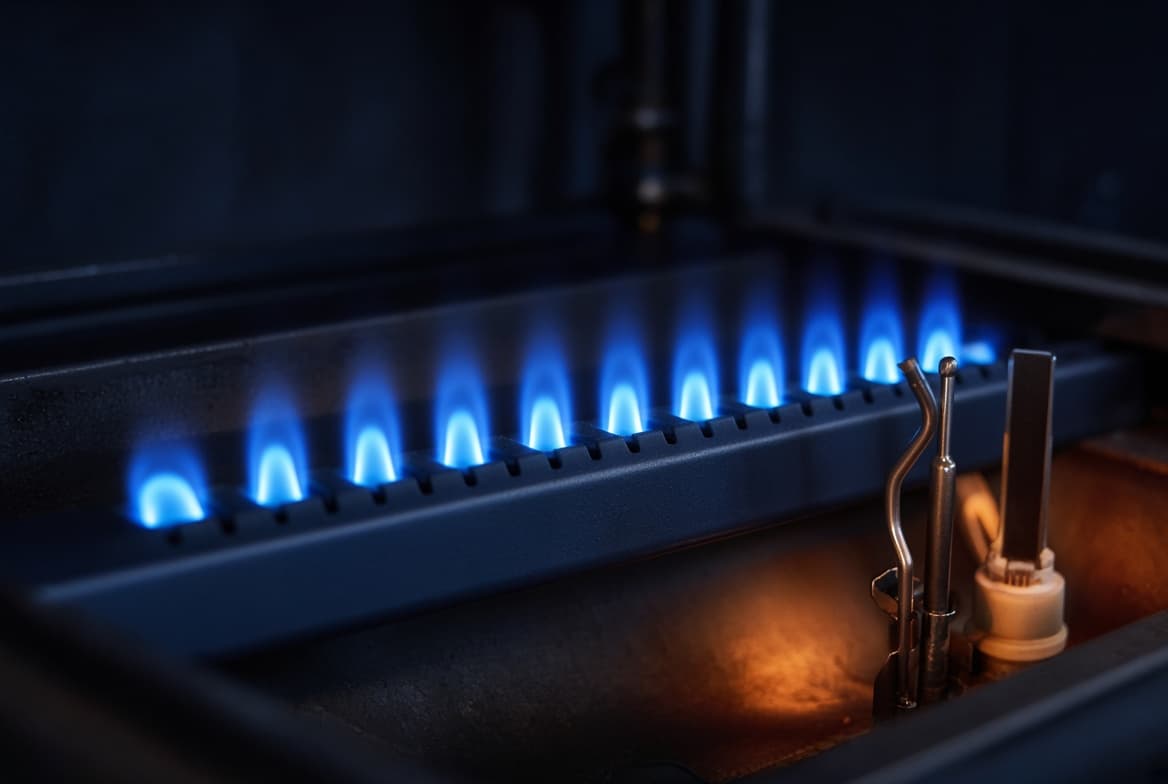
A furnace flame sensor is a thin metal rod that sits in the burner flame and tells the control board a fire is actually burning. If the board doesn't get that signal within a few seconds of opening the gas valve, it shuts the gas off. A dirty flame sensor is one of the most common reasons a gas furnace lights, runs for a few seconds, and goes out. A careful homeowner can often fix it in about 15 minutes with the power and gas off, and a replacement sensor is one of the cheapest parts in the furnace.
What a Flame Sensor Does
Every modern gas furnace runs the same startup sequence: the inducer fan clears the combustion chamber, the ignitor heats up or sparks, the gas valve opens and the burners light. The flame sensor is the last checkpoint. It proves the gas is burning instead of pouring unburned into the heat exchanger.
It works through a process called flame rectification. The control board sends a small AC voltage to the rod. A flame conducts electricity, and because the burner it touches is much larger than the rod, current flows more easily in one direction. The board sees a tiny DC current, measured in microamps (millionths of an amp), flowing from the rod through the flame to the grounded burner. If that current is there, the gas valve stays open. If it's missing or too weak, the board closes the valve, usually within a few seconds.
The rod is easy to tell apart from the ignitor. A flame sensor is a single bent metal rod with a white porcelain base and one wire. A hot surface ignitor is a flat or round ceramic element with two wires. The sensor usually sits at the far end of the burner row, in the path of the flame.
Signs of a Dirty or Failing Flame Sensor
A flame sensor problem has a distinctive rhythm. Watch the burners through the small sight window in the furnace door, or stand nearby and listen:
- The inducer starts.
- The ignitor glows or clicks.
- The burners light normally.
- Two to ten seconds later, the flame goes out while the inducer keeps running.
- The furnace waits, then tries again.
After a set number of failed tries, often three, the board locks out and blinks a code on its LED. Many boards retry on their own after about an hour, which is why some owners notice the house getting heat in short bursts with long cold gaps.
Other signs:
- A blink code for "flame not sensed," "failure to prove flame" or "ignition lockout" on the sticker inside the panel door.
- A rod coated in black soot, white or tan powdery film, or a dull bluish tint.
- Cold air from the vents after the burner drops out, because the blower may run to cool the heat exchanger. See furnace blowing cold air for the other causes of that symptom.
- A furnace that worked fine yesterday and now short cycles every few minutes.
Diagnostic Table: Flame Sensor or Something Else?
Several faults look alike at first. Where in the sequence the furnace stops tells you which one you have.
| What you see | Most likely cause | What to do |
|---|---|---|
| Burners light, go out within about 2 to 10 seconds, retry | Dirty or misaligned flame sensor, weak ground | Clean the sensor; if it returns quickly, have the ground and flame checked |
| Ignitor never glows, no flame | Cracked ignitor, open pressure switch, board fault | Not the sensor. See how a furnace ignitor fails |
| Ignitor glows, no flame at all | Closed gas valve, no gas supply, failed gas valve | Check the gas shutoff; leave valve diagnosis to a technician |
| Burners run several minutes, then shut off while blower keeps running | High limit tripping on overheating | Not the sensor. See the furnace limit switch guide |
| Burner flame is yellow, lazy or lifting off the burner | Combustion problem: dirty burners, gas pressure, venting | Turn the furnace off and have it inspected |
| Sensor cleaned, still drops out | Cracked porcelain, bad wire, poor ground, wrong polarity, failing board | Technician measures the microamp signal |
How to Clean a Flame Sensor
This is the job most guides cover, and it's a reasonable homeowner task on most standard furnaces. Read the steps through before starting.
What you need: a 1/4-inch nut driver or screwdriver, a fine nonwoven abrasive pad or very fine steel wool (fine emery cloth also works), a clean dry cloth, and a flashlight.
- Turn the thermostat down so it isn't calling for heat.
- Shut off power at the furnace service switch (it looks like a light switch on or near the unit) or the breaker.
- Turn off the gas at the shutoff valve on the furnace supply pipe. The handle sits crosswise to the pipe when closed.
- Let it cool. The burner area stays hot for several minutes after a cycle.
- Remove the front panels. On most upflow furnaces the burner compartment is behind the upper door.
- Find the sensor. Look for the single rod with a porcelain base, usually held by one screw, at the end of the burner row opposite the ignitor.
- Take a photo, then remove the screw and slide the sensor out. Pull the wire off its terminal gently, by the connector, not the wire.
- Clean only the metal rod. Use light strokes along its length until it's evenly bright. Don't scrape hard, and keep abrasives off the porcelain.
- Wipe it clean with a dry cloth so no grit goes back into the burner. Don't touch the rod with oily fingers.
- Reinstall it in exactly the same position, reconnect the wire firmly, and tighten the screw so the bracket has good metal-to-metal contact.
- Restore gas and power, replace the panels, and raise the thermostat. Watch at least one full cycle. The burners should light and stay lit.
On abrasives: advice varies. Many technicians use a fine pad or steel wool, while some manufacturers recommend against abrasives because scratches give deposits more surface to cling to. Coarse sandpaper is the one thing nearly everyone agrees to avoid. If your furnace manual gives a method, use it.
When not to do this yourself: some sealed-combustion furnaces put the burners inside a closed burner box with a gasketed cover. If reaching the sensor means unscrewing that box, leave it to a technician, because the gasket has to reseal for the furnace to vent safely.
Why Your Flame Sensor Keeps Getting Dirty
This is the angle most cleaning guides skip. A flame sensor that needs cleaning once a year is normal. One that fails again within days or weeks is telling you about another problem.
- Chemical vapors in the combustion air. Furnaces that draw air from a laundry room, workshop or storage area pull in vapors from bleach, detergent, pool chemicals, paint, solvents and aerosol sprays. When those burn, they leave a hard white or tan coating on the rod. Store chemicals away from the furnace, or have a technician look at whether outdoor combustion air makes sense.
- Construction dust. Drywall sanding and renovation dust gets drawn into the burners and bakes onto the sensor. Run a fresh filter during and after any project, and keep the furnace off during heavy sanding if you can.
- A dirty or off-spec flame. If the burners are dirty or the gas pressure is wrong, the flame burns less cleanly and soots the rod. That's a combustion problem a technician needs to check with a manometer and, ideally, a combustion analyzer.
- A poor ground. The flame signal returns to the board through the burner and the furnace chassis. A loose ground wire, corroded burner mounting or rusty bracket weakens it, so even a clean sensor reads low.
- Reversed polarity. Many control boards need the 120-volt supply wired with correct hot and neutral. If the furnace was rewired or moved and polarity is reversed, some boards can't read the flame signal at all and show a dedicated code.
- A bent rod. If the sensor was knocked during a previous service and sits at the edge of the flame instead of in it, the signal is weak. The rod should sit in the flame, not above or beside it.
How Technicians Test a Flame Sensor
A cleaning fixes most cases, but only a measurement confirms the sensor is healthy. A technician puts a meter on its microamp DC setting in series with the sensor wire and reads the current while the burner runs. Each furnace's service literature lists a minimum and a normal range. Readings near the minimum, or ones that drift down as the furnace warms, explain intermittent dropouts that a visual check would miss.
They'll also look for a cracked porcelain insulator, which can leak the signal to ground, check the sensor wire and terminal, confirm the ground path and polarity, and watch the burner flame. This test happens with live line voltage inside the cabinet, so it's not one to try yourself.
Flame Sensor Replacement
Replace the sensor when the rod is pitted, corroded or thinned, the porcelain is cracked, or the signal stays weak after cleaning and the ground checks out. The part is simple, but match it properly: rod length, bend angle, mounting bracket and terminal type all affect where it sits in the flame. The furnace model number gives you the exact part. Universal sensors exist, but only use one if its dimensions match the original.
Published cost guides commonly put a flame sensor at roughly $10 to $30 for the part and about $75 to $250 installed, with the service call fee making up most of the bill. Ask whether a cleaning and a microamp test were tried before replacement, and whether the quote includes the trip charge. Our gas furnace repair guide covers how this fits against other furnace repairs.
What Not to Attempt Yourself
- Never bypass or jumper the flame sensor or any other safety. It's the only thing stopping gas from flowing with no flame.
- Don't keep resetting a furnace that locks out. One or two resets is reasonable. Repeated ignition attempts wear the ignitor and cover up whatever is actually wrong.
- Stop if you smell gas. Don't touch switches or try to relight. Leave the house and call the gas utility or 911 from outside.
- Leave it alone if the flame looks wrong. Yellow, orange, lifting or rolling flames, soot around the burner door or a tripped rollout switch point to a combustion or venting problem with carbon monoxide risk.
- Don't open a sealed burner box or disturb gas valve wiring.
If cleaning doesn't solve it, work back through the furnace not working troubleshooting guide for the other common causes, and ask the technician what the microamp reading was before and after. Having the sensor checked during annual furnace maintenance is the simplest way to keep it from stranding you on a cold night.
Frequently Asked Questions
How do I know if my furnace flame sensor is bad?
The classic sign is a burner that lights, runs for a few seconds, then shuts off, with the furnace retrying several times before it locks out and blinks a code. A sooty or white-coated rod, a cracked porcelain base, or a flame code on the control board points the same way. A technician confirms it by measuring the flame signal in microamps while the burner runs.
Can I clean a flame sensor with sandpaper?
Use the gentlest abrasive that removes the film: a fine nonwoven pad, very fine steel wool or fine emery cloth, with light strokes along the rod. Coarse sandpaper leaves scratches that collect deposits faster. Some manufacturers advise against abrasives entirely, so check your furnace manual first.
How often should a flame sensor be cleaned?
Most furnaces only need it once a year during a fall tune-up. If yours needs cleaning every few weeks, something is coating it: chemical vapors near the furnace, drywall dust, a poor ground or a burner flame that isn't burning cleanly. Find that cause rather than cleaning on repeat.
Can a furnace run without a flame sensor?
No, and it shouldn't. The flame sensor is the safety that proves a flame exists before the control board keeps the gas valve open. Without a flame signal the board shuts off the gas within seconds. Bypassing it would let raw gas flow with no flame, which is a fire and explosion hazard.
How long does a furnace flame sensor last?
There's no fixed lifespan. Many last as long as the furnace with an occasional cleaning. Replace it when the rod is pitted or corroded, the porcelain is cracked, or the flame signal stays weak after a careful cleaning.