
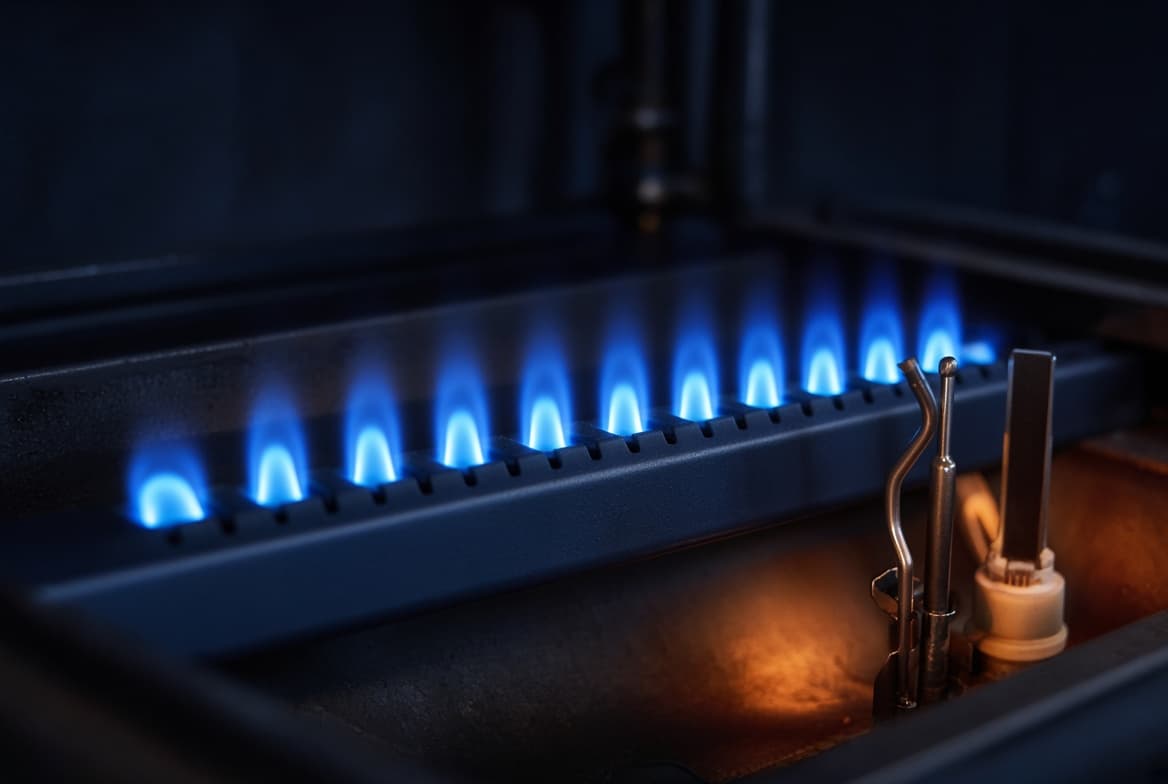
A cracked heat exchanger is a split or hole in the metal chamber that keeps a gas furnace's flame and exhaust separate from the air it blows through your house. A crack can let combustion gases, which may include carbon monoxide, leak into that air, so it's treated as a safety failure, not a comfort problem. You can't confirm a crack yourself. If your carbon monoxide alarm sounds, get everyone outside first and call for help from there. If you only suspect a crack, turn the furnace off and have it inspected before using it again.
What a Heat Exchanger Does
A heat exchanger is any device that moves heat from one fluid to another without letting them mix. In a gas furnace, the burners fire into a set of metal tubes or clamshell-shaped chambers. Hot combustion gases flow through the inside and out the flue or vent pipe. The blower pushes house air across the outside of the metal, which picks up the heat and carries it to your rooms.
The metal wall between those two airstreams is the only thing keeping exhaust out of the air you breathe. That's why a hole in it matters.
- Mid-efficiency furnaces (roughly 80% AFUE, with a metal flue) have one primary heat exchanger.
- High-efficiency condensing furnaces (roughly 90% AFUE and up, with white PVC vent pipes) have a primary heat exchanger plus a secondary one that pulls extra heat from the exhaust, producing acidic condensate as it does. Either one can fail.
Air conditioners and heat pumps also use heat exchangers, called coils, but they move refrigerant, not combustion gas. The carbon monoxide concern on this page applies to fuel-burning furnaces.
How a Heat Exchanger Cracks
The metal expands every time the burner fires and contracts every time it shuts off. Over thousands of cycles, stress concentrates at bends, seams and welds. Several things speed that up:
- Overheating from poor airflow. A clogged filter, closed registers, undersized ducts or a weak blower let the metal run hotter than designed. The furnace limit switch shuts the burner off at a set temperature, but repeated trips still stress the metal.
- Oversizing and short cycling. A furnace too big for the house runs many short cycles, multiplying heat-up and cool-down stress.
- Overfiring. Gas pressure set too high puts more heat into the heat exchanger than it was built for.
- Corrosion. Condensation inside the heat exchanger, chlorine or other chemical vapors in the combustion air, and moisture from a leaking AC coil above the furnace can all eat at the metal.
- Age. Metal fatigue is cumulative. Older furnaces are more likely to have cracks, though age alone doesn't prove one exists.
- Manufacturing defects. Some models have had known heat exchanger problems, which is part of why heat exchanger warranties tend to be long.
Signs of a Cracked Heat Exchanger
Each of these has other possible causes. Together, or combined with an older furnace, they justify an inspection.
| Sign | What it might mean | What to do |
|---|---|---|
| Carbon monoxide alarm sounds | Carbon monoxide in the home from the furnace, another appliance, or an attached garage | Get everyone outside, call 911 or the gas utility, don't restart the furnace until inspected |
| Headaches, nausea, dizziness or fatigue that ease away from home, especially if several people feel it | Possible carbon monoxide exposure | Get fresh air, seek medical care, have all fuel-burning appliances checked |
| Soot around the burners, furnace door or registers | Incomplete combustion, sometimes from a crack disturbing the flame | Turn the furnace off and schedule an inspection |
| Burner flame wavers, lifts or turns yellow when the blower starts | Blower air reaching the flame through a crack | A classic technician test; turn the furnace off |
| Rollout switch trips | Flame escaping the burner area, from a blocked or cracked heat exchanger or a venting problem | Don't keep resetting; have it inspected |
| Rust, scaling or visible cracks on the heat exchanger | Corrosion, possible holes | Technician inspection |
| Sharp, unusual or chemical odor while the furnace runs | Combustion products in the airstream | Turn the furnace off and have it checked |
| Water pooling under a condensing furnace | Drain problem, or a leaking secondary heat exchanger | Check the condensate drain; schedule service if it continues |
The flame test in the fourth row is worth understanding. With the burners lit and the blower off, the flame should be steady. When the blower starts, a healthy furnace's flame shouldn't react. If blower air is reaching the burner side through a crack, the flame may dance, lift, roll or change color.
How Technicians Confirm a Crack
A homeowner can't see most of the heat exchanger without taking the furnace apart. Technicians use several methods, and a thorough inspection combines more than one:
- Visual inspection with a bright light and mirror, or a small inspection camera fed into the heat exchanger through the burner openings or flue.
- Flame observation when the blower starts, as described above.
- Combustion analysis. An analyzer in the flue measures carbon monoxide and oxygen. A reading that changes sharply when the blower starts suggests air is crossing into the combustion side.
- Ambient carbon monoxide testing in the supply air, around the furnace and in living spaces.
- Manufacturer procedures. Some manufacturers publish their own inspection or pressure test methods for warranty claims.
Ask for evidence
This is the part most heat exchanger articles leave out. A cracked heat exchanger diagnosis usually leads to a big bill, so it's reasonable to ask:
- Where exactly is the crack? Can you show me a photo or video?
- Which test confirmed it, and what were the readings?
- Is this a crack or hole, or surface rust or scale?
- Is the heat exchanger still under warranty? Will you check my serial number?
- What would a repair cost compared with a replacement?
A legitimate technician can usually show you what they found. Be cautious of a diagnosis based only on the furnace's age, a refusal to show evidence, or pressure to sign a replacement contract the same day. Getting a second opinion is normal and reasonable. While you wait for it, though, don't run a furnace that's been flagged as unsafe.
What "red-tagged" means
If a technician confirms a crack, they will commonly shut off the gas to the furnace and attach a tag saying it's unsafe to operate. Policies and local rules vary, and in some areas the gas utility does the same. Don't remove the tag or relight the furnace yourself. Use safe temporary heat (electric space heaters with 3 feet of clearance, plugged directly into the wall) until it's fixed.
Repair or Replace?
A crack can't be safely welded or patched. The options are a new heat exchanger or a new furnace.
Replacing the heat exchanger means taking most of the furnace apart, so labor is the big cost even when the part is covered. Many manufacturers warranty heat exchangers far longer than other parts, often 20 years or a limited lifetime for the original registered owner, but those warranties usually cover the part only. Registration and maintenance records can affect a claim.
Published cost guides vary widely. Labor-only warranty jobs are commonly put at roughly $600 to $1,500, and out-of-warranty heat exchanger replacement at roughly $1,000 to $4,500 in total. Condensing furnaces with a secondary heat exchanger tend to cost more.
| Situation | Usually makes sense |
|---|---|
| Furnace under about 10 years old, part under warranty | Replace the heat exchanger under warranty, paying labor only |
| Furnace in its middle years, part covered, other parts in good shape | Compare the labor quote with a new furnace quote side by side |
| Furnace over about 15 years old, or no warranty | A new furnace is usually the better value |
| Furnace was oversized or ducts are restrictive | Fix sizing and airflow with the replacement, or the new heat exchanger may face the same stress |
See furnace replacement cost for what a new furnace involves, and our gas furnace repair guide for how repair-versus-replace math works on other parts.
What Not to Attempt Yourself
- Don't remove the burners or heat exchanger panels to look for a crack.
- Don't seal a crack with tape, high-temperature sealant, furnace cement or patches.
- Don't run a red-tagged furnace, even for a night.
- Don't ignore a CO alarm by resetting it and going back to bed. Get out, then call.
- Don't rely on a CO alarm in place of an inspection. A crack may not release enough carbon monoxide to trigger it.
How to Prevent Heat Exchanger Damage
- Replace the filter on schedule and keep every register and return open.
- Fix a furnace limit switch that keeps tripping instead of living with it.
- Keep chemicals, paint and pool supplies away from the furnace's combustion air.
- Have an annual furnace inspection that includes the heat exchanger and a combustion check.
- On an older furnace with a standing pilot, watch the furnace pilot light flame. A flame that changes when the blower starts is a reason to call.
- Keep carbon monoxide alarms on every level of the home and outside sleeping areas, test them monthly and replace them on the manufacturer's schedule.
If your furnace isn't heating and you're not sure where the problem lies, start with the furnace not working troubleshooting guide.
Frequently Asked Questions
What are the signs of a cracked heat exchanger?
Warning signs include a carbon monoxide alarm, headaches, nausea or dizziness that ease when you leave the house, soot around the burners or furnace door, a burner flame that changes shape or color when the blower starts, a tripped rollout switch, rust or corrosion on the heat exchanger, and an unusual sharp odor while the furnace runs. None of these confirms a crack on its own. A technician's inspection does.
Can a cracked heat exchanger cause carbon monoxide poisoning?
It can. A crack can let combustion gases, which may include carbon monoxide, mix with the air the blower sends through the house, and it can disturb the burner flame so it produces more carbon monoxide. Not every crack leaks measurable carbon monoxide, but because the risk can change without warning, a cracked heat exchanger is treated as unsafe.
Can you run a furnace with a cracked heat exchanger?
You shouldn't. Technicians commonly shut off the gas and tag a furnace with a confirmed crack as unsafe to operate. If you're waiting on a second opinion or a replacement, use safe temporary heat such as electric space heaters with proper clearances, and keep carbon monoxide alarms working.
How much does it cost to replace a heat exchanger?
Published cost guides vary widely. If the heat exchanger is under warranty, you typically pay labor only, which several guides put at roughly $600 to $1,500. Out of warranty, totals of roughly $1,000 to $4,500 are commonly cited. Because the job means taking the furnace apart, many owners of older furnaces choose replacement instead.
Is a cracked heat exchanger covered by warranty?
Often the part is. Many manufacturers give heat exchangers a much longer warranty than other furnace parts, sometimes 20 years or a limited lifetime for the original registered owner. These warranties usually cover the part, not the labor, and may require registration and proof of maintenance. Check your warranty paperwork or the manufacturer's site with your serial number.
Will a carbon monoxide detector detect a cracked heat exchanger?
Not reliably. A CO alarm reacts to carbon monoxide in the room, not to the crack, and a crack may not release enough to set it off. Alarms are an essential backup, but they don't replace an inspection. Keep them on every level of the home and outside sleeping areas, and replace them on the manufacturer's schedule.