
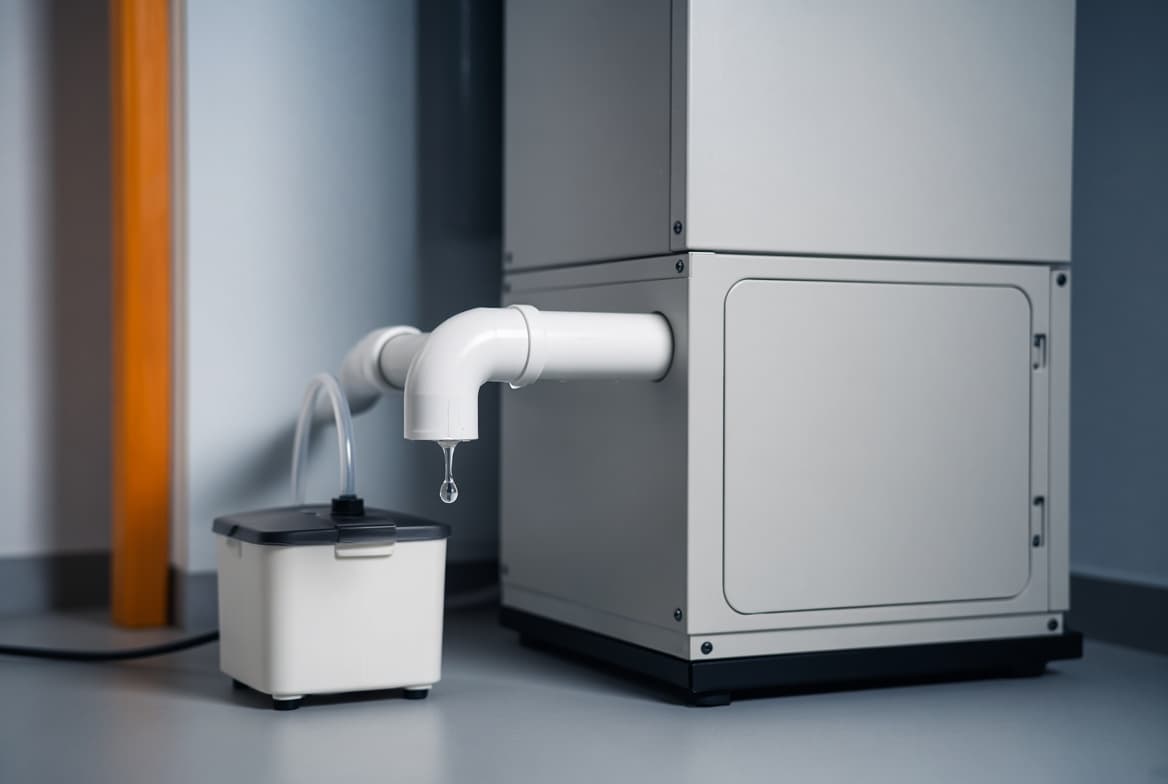
A condensate pump is a small electric pump that collects the water your air conditioner or high-efficiency furnace produces and pushes it up and out to a drain when gravity cannot get it there. It fails in a few predictable ways: it stops running, runs nonstop, gets loud, or overflows. Most of those failures come from slime in the reservoir or check valve, which you can clean yourself, and the rest end in a replacement pump that costs little next to the water damage it prevents.
If water is already on the floor and you are not sure the pump is to blame, start with AC leaking water inside.
What Is a Condensate Pump and Why Do Some Systems Need One?
An air conditioner or heat pump pulls moisture out of the air at the evaporator coil. A condensing furnace, rated around 90 percent AFUE or higher, also makes water as it cools its exhaust. So a basement furnace with an AC coil on top makes water in summer and winter. Most systems drain by gravity; a pump takes over when there is no downhill path:
- Basement furnaces and air handlers with no floor drain nearby
- Closets in slab homes, where the line would have to climb through a wall to get out
- Attic units without room to slope a drain across the attic floor
- Ductless mini split heads on interior walls or mounted too low to drain outside
Furnace condensate is acidic, commonly around pH 3 to 4, which affects which pump you buy and where the water may go.
How a Condensate Pump Works
A standard pump is a plastic reservoir, commonly around a half gallon, with inlet holes in the lid where the drain lines drop in. Inside, a float rises with the water and trips a switch that starts a small motor and impeller. The motor empties the tank in a few seconds up the discharge tubing, usually 3/8 inch inside diameter vinyl. A check valve at the outlet holds the water in the tubing so it does not fall back when the motor stops. A second, higher float runs the safety switch, which has its own pair of wires.
The Safety Switch Is What Prevents Floods
The safety (overflow) switch is wired into the furnace or air handler's 24 volt control circuit. If the pump fails and water keeps rising, the switch opens and breaks the call for cooling, and on a condensing furnace usually the call for heat as well.
Current editions of the International Mechanical Code require a condensate pump in an uninhabitable space, such as an attic or crawlspace, to be connected so the equipment cannot run when the pump fails, and many local codes adopt that rule. Plenty of older installs leave the safety leads coiled up and unconnected, which is why some pump failures end in a shutdown and others in a ceiling stain.
Never jumper or bypass it. For which control wire it interrupts, see thermostat wire colors and terminals.
Signs Your Condensate Pump Is Failing
- A full reservoir with a silent motor, or water around the pump
- The pump runs constantly, or restarts every few seconds
- Humming with no water moving
- Water around a high-efficiency furnace in winter
- The AC or furnace shut off and will not restart while the thermostat still calls. A condensing furnace may also flash a drain or pressure switch code; see why a furnace stops working for the rest of that sequence
- New noises, or a musty smell from algae in the tank
Condensate Pump Troubleshooting Table
Unplug the pump before you open the lid or reach into the reservoir.
| What you see | Most likely cause | Check and fix |
|---|---|---|
| Silent, tank full | No power, or float stuck down in sludge | Test the outlet with a lamp and check the breaker or GFCI. Clean the float. Power good and float free means a new pump |
| Hums, water level does not drop | Clogged impeller inlet, blocked check valve, kinked or clogged tubing | Run the pump into a bucket with the tubing off. Clean the check valve and tubing, or replace the pump |
| Runs constantly or restarts within seconds | Check valve stuck open, float jammed up, tubing pressing on the float | Watch the tubing after it stops; water sliding back means the check valve. Clean or replace it and reposition the drain lines |
| Water on the floor, pump working | Cracked reservoir, a drain line that missed its inlet, or a leak at the barb | Dry everything, run a cycle, and watch where water appears first |
| AC or furnace off, tank full | Pump failed and the safety switch did its job | Fix or replace the pump. Do not bypass the switch |
| AC or furnace off, tank empty | Safety float stuck, a loose safety wire, or another fault entirely | Clean the safety float and check its wires. If the pump is fine, look elsewhere |
| Loud rattle, gurgle, or grinding | Pump unlevel or touching a wall, air in the line, worn bearings | Level it on a firm surface. Grinding that persists means the motor is wearing out |
| Furnace pump fails in a cold snap | Discharge line frozen where it leaves the house | Thaw it and reroute the end so it cannot freeze |
How to Test a Pump and Its Safety Switch
Pour a cup or two of water slowly into an inlet. The float should lift, the motor start, the tank empty within seconds, and the motor stop. Then watch the tubing for a minute: water draining back means the check valve is not holding.
The safety switch is the part that protects your house, so test it too. Set the thermostat to call for cooling. Unplug the pump so it cannot empty itself, and keep pouring water slowly until the level reaches the safety float. Within seconds the outdoor unit (or the burner, on a heating call) should shut down. Plug the pump back in and confirm the system restarts. If it kept running with the tank full, the switch is not connected or not working, and that needs correcting first.
How to Clean a Condensate Pump Reservoir and Check Valve
Clean it each cooling season, and before heating season too if it serves a condensing furnace.
- Turn the equipment off at the thermostat, then unplug the pump. If it is hardwired, switch off its circuit.
- Pull the drain lines out of the inlets and set their ends in a bucket. Disconnect the discharge tubing.
- At a utility sink, pour out the water and remove the lid and motor assembly. Keep the motor and wiring dry.
- Scrub the reservoir, floats, and impeller inlet with warm soapy water or a vinegar and water mix until the slime is gone. Both floats should move freely.
- Unscrew the check valve at the outlet, rinse it, and make sure the ball or flapper moves and seats. Replace a valve that stays stuck.
- Flush the discharge tubing, or replace it if it is stiff or packed with sludge.
- Reassemble, set the pump back level, reconnect everything, and run the cup-of-water test.
Check the pump manual before adding algae tablets. Keeping the drain line upstream clean keeps the pump cleaner too; the steps are in how to unclog an AC drain line.
Replacing a Condensate Pump: How to Choose the Right One
| Spec | What to match | Why it matters |
|---|---|---|
| Lift (head) | The vertical distance from the pump to the highest point of the discharge line, plus headroom | The maximum or shutoff head is where flow drops to zero. You want comfortable flow at your actual lift |
| Flow (GPH) | The flow at your lift, from the performance chart | Headline GPH is usually rated at 1 foot of lift. Long runs and fittings cut it further |
| Voltage | 115 volt for most; 230 volt models exist | Wrong voltage destroys the motor |
| Safety switch | Built in, with leads for the control circuit | Required in attics and crawlspaces, worth having everywhere |
| Condensate type | Rated for furnace or boiler condensate if a condensing furnace feeds it | Acidic water attacks parts rated only for AC water |
| Tubing | The outlet barb size, usually 3/8 inch ID vinyl | Undersized or kinked tubing chokes flow |
Wiring the Safety Switch
The safety switch usually has two leads, and some offer both normally open and normally closed contacts. In the common setup, the normally closed contacts go in series with a 24 volt control wire, often R or Y, so an overflow breaks the circuit. A pump that also handles furnace condensate needs to stop heating calls too, which usually means breaking R rather than Y. Follow both sets of instructions, and never put the safety leads on line voltage unless the switch is rated for it.
Routing the Discharge Tubing
- Run the tubing straight up to its high point, then slope it down with no sags. Secure it so it cannot kink or slip off the barb.
- End it where code allows: outdoors away from the foundation and walkways, a floor drain, a utility sink, or a drain with an air gap. Never into a plumbing vent. Rules on sump pits vary by area.
- With a condensing furnace, keep the outdoor end from freezing in winter, and check whether your area requires a condensate neutralizer.
Can You Replace It Yourself?
A plug-in pump on the floor next to the furnace, with the safety leads already landed on accessible terminals, is a reasonable DIY swap. Photograph the wiring, match the specs above, and test both the pump and the safety switch afterward. Leave it to a technician if the pump is hardwired, sits in an attic or crawlspace, needs its safety switch wired for the first time, or serves a mini split.
Mini Split Condensate Pumps Are Different
A mini split head often needs a pump because it hangs where the drain hose cannot fall outside. These are not box pumps. Most are split designs: a small reservoir with a water level sensor sits under the head's drain outlet or in the line set cover, and a compact piston or diaphragm pump mounts in the head, the line set cover, or the wall or ceiling space nearby.
They move very little water, so a little biofilm stops them, and many make a ticking or buzzing that people notice at night. Their safety contacts tie into the indoor unit's controls, which vary by brand, so replacing one belongs with a technician. The mini split repair guide covers the head's other common faults.
When to Call a Pro
Bring in an HVAC technician when water reached drywall or a ceiling, the pump is hardwired or in an attic or crawlspace, the safety switch was never connected, the system still shuts off after the pump checks out, or a new pump keeps failing.
Questions worth asking:
- What lift and flow is the new pump rated for, and what is my actual lift?
- Will you show me the safety switch shutting the system down?
- Is the pump rated for furnace condensate, and does my area require a neutralizer?
- Where does the discharge line end, and can it freeze?
The AC repair problems and costs guide covers vetting the work more broadly.
What Affects Condensate Pump Replacement Cost
Published prices vary too widely for one honest range. From cheapest to most expensive:
- Cleaning the pump, or a new check valve or tubing. Free to cheap, and a short add-on to a maintenance visit.
- Swapping a standard plug-in pump. The pump is a modest part cost; labor is the bigger share when a technician does it.
- A high-lift, low-profile, or pump and neutralizer combination. Higher part cost, often a longer tubing run.
- Wiring the safety switch for the first time or rerouting the discharge line. Labor driven, especially through finished walls or an attic.
- A mini split pump. Specialized parts and work inside the indoor unit.
Attic access and water damage add to any of these. Because a basic pump costs little next to a service call, technicians usually replace a pump with a failed motor or float rather than repair it. Ask whether the diagnostic fee is credited toward the repair.
Frequently Asked Questions
How long does a condensate pump last?
Most residential condensate pumps last somewhere around 5 to 10 years, but the range is wide. Pumps that handle furnace condensate year round, sit in a hot attic, or never get cleaned tend to fail sooner.
How do I know if my condensate pump is bad?
Confirm the outlet has power, then pour a cup or two of water into the reservoir. A good pump starts when the float rises, empties the tank in seconds, and stops. If it never starts, the float or motor has failed. If it hums but the water stays, something is blocked. If water flows back into the tank afterward, the check valve is leaking.
Why is my condensate pump running constantly?
Usually a check valve stuck open lets the water in the discharge tube fall back into the reservoir every time the pump stops, so the float lifts again right away. A float jammed up by sludge or by tubing pressing on it does the same thing. Less often, the pump is undersized for the lift.
Does my AC need a condensate pump?
Only if water cannot drain away by gravity, such as a basement unit with no floor drain or a closet in the middle of a slab house. If the drain line can slope down to an approved drain or the outside, you do not need one.
Can I clean a condensate pump myself?
Yes, on a plug-in pump you can reach. Unplug it, scrub the reservoir and floats, rinse the check valve, keep the motor dry, and test with a cup of water. Leave hardwired, attic, and mini split pumps to a technician.
What happens if a condensate pump fails?
If the safety switch is wired correctly, the AC or furnace shuts off when the reservoir fills, so you get a warm or cold house instead of a flood. If the safety switch was never connected, the reservoir overflows, and in an attic that means water through the ceiling.