
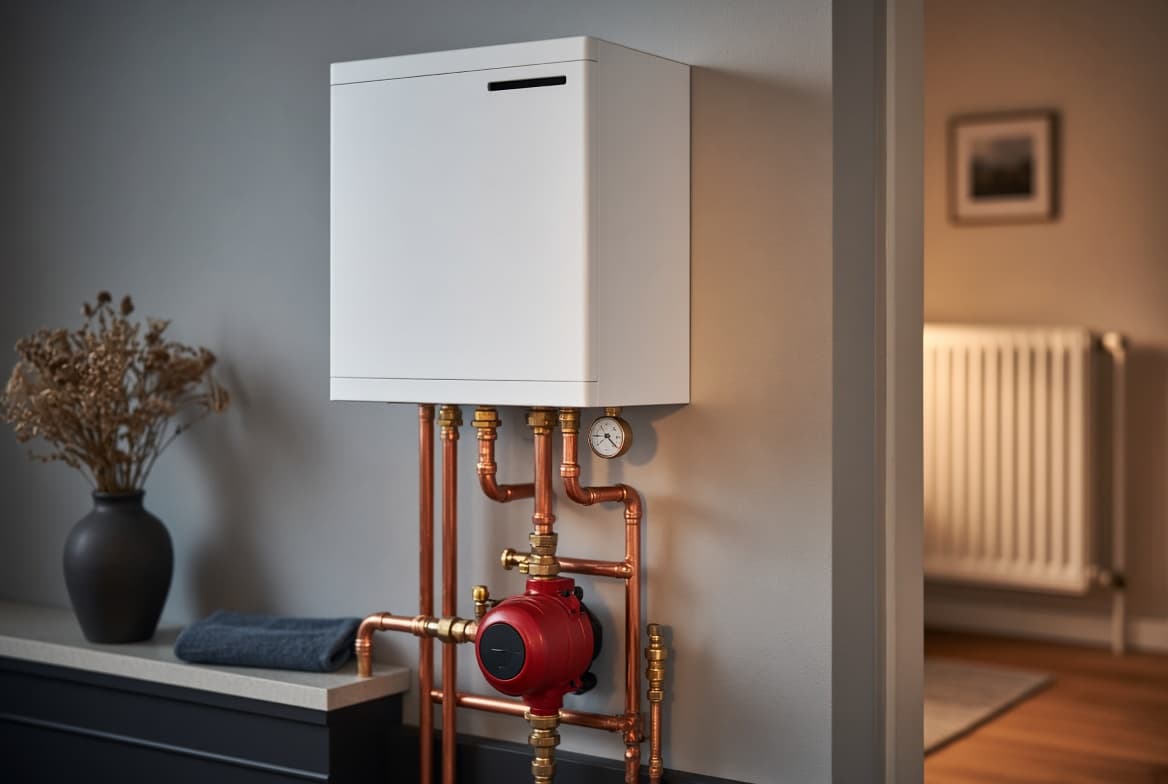
Most boiler repair comes down to four things: pressure, air, circulation and ignition. If the radiators are cold, read the pressure gauge first, then listen for the circulator pump, then check whether the burner fires. A dripping relief valve, gurgling pipes or a boiler that keeps losing pressure each point to a short list of parts, and most of them are single-part repairs.
This guide covers hot water (hydronic) boilers that heat radiators, baseboard or radiant floors. Steam boilers run at much lower pressure, typically under 2 psi, and have their own sight glass and controls. If you aren't sure the boiler is the problem, start with heating repair by system type.
How a Hot Water Boiler System Works
The boiler heats water and a pump circulates it through the house. The main parts:
- Burner and ignition. Gas or oil, with a pilot or electronic ignition and a flame sensor or thermocouple.
- Heat exchanger. Cast iron, steel, or a stainless or aluminum condensing exchanger.
- Circulator pump. Moves water through the loops, sometimes one pump per zone.
- Zone valves. Motorized valves that open each zone when its thermostat calls for heat.
- Expansion tank. Absorbs the water's expansion as it heats so pressure doesn't spike.
- Fill valve. Feeds water in to hold the set pressure.
- Relief valve. Opens to protect the boiler if pressure gets too high. Many residential boilers use a 30 psi valve.
- Air vent or air separator. Removes air that collects in the water.
- Low-water cutoff. Shuts the burner down if the water level or pressure drops too low.
- Controls. An aquastat or control board that sets water temperature.
Many boiler systems also heat domestic water, either with a combi boiler or an indirect tank that runs as one more zone off the boiler.
Boiler Symptoms and Likely Causes
| What you notice | Most likely cause | Who handles it |
|---|---|---|
| No heat anywhere, boiler cold | Thermostat, emergency switch, breaker, ignition failure, low-water cutoff tripped | Power and thermostat are yours. Ignition and cutoff are a tech job |
| Boiler hot, radiators cold | Circulator pump stopped or seized, closed zone valve, air lock | Tech, after you check pressure and bleed radiators |
| One zone cold, others fine | Failed zone valve motor, zone thermostat, zone circulator | Check that zone's thermostat, then a tech |
| Radiators warm at the bottom, cold at the top | Air trapped in the radiator | Bleed the radiator |
| Pressure below the cold-fill setting | Leak, relief valve discharge, fill valve closed or clogged | Look for leaks. Repeat drops need a tech |
| Pressure climbs near 30 psi when hot | Waterlogged expansion tank, fill valve passing too much water | Tech |
| Relief valve dripping or discharging | Pressure reaching the valve rating, or a worn valve | Tech. Never cap or plug it |
| Gurgling or rushing water sounds | Air in the system, low pressure | Bleed radiators, check pressure |
| Rumbling or kettle sound from the boiler | Kettling from scale or sludge, low flow through the boiler | Tech |
| Pilot or burner won't stay lit | Dirty flame sensor or thermocouple, ignitor, gas valve, venting problem | Tech |
| Boiler short-cycles | Oversized boiler, aquastat settings, low flow, failing control | Tech |
| Soot, a fuel smell, or a CO alarm | Combustion or venting problem | Leave the house. Call 911 or the gas utility from outside |
Check the Pressure Gauge First
Most hot water boilers have a combination gauge showing pressure and temperature. On many residential systems the cold fill pressure sits around 12 to 15 psi, but the right number depends on how tall the building is and on the manufacturer, so check the label on the boiler or the fill valve setting. Read it cold, before the boiler has been running.
Pressure rises as water heats, so a higher reading when hot is normal within limits. Two patterns mean trouble:
- Pressure keeps dropping. Water is leaving the system. Look for drips at radiators, valves, the boiler base and the relief valve discharge pipe. A slow leak can hide inside a wall or under a floor.
- Pressure climbs toward the relief valve rating. The expansion tank has usually lost its air charge or its diaphragm has failed, so there's nowhere for expanding water to go. A fill valve that lets water keep entering causes the same symptom.
What You Can Safely Check Before Calling Anyone
- Thermostat. Set to Heat, setpoint above room temperature, fresh batteries. In a zoned house, check each zone's thermostat.
- Power. Check the boiler breaker and the emergency switch, often a red plate at the top of the basement stairs or at the boiler room door.
- Pressure. Compare the cold reading to the label.
- Leaks. Look around the boiler, the relief valve pipe, radiator valves and any exposed piping.
- Bleed radiators. With the heat off and the system cool, open each radiator's bleed valve with a radiator key over a cloth until water runs steadily, then close it. Start on the lowest floor and work up. Check the pressure afterward.
- Vent terminal. On a condensing boiler with PVC pipes through the wall, clear snow and ice from the outside terminal.
- Condensate. Condensing boilers drain water through a trap and sometimes a small pump. A blocked drain can shut the boiler down.
What Not to Touch
- Never cap, plug or remove the relief valve. It's the last protection against a boiler overpressure failure.
- Never jumper or bypass the low-water cutoff or any limit control.
- Don't add cold water to a boiler that ran dry and overheated. Shut it off and let a technician handle it, because cold water on a hot heat exchanger can crack it.
- Leave the gas valve, burner, ignition and wiring alone. If you smell gas, leave the house and call the gas utility from outside.
- On an older relief valve, don't lift the test lever yourself. Old valves often won't reseat and start leaking.
What Common Boiler Repairs Involve
Circulator pump. The tech confirms the pump is getting power and checks whether the motor or the cartridge is seized. Many pumps can be swapped between their flanges with isolation valves, which avoids draining the system.
Expansion tank. The tech isolates and drains the tank to test its air precharge, which should match the system fill pressure. A tank with a failed diaphragm gets replaced.
Air removal. Persistent air means a failed automatic air vent, a missing air separator, or a leak. Baseboard systems are purged at the boiler.
Zone valves. Most failures are in the motor head or its end switch, which can often be replaced without draining.
Relief valve and fill valve. A worn relief valve is replaced with one of the same pressure rating. A fill valve that won't hold its setting is rebuilt or replaced.
Ignition and flame proving. The tech cleans or replaces the flame sensor, thermocouple or ignitor and checks the gas valve, then runs a combustion analysis.
Kettling. Scale or sludge on the heat exchanger makes water flash to steam. The fix is a system flush and chemical cleaning, plus checking circulator flow. Kettling that returns often means hard fill water or a slow leak bringing in fresh water.
Low-water cutoff. The probe is cleaned or the control replaced, and the tech finds out why the water dropped.
What Drives Boiler Repair Cost
- The part. Bleeding, purging and a relief valve sit at the low end. Zone valve motors, ignition parts and fill valves fall in the lower middle. Circulators and expansion tanks land in the middle. Control boards and condensing boiler parts run higher. A leaking or cracked heat exchanger is the most expensive repair and often triggers replacement.
- Whether the system must be drained. Draining and refilling adds labor and time.
- Boiler type. Condensing and combi boilers use model-specific parts. Oil boilers need burner service and a combustion test.
- Warranty. Heat exchangers often carry longer manufacturer warranties than other parts. Some homeowners also have plans that cover boiler parts. See what home warranties cover on heating systems.
- Timing. Nights, weekends and cold snaps cost more.
Regular annual HVAC maintenance, including boiler maintenance with a combustion test, catches most of these early.
Repair or Replace Your Boiler?
Boilers commonly last 15 to 30 years, with cast iron at the long end and many condensing boilers in the middle. Repair makes sense when the boiler is mid-life and the problem is a pump, valve, tank or ignition part, since those are the system's wear items.
Replacement moves to the top of the list when:
- The heat exchanger leaks or a cast iron section cracks.
- The repair costs more than half of a new boiler on a unit past the middle of its life.
- An old, low-efficiency boiler burns far more fuel than a modern one.
- Parts are discontinued.
Your radiators and piping often outlive several boilers, so replacement is usually the boiler alone. See boiler replacement cost for typical prices and the venting and piping work that changes them. That's also the time to decide between a heat-only boiler with an indirect tank or a combi unit, or to compare other systems. The boiler vs furnace comparison covers whether converting ever makes sense.
Who to Call to Fix a Boiler, and How to Vet Them
Gas and oil boilers are serviced by heating contractors and HVAC companies that do hydronic work, and some plumbing companies also service boilers. Oil boilers are often serviced by oil heat technicians, sometimes through the fuel supplier. Steam systems need someone with steam experience, so ask directly. In a local boiler repair company, check that they are licensed for gas or oil work in your area, have hydronic or steam experience, know your boiler brand and control board, and have a plan for no-heat calls in winter.
Hydronic work is a specialty. Plenty of HVAC companies focus on furnaces and air conditioning and rarely service boilers.
Questions to ask:
- How many boilers do you service, and do you work on this brand?
- What pressure did the system read cold and hot, and what did the expansion tank precharge measure?
- Will you run a combustion analysis and check for carbon monoxide?
- Can the pump or valve be replaced without draining the system?
- What warranty covers the parts and labor?
Red flags: adding water to a system that keeps losing pressure without looking for the leak, replacing the relief valve without checking the expansion tank, recommending tearing out a working hydronic system for forced air without a clear reason, and declining to do a combustion test on a gas or oil boiler.
Frequently Asked Questions
What should the pressure be on my boiler?
Many residential hot water boilers run roughly 12 to 15 psi cold, but check the manufacturer's label, since building height changes the number. Pressure rises as the water heats. If it nears the relief valve rating, often 30 psi, something is wrong.
Why does my boiler keep losing pressure?
Water is leaving the system: a leak at a fitting, radiator or the boiler itself, a dripping relief valve, or bleeding without the fill valve topping it up. Get frequent refilling checked, because fresh water brings in oxygen and minerals that corrode and scale the boiler.
Why is my boiler making a banging or kettle noise?
A rumbling, kettle-like sound usually means water is flashing to steam on a scaled heat exchanger, or flow is too low from a failing circulator. Banging in the pipes is more often trapped air or pipes expanding against framing.
Why is my boiler pressure relief valve dripping?
Usually because pressure is reaching the valve's rating, most often from a waterlogged expansion tank or a fill valve passing too much water. Sometimes the valve is simply worn. Never cap or plug a relief valve.
Can I bleed my radiators myself?
Yes, on radiators with bleed valves. With the heat off and the system cool, open the valve with a radiator key until water runs steadily, close it, and check the boiler pressure. Baseboard without bleed valves is purged at the boiler by a technician.
How long should a boiler last?
Boilers commonly last 15 to 30 years, with cast iron toward the long end and condensing boilers often in the middle. Water quality, maintenance and how often the system takes on fresh water all affect lifespan.
How long does it take to fix a boiler?
Many common repairs can be done in one visit when the part is on the truck, such as repressurizing, bleeding radiators, or replacing a pressure relief valve, circulator, expansion tank or ignition part. A brand-specific control board, gas valve or heat exchanger part that has to be ordered adds days. A leaking heat exchanger usually turns into a replacement decision.
If your house uses forced air rather than water, the gas furnace repair guide covers that system instead.