
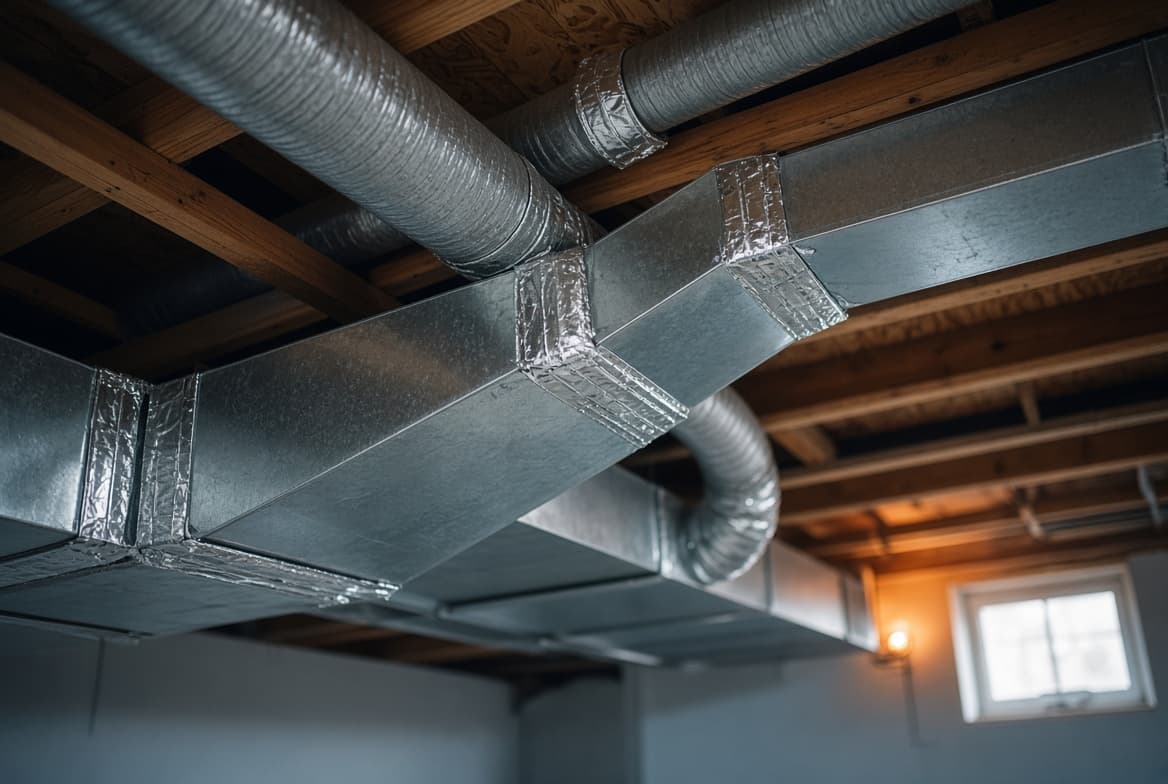
Duct sealing means closing the gaps, open seams and loose connections in your heating and cooling ducts so conditioned air reaches your rooms instead of the attic or crawl space. ENERGY STAR estimates that in a typical house about 20 to 30 percent of the air moving through the ducts is lost to leaks, holes and poorly connected ducts. The fix, in order: mastic or UL 181 foil tape on joints you can reach, an internal aerosol process such as Aeroseal for the ones you can't, then insulation on any duct in unconditioned space. HVAC duct sealing, also called ductwork sealing, covers both the supply and return ducts. The return side matters because leaks there pull attic or crawl space air into the system.
Signs Your Ducts Are Leaking
Leaky ducts show up as comfort and cost problems that new equipment won't fix.
| What you notice | What the leak is doing | Where to look first |
|---|---|---|
| Rooms that never heat or cool properly | Supply air escapes before it reaches the end of the run | Long attic or crawl space branches, register boots |
| Dust returns fast, or a musty smell | Leaky returns pull attic, crawl space or wall air into the system | Return plenum, filter slot, air handler cabinet |
| Bills climbing, system runs long | Conditioned air dumps outside the living space | Supply plenum and trunk seams |
| Ducts sweat or drip in summer | Humid air reaches cold metal through gaps or torn jackets | Attic and crawl space ducts, boots |
| Ducts in an attic, crawl space or garage | Highest-loss location even without symptoms | Everything, starting at the air handler |
How Much Do Ducts Leak, and Why Location Matters
The 20 to 30 percent figure is an average. A newer home built under a code that required a leakage test may leak far less; an older home with trampled flex duct may leak more. ENERGY STAR also says leaky ducts can reduce system efficiency by as much as 20 percent.
Location matters as much as leak size:
- Attic, vented crawl space or garage. Leaked supply air is gone, and return leaks pull in air at attic temperature. Sealing pays off most here.
- Inside the conditioned space. Leaked air stays in the house, so the energy penalty is small. These leaks mostly hurt room balance.
- Returns near gas appliances. ENERGY STAR warns that leaky ductwork can cause backdrafting, pulling combustion gases from a furnace, water heater or dryer back into the house.
- Returns in a garage. Gaps can pull in car exhaust. The International Residential Code doesn't allow return air to be drawn from a garage, so seal these first.
How Duct Leakage Is Measured
The duct blaster test. A technician tapes over every register and grille, connects a calibrated fan to the system, and pressurizes the ducts to 25 pascals, roughly normal operating pressure. The airflow the fan needs to hold that pressure is the leakage, reported as CFM25 (cubic feet per minute at 25 pascals).
Total leakage vs leakage to outside. A plain duct blaster test measures total leakage, including leaks that only spill into the house. Running a blower door at the same time isolates leakage to outside, the number that drives your bills. Ask which one a contractor is quoting.
What a good number looks like. The 2021 IECC limits total leakage on new systems to 4.0 CFM25 per 100 square feet of conditioned floor area with the air handler installed, about 80 CFM25 for a 2,000-square-foot house. Existing homes aren't held to that, but it's a useful yardstick. Technicians may also use a pressure pan at each register or a smoke pencil to pinpoint gaps.
How to Seal Ducts With Mastic and Foil Tape
Manual sealing is the standard for every joint you can reach.
- Duct mastic is a thick, water-based paste brushed over seams. It stays flexible and suits irregular joints like takeoffs, boots and plenum connections. Embed fiberglass mesh tape in it for gaps wider than about 1/4 inch.
- Foil tape with a UL 181 listing (181A for duct board, 181B for flex duct) is faster on straight seams but needs a clean, dry surface and firm pressure.
Why cloth duct tape fails. Gray duct tape's rubber adhesive dries out under the heat and temperature swings ducts see. Lawrence Berkeley National Laboratory testing found traditional cloth duct tapes significantly underperformed other sealants, and California's energy code stopped giving duct tightness credit for them. Treat any joint with peeling gray tape as a leak.
To seal a joint:
- Turn the system off.
- Fix the connection first: strap slipped flex duct back onto its collar and screw loose metal joints. Sealant isn't a fastener.
- Wipe off dust so the sealant bonds.
- Brush mastic about nickel-thick, an inch or two past each side of the seam, or squeegee foil tape down hard.
- Let mastic cure per the label before insulating over it.
What a Homeowner Can Reach and Seal Safely
Good DIY targets:
- Register boots. Pull the register and seal the boot to the drywall or subfloor, plus the boot's own seams.
- The return side at the air handler. Return plenum seams and the filter slot, which ENERGY STAR lists as a common leak point. A filter slot cover is a cheap fix.
- Exposed basement trunks and branches, and attic or crawl space ducts you can reach safely.
Leave these alone:
- Flue pipes and vent connectors on gas or oil appliances. Never tape or mastic a flue.
- The electrical compartment. Shut off power before working near the cabinet.
- Chalky old duct wrap or tape in pre-1980s homes, which can contain asbestos. Test it first.
- Ducts inside finished walls and ceilings. That's Aeroseal or professional territory.
In attics, work early on summer days, step only on joists, and wear a respirator and gloves. Check crawl spaces for standing water, pests and loose wiring first. ENERGY STAR also recommends a combustion safety test after ducts are sealed in a home with gas or oil appliances, since sealing changes air pressures in the house.
Aeroseal: How Internal Duct Sealing Works
Aeroseal seals leaks from the inside. It was developed at Lawrence Berkeley National Laboratory and is sold through trained contractors.
- Prep. Registers are blocked, and the furnace or air handler and coil are isolated so sealant stays out of the equipment.
- Baseline. A fan pressurizes the ducts and software records starting leakage.
- Injection. Aerosolized polymer particles of about 2 to 20 micrometers are blown in. They stay suspended until escaping air carries them to a leak, where they collect on the edges until the gap closes.
- Report. Leakage falls on screen in real time, and you get a before-and-after report.
The claims. The laboratory's technology page says the process has been proven to seal 70 to 90 percent of duct leaks and cites a 10-year guarantee. Those are developer and manufacturer figures, so the before-and-after test on your own system is the number to hold a contractor to.
What it seals: small and moderate gaps anywhere air reaches, including inside walls and under insulation. The commonly cited practical maximum is about 5/8 inch, and research notes sealing slows sharply as gaps widen.
What it can't fix:
- Disconnected ducts and large holes, which must be repaired by hand first
- Crushed, kinked or undersized ducts
- Air handler cabinet and filter rack leaks, because the equipment is blocked off during the process
- Missing or torn insulation
- Very dusty ducts, where contractors say the sealant bonds to dust instead of metal
Which Approach Fits Your Situation
| Your situation | Best approach |
|---|---|
| Ducts exposed in an unfinished basement or open attic | DIY mastic and UL 181 foil tape |
| Reachable ducts, but the attic is tight or hot, or you want test numbers | Professional manual sealing with a duct blaster test |
| Leaks inside walls, ceilings or between floors | Aeroseal, after hand repairs |
| Exposed trunks plus hidden branches | Manual sealing on reachable joints and the air handler, then Aeroseal |
| Flex duct crushed, torn or breaking down system-wide | Replace the ducts |
| Undersized ducts or a layout that never worked | Redesign and replace |
| Wet or moldy duct board or lined duct | Replace those sections |
For the last three rows, read when new ductwork makes more sense before paying for sealing.
Duct Insulation: R-Values for Unconditioned Spaces
Sealing stops air leaks; insulation slows heat moving through the duct wall. Ducts in attics, crawl spaces and garages need both.
Code levels. In the 2015, 2018 and 2021 IECC, attic supply and return ducts need at least R-8 at 3 inches in diameter and larger (R-6 if smaller). Ducts in other unconditioned areas need at least R-6 (R-4.2 under 3 inches). Ducts fully inside conditioned space are exempt. States and cities amend these, so check your local code. For existing homes, ENERGY STAR recommends at least R-6 in unconditioned areas.
Doing it right:
- Use rated duct wrap and check the installed R-value on the label.
- Keep the vapor jacket outside and tape every seam with UL 181 foil tape. Torn jackets are how attic ducts start dripping on ceilings.
- Don't compress the wrap, which cuts its R-value.
- Insulate the boots. The Department of Energy points to exposed attic boots as a prime spot for energy loss.
In a damp crawl space, cold supply ducts can still sweat. A vapor barrier or a crawl space dehumidifier protects both ducts and insulation.
The Right Order: Repair, Seal, Insulate, Test
- Repair disconnected, sagging or crushed runs.
- Clean only if needed. See when air duct cleaning actually helps. Cleaning doesn't seal anything.
- Seal reachable joints, the air handler and filter slot, then Aeroseal hidden leaks if needed.
- Insulate once sealant cures. Insulation over a leaky joint hides the leak without stopping it.
- Test leakage, airflow and static pressure, plus combustion safety with gas or oil appliances.
One check many guides skip: static pressure after sealing. An undersized return may have been breathing through its leaks. Seal them and static pressure can rise, showing up as noisy grilles or a strained blower. The fix is added return capacity.
What Affects Duct Sealing Cost
Published cost guides disagree, including on whether Aeroseal costs more or less than manual sealing, so use these as relative tiers and get quotes.
- DIY materials: lowest tier. Mastic, mesh and foil tape are inexpensive.
- Professional manual sealing: mostly labor hours, driven by joint count and access.
- Aeroseal: usually a whole-system price based on home size, register count, layout and starting leakage, plus any hand repairs.
- Duct replacement: highest tier. See the ductwork installation cost guide.
Also check whether testing and insulation are included, and look for utility duct sealing rebates and current state programs before you sign.
Is Duct Sealing Worth It?
For ducts outside the conditioned space, usually yes. ENERGY STAR says sealing and insulating can often pay for itself, and the comfort gain shows up right away. The case is strongest when ducts run through an attic, crawl space or garage, a test shows real leakage to outside, dust points at the returns, or you're replacing equipment, since new equipment on leaky ducts can't deliver its rated efficiency. It's weakest when every duct is indoors and rooms are comfortable.
Test first. A leakage number turns "worth it" into arithmetic and lets you verify the work. A look at accessible ducts also belongs in routine HVAC system maintenance.
What to Ask a Duct Sealing Contractor
- Will you test before and after, and is that total leakage or leakage to outside?
- Will you seal the air handler cabinet, filter slot and register boots?
- What materials will you use?
- If Aeroseal, what hand repairs come first, and what does the warranty cover?
- Will you check static pressure and do a combustion safety test?
Red flags: no test, sealing pitched as a fix for crushed or undersized ducts, and cloth duct tape on the materials list.
Frequently Asked Questions
Is duct sealing worth it?
Usually, when your ducts run through an attic, crawl space or garage and a leakage test shows real losses. ENERGY STAR says leaky ducts can cut heating and cooling efficiency by as much as 20 percent. It pays least when every duct sits inside the conditioned space, because leaked air still ends up in the house.
How long does duct sealing last?
Mastic and UL 181 listed foil tape on clean, dry metal should last many years, often as long as the duct. Cloth duct tape is the exception and fails much sooner. Aeroseal's developer cites a 10-year guarantee; get the contractor's warranty terms in writing.
Is Aeroseal safe?
The manufacturer describes the sealant as a non-toxic, water-based polymer, and the equipment and registers are blocked off during the process. That information comes from the manufacturer, so ask the contractor for the safety data sheet and ventilation guidance if anyone at home has breathing sensitivities.
Can I use duct tape to seal air ducts?
No. ENERGY STAR says never to use ordinary gray duct tape on ducts because it doesn't last. Use water-based mastic or foil tape with a UL 181 listing printed on the backing.
Does sealing ducts reduce dust?
Often, when the dust comes from leaky return ducts pulling in attic or crawl space air. Sealing the returns, filter slot and air handler cabinet closes that path. It won't remove dust already inside the ducts.
Should ductwork in the attic be insulated?
Yes. Recent editions of the International Energy Conservation Code call for at least R-8 on attic supply and return ducts 3 inches and larger. Seal the joints first, then insulate, and keep the vapor jacket intact so the ducts don't sweat.
Can you seal air ducts from the inside?
Yes, with an internal aerosol process such as Aeroseal, which pressurizes the ducts and seals leaks from the inside. It reaches leaks inside walls and ceilings that mastic cannot, but it does not fix crushed, disconnected or badly undersized ducts, which need repair first.