
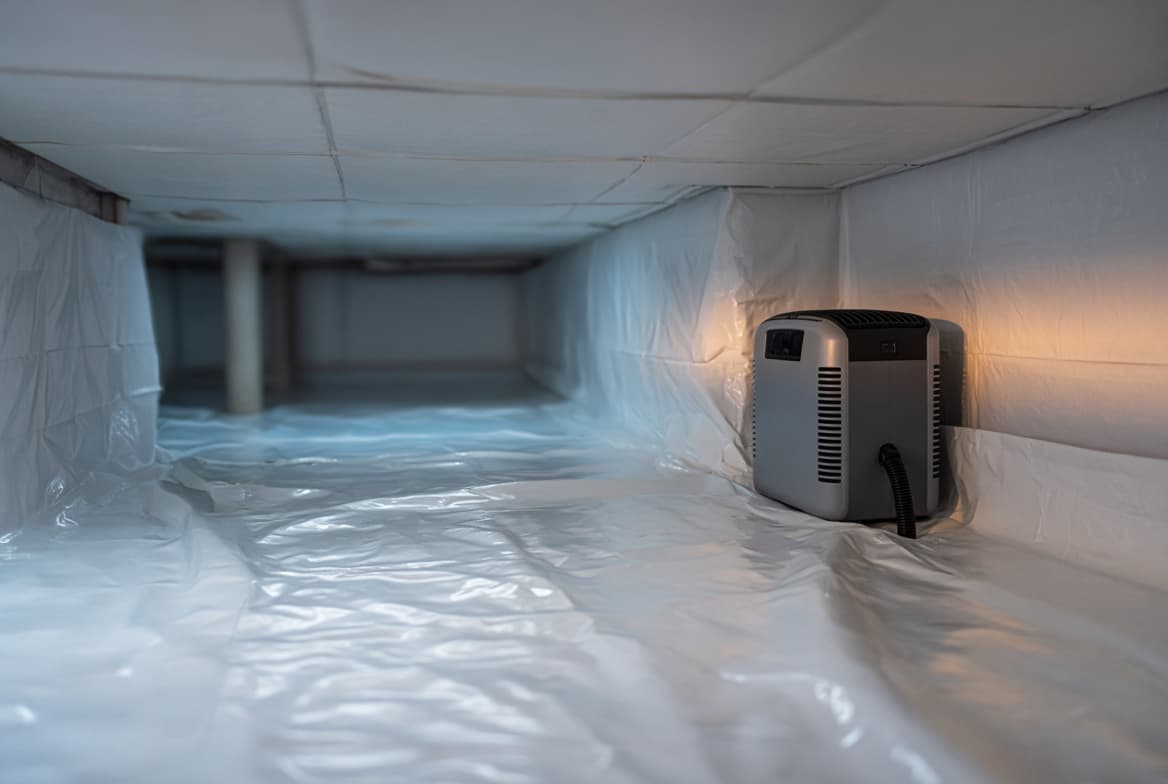
A crawl space dehumidifier is a compact, low-temperature-rated dehumidifier that drains continuously and runs unattended under your house, keeping the crawl space below 60 percent relative humidity so wood, insulation, and ducts stay dry. It only works in a crawl space that is already sealed: ground covered with a vapor barrier, vents closed, standing water handled. Put one in a vented crawl space over open dirt and it will run nonstop drying the outdoors.
This guide is part of our indoor air quality guides. If the dampness is in the living space or a basement rather than under the floor, start with whole house dehumidifier vs portable.
Why Crawl Spaces Get Damp
Moisture reaches a crawl space three ways, and a dehumidifier only handles one of them.
- Ground moisture. Bare soil gives off water vapor all year, even when it looks dry. Torn or loose plastic barely slows it.
- Outdoor air through vents. In humid summers, warm outdoor air flows in, hits cool foundation walls, ducts, and pipes, and condenses. Vented crawl spaces are often wettest in July.
- Bulk water. Rain running toward the foundation, short downspouts, a high water table, or a plumbing leak puts liquid water on the floor.
Signs of trouble: a musty smell upstairs (crawl space air rises into the house), sagging wet insulation, growth on joists, cupping floors above, and condensation on pipes. Sweating ductwork can even pass for an AC leak; see ducts sweating in a humid crawl space.
Fix the Water and Seal the Ground Before You Dehumidify
Work in this order. Skipping ahead is the usual reason a crawl space dehumidifier "doesn't work."
| Step | What it involves | Why it comes first |
|---|---|---|
| 1. Stop bulk water | Gutters, downspouts extended several feet out, soil graded away, plumbing leaks fixed, a sump pump if water pools | No dehumidifier can keep up with liquid water |
| 2. Cover the ground | Polyethylene vapor barrier, 6 mil minimum, 10 to 20 mil for full encapsulation, seams overlapped and taped, run up the walls and sealed | Cuts off the largest continuous moisture source |
| 3. Close the crawl space | Seal vents, the rim joist, and penetrations; insulate the walls rather than the floor above in a fully sealed design | Stops humid outdoor air from feeding the space |
| 4. Dry and condition the air | A dehumidifier, or conditioned supply air, sized for the sealed space | Removes what still gets in |
Closing a crawl space has code consequences. The residential code requires an unvented crawl space to have one of these: continuous exhaust, conditioned supply air at about 1 cubic foot per minute per 50 square feet of floor, or, in the 2021 edition, dehumidification sized at 70 pints per day per 1,000 square feet. Local adoption varies, and some jurisdictions also want a sump in a sealed crawl space, so check before you close vents.
What Makes a Dehumidifier Crawl-Space Rated
A crawl space is cool, dirty, tight, and unattended. Units built for it differ from household portables in checkable ways.
| Feature | Why it matters down there | What to check on the spec sheet |
|---|---|---|
| Low-temperature operation | Crawl spaces often sit in the 50s and 60s F; ordinary units frost their coil and stall | Minimum operating temperature and hot-gas or automatic defrost |
| Continuous drainage | Nobody empties a bucket under a house | Gravity drain outlet, or a built-in condensate pump with stated lift height |
| Duct collars | Lets you pull air from one end and push dry air to the far corners | Intake and discharge collar sizes, rated airflow in CFM |
| Compact, rugged cabinet | Has to fit through a small access hatch and survive dust and moisture | Dimensions against your hatch, metal or heavy-duty housing |
| Honest capacity rating | Capacity numbers swing widely with test conditions | Pints per day at a stated temperature and humidity |
| Unattended controls | Must restart itself after outages | Auto-restart, remote humidistat, alarm or app monitoring |
Pints per Day, AHAM Ratings, and the 2019 Test Change
Crawl space spec sheets commonly list up to three capacity numbers for the same machine:
- Saturation (around 90 F and 90 percent humidity). The biggest number on the box, and conditions a sealed crawl space should never see.
- AHAM at 80 F and 60 percent. The long-standing industry rating, and the one most crawl space makers still lead with.
- The current federal rating at 65 F and 60 percent. In 2019 the Department of Energy test moved portable-class units to this cooler condition (ducted whole-home units test at 73 F), which produces a much smaller number.
The gap is large. A compact unit sold as 70 pints at the AHAM 80 F condition can show up at around 44 pints on the ENERGY STAR listing at 65 F. Neither number is wrong, but only same-condition numbers compare.
What Size Crawl Space Dehumidifier Do You Need?
Start from the code baseline of 70 pints per day per 1,000 square feet and adjust for how wet the site is. Figures below are in the AHAM 80 F numbers most crawl space makers publish.
| Sealed crawl space floor area | Dry to moderate site | Wet site, humid coastal climate, or long duct runs |
|---|---|---|
| Up to 1,000 sq ft | Up to 70 pints | 70 to 90 pints |
| 1,000 to 1,600 sq ft | 70 to 110 pints | 110 to 130 pints |
| 1,600 to 2,300 sq ft | 110 to 160 pints | 160 pints or more, or two units |
| Over 2,300 sq ft | Two units or a high-capacity model | Two units, ducted to each end |
Crawl spaces divided by footings often dry better with ducting to the far sections, or two units, than with one big machine in a corner. A correctly sized unit that runs nonstop in mild weather points to a leaking barrier or vents.
Best Crawl Space Dehumidifier: How to Compare Models
There is no single best crawl space dehumidifier, only the right one for your square footage, temperature, drain route, and hatch size. Well-known crawl-space-rated product lines include Santa Fe, AlorAir Sentinel, Aprilaire's crawl space and basement models, and SaniDry, which is sold through dealers. They're examples of the category, not a ranking. Line up two or three candidates on documented specs:
- Capacity at the same test condition for every unit
- Minimum operating temperature at or below your crawl space's winter low
- A drain method that fits your site, and pump lift if it has one
- Cabinet dimensions that clear your access opening
- Energy factor, higher is better
- Warranty length and coverage (check the manufacturer's current warranty terms, including any registration or professional-install requirement)
- Parts and service availability where you live
A big-box portable usually fails this list on temperature, drainage, and duty cycle, which is why it tends to frost up or quit within a few seasons under a house.
How to Install a Crawl Space Dehumidifier
- Placement. Near the middle, or at one end with ducting to the other. Set it level on solid blocks or a pad on top of the barrier, or hang it from the joists with straps or a hanging kit and rubber isolators to keep vibration out of the floor. Keep the intake clear and leave room to pull the filter.
- Drain. A gravity drain needs continuous downward slope, about 1/8 inch per foot, to a sump, floor drain, or an approved exterior outlet. If water has to go up and out, use the unit's internal pump or a separate one; see how a condensate pump works. Keep exterior lines from freezing.
- Power. A dedicated outlet sized for the unit. Receptacles in a crawl space need GFCI protection under the electrical code. No extension cords.
- Ducting and controls. Short insulated flex to far corners or divided sections. Start the setpoint at 50 to 55 percent.
Safety: a new circuit, or any 240-volt work, belongs to an electrician. Never bypass a pump's overflow switch. Wear a respirator in a crawl space with visible mold, and leave mold remediation larger than a small patch to a remediation contractor.
Leaky crawl space ducts add moisture and energy problems of their own; see ductwork repair and installation cost.
Cost Factors
Published cost figures disagree too much to quote a range, so plan around the factors:
- The unit. Crawl-space-rated units cost several times what a household portable does, and price rises with capacity, pump, and controls.
- Installation. Short when there's a drain and outlet nearby; longer with ducting, a pump, a long drain run, or a tight space.
- Electrical. A new circuit or GFCI outlet can be a meaningful share of the job.
- Encapsulation. If the crawl space isn't sealed yet, the barrier, vent sealing, and wall insulation are usually the bigger bill.
- Running cost. Wattage times hours. A unit drawing 500 watts that runs 8 hours a day uses 4 kWh a day; multiply by your electric rate. A well-sealed space cuts runtime sharply.
Maintenance
- Clean or replace the filter every one to three months, then adjust to the dust load.
- Yearly: flush the drain, test any pump, and vacuum the coil.
- Walk the vapor barrier for tears, and check the vent and access door seals.
Signs Your Crawl Space Dehumidifier Is Working
- Humidity holds 45 to 55 percent, never above 60, on a wireless hygrometer you can read from upstairs.
- Wood moisture drops. A pin moisture meter on joists and subfloor reads under about 15 percent. Readings near 20 percent or higher mean the framing is still at risk.
- It cycles off in spring and fall.
- Ducts and pipes stay dry on humid days.
- The musty smell fades upstairs over a few weeks.
What to Ask a Crawl Space Contractor
- What is the water source, and is it fixed before the dehumidifier goes in?
- What capacity, at which test condition, and why that size?
- Where does the condensate go, and does a pump have an overflow switch?
- Does local code require a sump, permit, or inspection?
Frequently Asked Questions
Do I need a dehumidifier in my crawl space?
You need one if the crawl space is sealed and still reads above 60 percent in humid weather. In a vented crawl space over open dirt, fix the ground and vents first, or the dehumidifier just dries outdoor air.
What size dehumidifier do I need for a crawl space?
A common baseline is about 70 pints per day for every 1,000 square feet of sealed crawl space floor, the figure the 2021 residential code uses for its dehumidification option. Size up for a wetter site, and compare units at the same rating condition.
What humidity should a crawl space be?
Keep it under 60 percent at all times, and aim for 45 to 55 percent. Wood framing should also measure under about 15 percent moisture content on a moisture meter.
Can I use a regular dehumidifier in a crawl space?
It usually fails. Household portables lose capacity and frost up in a cool crawl space, rely on a bucket or weak hose fitting, and aren't built for continuous duty there.
Where should a crawl space dehumidifier be placed?
Near the middle of the space, level, on blocks or hung from the joists, close to a drain route and a dedicated GFCI outlet, with the intake clear.