
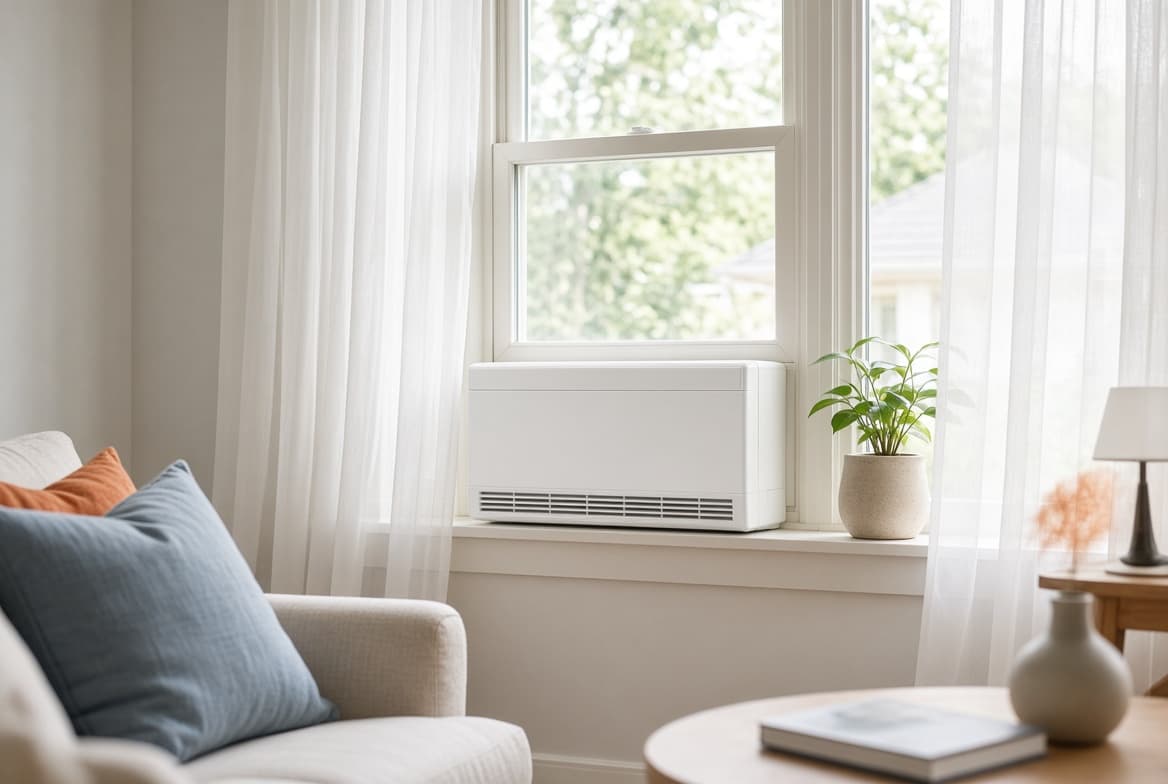
A through the wall air conditioner is a room AC that slides into a metal sleeve in an exterior wall and vents only out the back, so it cools one room without blocking a window. A PTAC unit (packaged terminal air conditioner) is its commercial cousin, the box under the window in most hotel rooms: a larger standard sleeve, 230/208 volt power and built-in heat.
If a sleeve is already in your wall, its size and brand decide what can go in it. For other options, see types of air conditioners compared.
Through the Wall AC vs Window Unit vs PTAC
| Window unit | Through the wall AC | PTAC unit | |
|---|---|---|---|
| Sleeve | None; sits on the sill | Brand-specific, commonly about 24.5 to 27 inches wide | Standard 42 x 16 inches on most current models |
| Venting | Side louvers and back | Rear only | Rear only, through an architectural grille |
| Heat options | Mostly cooling only; some electric heat or heat pump | Cooling only, electric heat, or heat pump | Electric strip heat, or heat pump with strip backup |
| Voltage | 115 V for most; 230 V for large sizes | 115 V small units; 230/208 V larger and most heat models | 230/208 V; 265 V in some commercial buildings |
| Typical capacity | 5,000 to about 25,000 BTU | Roughly 8,000 to 14,000 BTU | Roughly 7,000 to 15,000 BTU |
| Typical use | Renters, seasonal cooling | Houses, condos, additions, garages | Hotels, apartments, senior housing |
For window fit, noise and running cost, see the window air conditioner buyer's guide.
Why a window AC can't go in a wall sleeve
A window unit's condenser pulls outdoor air through louvers on the sides of the cabinet. In a sleeve those louvers face sheet metal, so the condenser can't reject heat and the compressor runs hot until it trips or fails early. A wall unit breathes through the back only. A few models are rated for both, and their manuals say so.
How a Wall Sleeve Works
The sleeve is a coated steel box fastened into the rough opening, sealed to the wall and pitched slightly toward the outside, with a grille on the outdoor end. The chassis (compressor, coils, fans and controls) slides into it from the room. The sleeve is permanent and the chassis is replaceable, so a new matching chassis slides into the old sleeve without touching the wall.
Why sleeve size and brand compatibility matter
Residential sleeves aren't standardized. Width differs by fractions of an inch between brands (Friedrich's comparison literature lists its own sleeve at about 25 7/8 inches and Amana's at 26), and so do height, depth and the rear grille. Some lines, such as Friedrich's Uni-Fit, are designed to fit sleeves from about 24.5 to 27 inches wide with a trim kit. Others fit only their own brand's sleeve.
PTACs are closer to universal: most current models fit a 42 x 16 inch sleeve, so one brand's chassis usually fits another brand's sleeve. Older buildings may have odd sizes, though.
Before buying a replacement:
- Read the model numbers on the old chassis and the sleeve label.
- Measure the sleeve's inside width, height and depth.
- Check that the new chassis is approved for your grille, so hot discharge air doesn't loop back into the intake.
- Match the plug and amperage to the receptacle.
- Replace a rusted or inward-sloping sleeve before a new chassis goes in.
PTAC Units: How They Heat
PTACs heat one of two ways.
Electric resistance (strip) heat. An element sits in the airstream, commonly 2.5, 3.5 or 5 kW, and each kilowatt delivers about 3,412 BTU per hour. It's cheap to buy and the most expensive way to make heat with electricity.
Heat pump PTAC (PTHP). A reversing valve runs the refrigerant cycle backward, pulling heat from outdoor air, which gives more heat per kilowatt-hour in mild weather. As it gets colder, the unit switches to its backup strip heater. Manufacturer and dealer literature puts that switchover anywhere from about freezing to about 40 degrees F, depending on model and settings, so check the spec sheet. The same two technologies show up in a window AC with heat.
230/208 V and the 208 V derating
PTACs are labeled 230/208 V because they run on either, and many apartment buildings with three-phase service deliver 208 V. A resistance heater's output falls with the square of the voltage, so at 208 V it makes about 82 percent of its 230 V rating. Spec sheets list both: one Hotpoint 3.5 kW model shows 3,535 watts at 230 V and 2,900 at 208 V. Cooling capacity drops only slightly. If your building runs at 208 V, size the heat on the 208 V figure.
Heater size also sets the plug. PTACs use NEMA 6-series 230 V plugs rated 15, 20 or 30 amps, and a 5 kW heater typically needs a 30 amp circuit. Never adapt a plug to fit a smaller receptacle. 265 V units are a separate commercial product and don't swap with 230/208 V units.
How to Size a Through the Wall AC or PTAC
Room units start from about 20 BTU per square foot of floor area.
| Room size | Starting cooling capacity |
|---|---|
| 250 to 350 sq ft | 7,000 to 8,000 BTU |
| 350 to 450 sq ft | 9,000 to 10,000 BTU |
| 450 to 550 sq ft | 12,000 BTU |
| 550 to 700 sq ft | 14,000 to 15,000 BTU |
Adjust for sun, kitchens and ceilings with the room AC sizing chart, but don't oversize: a big unit shuts off before it dries the air. Check heat separately. A common electric heat rule of thumb is about 10 watts per square foot for an insulated room in a moderate climate, so a 350 square foot room lands near 3.5 kW.
New Wall Opening vs Replacing Into an Existing Sleeve
Replacing into an existing sleeve is mostly a chassis swap: unplug, slide the old chassis out, reseal the sleeve and slide the new one in.
Cutting a new opening is a structural job:
- Framing. With studs 16 inches apart, a 26 inch sleeve cuts at least one stud and a 42 inch PTAC sleeve cuts two or more. A load-bearing wall needs a header sized for the span, with king, jack and cripple studs, like a window opening.
- Masonry. Brick or block needs a lintel and often an engineer's input.
- Weatherproofing. Flash and seal the opening; set the sleeve at the specified outward slope.
- Electrical. Plan a dedicated circuit with a receptacle within cord reach. A new 230 V circuit is electrician work.
- Permits. Many jurisdictions require a building permit to cut a structural wall and an electrical permit for a new circuit. Condo boards and HOAs often must approve exterior changes.
Condensate and Drainage
Condensate collects in the base pan. On most units a slinger ring on the outdoor fan flings it onto the hot condenser coil, where much of it evaporates (the splashing sound on humid days), and the rest drains out the back of the sleeve. Heat pump defrost meltwater can also freeze on a sill or walkway. Over entries or above other units, a drain kit can pipe condensate to a building drain.
Water running down the inside wall usually means an inward-sloping sleeve, clogged drain openings or a failed gasket. Don't drill a drain hole in the base pan; refrigerant tubing can run close to it.
Noise and Efficiency: CEER and EER
With the compressor in the room, these units run louder than a mini split. For a bedroom, compare published sound levels.
Ratings differ by category. Through the wall units are residential room air conditioners rated in CEER, which counts standby power too. PTACs are regulated as commercial equipment and rated in EER, plus COP for heat pump heating. Compare like with like; higher is better. Keep the sleeve caulked, and cover a cooling-only unit in winter.
What Drives the Cost
Installed cost falls into three tiers:
- Lowest: a same-size chassis swap into an existing, compatible sleeve.
- Middle: a new sleeve in an existing opening, a trim kit to adapt another brand, or a new receptacle.
- Highest: a new opening with framing or masonry work, siding and interior repair, a new 230 V circuit and permits.
Heat pump models cost more up front than strip heat but less to run.
Maintenance
- Wash the front filter every two to four weeks in heavy use.
- Once a year, pull the chassis and clean both coils, rinsing the outdoor coil gently from the inside out with electrical parts covered.
- Clear the base pan and sleeve drain openings, and check the caulk and chassis gasket.
- Test the heat before cold weather.
Unplug the unit before removing any panel. Capacitors hold a charge after power is off and can injure you. Refrigerant work requires EPA Section 608 certification, 230 V circuit work belongs to an electrician, and a wall unit should never run on an extension cord or adapter.
When a Through the Wall Unit Is the Wrong Answer
A ductless mini split is the stronger choice when you need quiet operation, more than one room, or primary heat in a cold climate, and it needs only a small hole for the line set. If you can't cut a wall at all, a window unit with heat is the next option.
What to Ask a Contractor
- Is the wall load-bearing, and who sizes the header?
- Does the quote include the permit, siding repair and interior finish?
- What voltage did you measure, and is the heater sized on it?
- Which sleeve and grille is the chassis approved for, and where will condensate drain?
Frequently Asked Questions
What is the difference between a PTAC and a through the wall air conditioner?
Both sit in a wall sleeve and vent out the back. A PTAC is commercial equipment built around a standard 42 by 16 inch sleeve, runs on 230/208 or 265 volts, and almost always includes heat. A through the wall air conditioner is a residential unit with a smaller, brand-specific sleeve, often runs on 115 volts, and may be cooling only.
Can I put a window air conditioner in a wall sleeve?
No, unless the manual says the model is rated for both. Window units pull outdoor air through side louvers, which a sleeve blocks, so the condenser can't shed heat and the compressor overheats. It can also void the warranty.
Are through the wall air conditioner sleeves universal?
No. Residential sleeves vary by brand in width, height, depth and grille design, with common widths between about 24.5 and 27 inches. Some lines fit a range of sleeves with trim kits. PTAC sleeves are closer to universal, since most current models use the 42 by 16 inch size.
Does a through the wall air conditioner need to be vented outside?
It vents itself through the exterior grille, so there is no duct or hose to run. It does need a clear outdoor side, with nothing close enough to send hot discharge air back into the intake.
How long does a PTAC unit last?
Industry sources commonly put PTAC service life at roughly 7 to 10 years in hotel-style use. A home unit with clean filters and coils can last longer. Corroded coils, repeated failures, or a repair near 40 percent of a new chassis price are signs to replace it.