
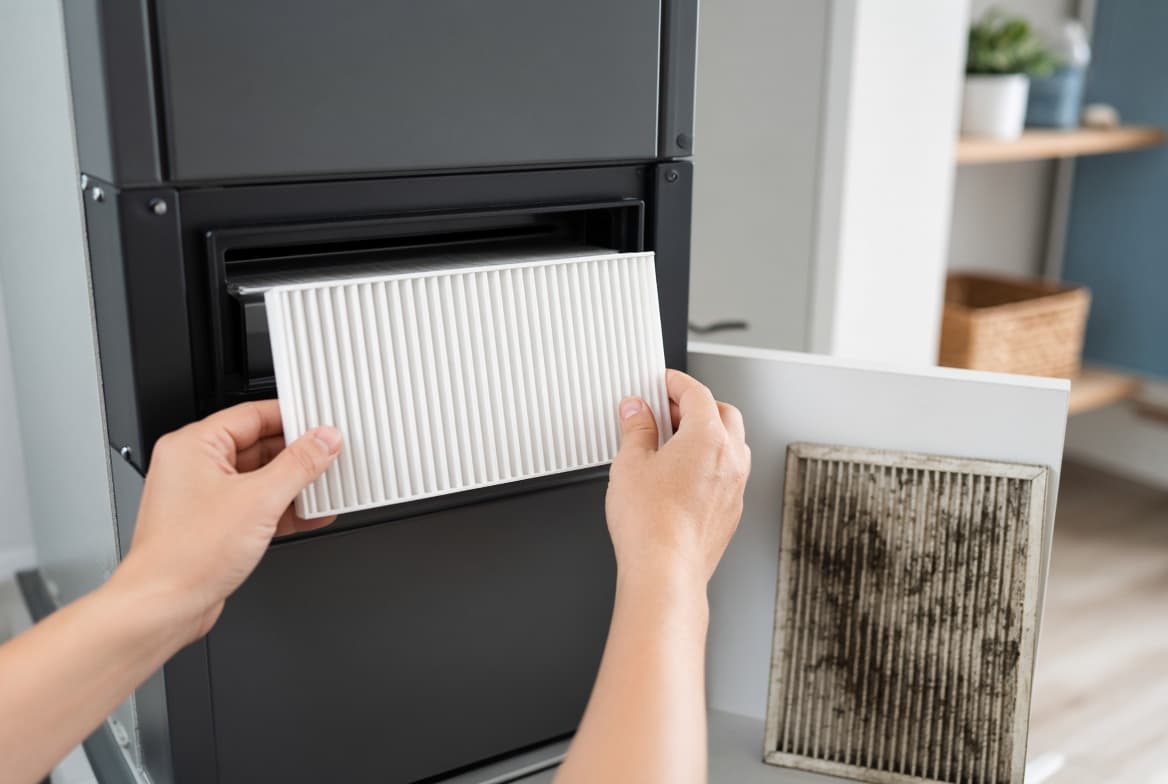
A MERV rating tells you how well an air filter captures airborne particles, on a scale from 1 to 16. It comes from ASHRAE Standard 52.2, which tests how much of three particle size ranges a filter traps. Higher numbers catch more of the smallest particles, such as smoke and some bacteria, but denser filters can also restrict airflow. For most homes, a MERV 8 to 13 filter that fits your system is the right range.
The EPA recommends at least MERV 13, or as high as your system's fan and filter slot can accommodate. That last part is the key: the best MERV is the highest one your system handles well, not simply the highest number on the shelf.
What MERV Stands For and How It's Tested
MERV stands for Minimum Efficiency Reporting Value. Under ASHRAE 52.2, a lab blows test particles through the filter and measures how many it captures in three size ranges:
- E1: 0.3 to 1.0 microns. Smoke, some bacteria, very fine combustion particles.
- E2: 1.0 to 3.0 microns. Fine dust, some mold spores, smaller pet dander particles.
- E3: 3.0 to 10.0 microns. Pollen, dust mite debris, larger mold spores and lint.
The word "minimum" matters. A filter's MERV is set by its lowest performance during the test, as dust loads onto it, not its best moment. The scale used to run to MERV 20, but ASHRAE removed MERV 17 to 20 from the standard. High-efficiency HEPA filters are now rated under separate standards.
MERV rating chart: minimum capture by particle size
| MERV | E1 (0.3 to 1 micron) | E2 (1 to 3 microns) | E3 (3 to 10 microns) |
|---|---|---|---|
| 1 to 4 | No requirement | No requirement | Under 20% (graded by arrestance) |
| 5 | No requirement | No requirement | 20% |
| 6 | No requirement | No requirement | 35% |
| 7 | No requirement | No requirement | 50% |
| 8 | No requirement | 20% | 70% |
| 9 | No requirement | 35% | 75% |
| 10 | No requirement | 50% | 80% |
| 11 | 20% | 65% | 85% |
| 12 | 35% | 80% | 90% |
| 13 | 50% | 85% | 90% |
| 14 | 75% | 90% | 95% |
| 15 | 85% | 90% | 95% |
| 16 | 95% | 95% | 95% |
These are the minimum capture percentages each level must meet, as published by the EPA from ASHRAE 52.2. Most websites summarize MERV in vague tiers; this is what the numbers actually require. Notice that nothing below MERV 11 has to catch any of the finest particles, the range that includes wildfire smoke.
Charged filters and MERV-A
Many pleated filters use electrostatically charged fibers, which grab fine particles well when new. That charge can fade as the filter is used. ASHRAE added an optional test, Appendix J, that conditions the filter to simulate that loss. A rating from that test is labeled MERV-A, for example MERV 13-A. If you see one, it's a more conservative number.
MERV 8 vs. MERV 13
These are the two ratings most homeowners end up choosing between.
| MERV 8 | MERV 13 | |
|---|---|---|
| Captures 0.3 to 1 micron (smoke, fine particles) | No minimum | At least 50% |
| Captures 1 to 3 microns (fine dust) | At least 20% | At least 85% |
| Captures 3 to 10 microns (pollen, lint) | At least 70% | At least 90% |
| Airflow resistance | Lower | Higher, especially in a 1-inch filter |
| Best fit | Most 1-inch filter slots, general equipment protection | Allergies, pets, wildfire smoke; best in 4 or 5-inch media |
| Cost per filter | Lower | Higher |
MERV 8 protects your equipment and catches the larger particles that collect on coils and blower wheels. MERV 13 adds real capture of fine particles. MERV 11 sits between them and is a common compromise for 1-inch slots in homes with pets.
What MERV Rating Should You Use?
| Your situation | Suggested starting point | Notes |
|---|---|---|
| Basic equipment protection, no allergies | MERV 8 | Change on schedule |
| Pets or mild allergies, 1-inch slot | MERV 11 | Watch airflow after switching |
| Allergies, asthma or wildfire smoke | MERV 13 | Best in a 4 or 5-inch media cabinet |
| Older system with a small return or fixed-speed blower | MERV 8, then test higher | Check the equipment manual first |
| Want more than your slot can handle | Media cabinet or bypass air cleaner | See whole house purifier options |
ASHRAE's residential ventilation standard sets a much lower floor, with MERV 6 in many ducted systems, while the EPA and ASHRAE's epidemic task force both point to MERV 13 as a better target where systems can handle it. If you want MERV 13 or higher without the airflow penalty of a 1-inch filter, a whole house air purifier with a deep media cabinet is the usual route.
Airflow: The Catch With High-MERV Filters
Denser filter media resists airflow more. If your blower can't overcome the extra resistance, less air moves across the coil and heat exchanger. Research on residential systems has measured higher pressure drop and somewhat lower airflow with higher-MERV filters, with effects that varied from system to system. Watch for these signs after switching to a higher MERV:
- Noticeably weaker airflow at the registers
- Whistling at the return grille or filter door
- The furnace shutting off early on its high limit switch
- An air conditioner coil or suction line that frosts over
- Longer run times or rooms that stop keeping up
A technician can measure static pressure across the filter during a tune-up to see whether your system tolerates a higher rating. Ask for it at your next service visit; our guide to AC tune-up cost explains what a thorough visit includes.
Why filter depth matters
A 4- or 5-inch media filter has far more pleated surface area than a 1-inch filter of the same face size, which generally means lower resistance at the same MERV and a much longer life between changes. A deeper filter needs a matching media cabinet; you can't put one in a 1-inch slot.
A filter that doesn't seal is worse than a lower-rated filter that does. Air that slips around the edges carries dust straight to the coil and blower. Make sure the filter is the right size and the filter door closes tightly.
MERV vs. MPR vs. FPR
Some retailers use their own rating scales:
- MPR (Microparticle Performance Rating) is 3M's scale for Filtrete filters. It focuses on particles from 0.3 to 1 micron. 3M's own comparison pairs MPR 1900 with roughly MERV 13.
- FPR (Filter Performance Rating) is The Home Depot's scale for its store brands, running from about 4 to 10.
Neither has an official conversion to MERV. Because MERV comes from a public standard, it's the number to compare across brands. Most packages print the MERV somewhere, often in small type on the side.
HVAC Filter Sizes: Nominal vs. Actual
Filter sizes are printed as nominal dimensions, rounded up for convenience. The actual filter is a little smaller so it slides into the slot. A filter labeled 16x25x1 typically measures about 15.5 by 24.5 by 0.75 inches.
| Nominal size (on the label) | Typical actual size |
|---|---|
| 14x20x1 | About 13.5 x 19.5 x 0.75 in. |
| 16x20x1 | About 15.5 x 19.5 x 0.75 in. |
| 16x25x1 | About 15.5 x 24.5 x 0.75 in. |
| 20x20x1 | About 19.5 x 19.5 x 0.75 in. |
| 20x25x1 | About 19.5 x 24.5 x 0.75 in. |
| 16x25x4 or 20x25x4 | Depth varies by brand; match the cabinet maker's size or part number |
| 16x25x5 or 20x25x5 | Depth varies by brand; often brand-specific |
Actual dimensions vary slightly by brand. The simplest way to get the right size is to copy the size printed on your current filter's frame. If there's no old filter, measure the slot and choose the nominal size that matches. Our guide to how to change a furnace filter shows where to find the filter and which way the airflow arrow points.
How Often to Change Your Filter
| Filter type | Typical change interval | Change sooner if |
|---|---|---|
| 1-inch fiberglass | About every 30 days | Pets, construction dust, constant fan use |
| 1-inch pleated (MERV 8 to 13) | At least every 3 months, often every 1 to 2 | Pets, allergies, smoke events |
| 4-inch media | About every 6 to 12 months | Heavy dust, the fan runs continuously |
| 5-inch media | Follow the cabinet maker's guidance | Same as above |
These are typical manufacturer recommendations. The real answer is to look at it: hold the filter up to a light, and if you can't see light through it, replace it. Higher-MERV filters load up faster, so check them more often. Write the install date on the frame.
When a Better Filter Isn't Enough
If dust keeps building up even with a good filter, the problem may be leaky return ducts pulling in attic or crawlspace air, or a filter that's bypassing. A technician can check both. Cleaning the ducts is rarely the fix for ordinary dust; see duct cleaning cost for when it actually helps. Filter changes are also one part of a broader routine covered in our HVAC system maintenance guide.
Frequently Asked Questions
What MERV rating should I use for my home?
The EPA suggests at least MERV 13, or as high a rating as your system's fan and filter slot can handle. In practice, MERV 8 to 11 suits most 1-inch filter slots, and MERV 13 works best in a 4- or 5-inch media cabinet or a system designed for it. If you move up, watch for weaker airflow and check the equipment manual.
Is MERV 13 bad for my furnace?
Not by itself. A MERV 13 filter is denser, so in a 1-inch slot on a system with a restrictive return it can cut airflow, which may cause overheating, short cycling or a frozen AC coil. The same rating in a deeper media filter restricts much less. Change it on time, since a loaded high-MERV filter restricts most.
What's the difference between MERV 8 and MERV 13?
Under ASHRAE 52.2, a MERV 8 filter must capture at least 70 percent of particles from 3 to 10 microns and 20 percent from 1 to 3 microns, with no requirement for the smallest range. A MERV 13 must capture at least 50 percent of particles from 0.3 to 1 micron, 85 percent from 1 to 3 microns and 90 percent from 3 to 10 microns.
Is a higher MERV rating always better?
Higher MERV filters catch more fine particles, but they also resist airflow more. The best filter is the highest MERV your system can move air through without problems, in the right size, sealed so air can't go around it, and changed on schedule.
Do HEPA filters have a MERV rating?
No. The current ASHRAE 52.2 scale runs from MERV 1 to 16. HEPA filters are rated under separate standards and are too restrictive for most home HVAC systems unless they're part of a dedicated bypass air cleaner.